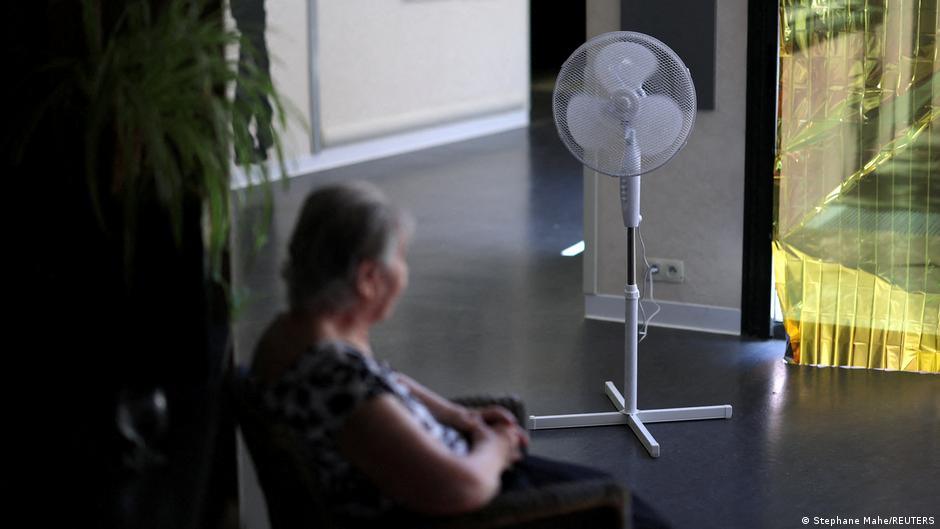
Much of Europe is suffering a heat wave this week, with temperatures exceeding 40 °C (104 °F).
France suffered the worst of it, with the highest temperature ever recorded on Tuesday, leaving thousands of homes without electricity. people over 55 have drownedAs residents jumped into the water to try to cool off.
Extreme weather usually brings with it a storm of propaganda; This heat wave is no different.
“The message needs to be linked to something that directly impacts people,” Anna Sieworek, head of climate disinformation resilience at the Climate and Strategy Foundation, told DW.
“We feel heat waves, we feel hurricanes or floods – and we are emotionally affected by it because we have economic fears, we have fears about our loved ones, about the infrastructure we have built, so on and so forth.”
DW Fact Check took a look at some of these false and misleading claims. Here are the cold, hard facts.
Spain’s fake air conditioning ban
Claim: “Spain is banning people from setting their air-conditioners below 27C,” one user wrote PostOver 800,000 views.
fact check: false
That claim is a screenshot time out titleWritten on August 3, 2022. At the time, the Spanish government had temporarily set that rule in response to Russia’s invasion of Ukraine and the resulting energy crisis in 2022.
spanish government Limit heating and cooling temperatures to 19 and 27C.The royal decree-law was only for ever implementedFor public buildings and shops. It ended after a year.
Other countries also took similar steps at that time: germany essential Lights have been switched off around monuments in France installedFines if air-conditioned shops leave their doors open, and Ireland handed over Grants for insulating attics and cavity walls.
Is sleeping with a fan running ‘extremely dangerous’?
ClaimAnother user wrote, “Sleeping with a fan on is very dangerous and most people do this every night.” Post1.7 million views. The post details how a fan launches “a silent attack on your respiratory system” by evaporating moisture from your mouth and nose, drying out your eyes, and causing a stuffy nose or “intense headache.”
fact check: misleading
It is true that fans can dry out the eyes, nose, and mouth, but this claim is greatly exaggerated.
World Health Organization, Centers for Disease Control and Preventionin America and Britain National Health Service All recommend using electric fans during extreme heat.
Peer-reviewed research supports this. one 2019 sleep study The study, published in Indoor Air, found that elderly participants slept just as well with a ceiling fan at 30C – based on brain activity and stress hormones – as they did sleeping in an air-conditioned room at 27C.
A team of researchers found that “the protective benefit of fans is underestimated by current guidelines.”
The guidelines warn not to use a fan if the temperature is above a certain level – some say 35C, some say 40. While the exact number is debated,Researchers agree that at a certain point fans warm you rather than cool you, because the moving air is warmer than the skin on the body.
The NHS also includes a disclaimer that the fan should not be aimed directly at your body, as this could cause dehydration.
The evidence landscape surrounding the fan and sinus is thin. Dr. Praveen Bhatia, a respiratory therapist with a background in sleep medicine, told the consumer technology website tom’s guide Sleeping with a fan “can dry out your mucus membranes, especially in the nose and throat, which can lead to nasal congestion, sore throat, or dry mouth by morning.”
“For people who already have respiratory problems or allergies, the fan can circulate dust and pollen, exacerbating symptoms and actually disrupting sleep quality,” she said.
So, with a few real drawbacks, the fan is actually a useful intervention for heat. But calling it “extremely dangerous” is scientifically baseless.
Connection between heat waves and climate change
Claim: “Who else is tired of dramatic idiots calling normal summer heat ‘climate change’?” a user wroteit on x passionateWhat echoingacrossSocial media in many posts.
DW Fact Check: false
The scientific consensus about climate change and heat waves is well established. Humans have warmed the planet by burning fossil fuels – this warming is directly linked to an increase in extreme weather, including heat waves, droughts and wildfires worldwide.
This record-breaking heat wave would have been “virtually impossible” without climate change, a rapid study finds StudyFrom the World Weather Attribution Group.
“Heat waves are becoming more frequent than they are today,” Sieviorek said. “There’s a huge area covered by heat, and this could not have happened without anthropogenic climate change.”
Europe is getting warmer twice as fastAs a global average. Last year was the third-warmest year on record, according to the European Union’s Copernicus Climate Change Service Programme. FirstAnd SecondHottest year? 2024 and 2023.
and medical journals The Lancet maintains one trackerThe Health Impacts of Climate Change – 2026 edition found that almost every region of Europe saw an increase in heat-related deaths over the past decade compared to 1991-2000.
There is a problem with the Copernican report and well-established facts and figures about Earth’s supposed warming: “Scientifically proven information is boring,” Siewiorek said. “We’re not messing with that.”
But don’t be fooled by claims that arouse excitement or emotion. Stick to the facts – and, while you’re at it, stay calm.
Edited by: Sarah Stephan