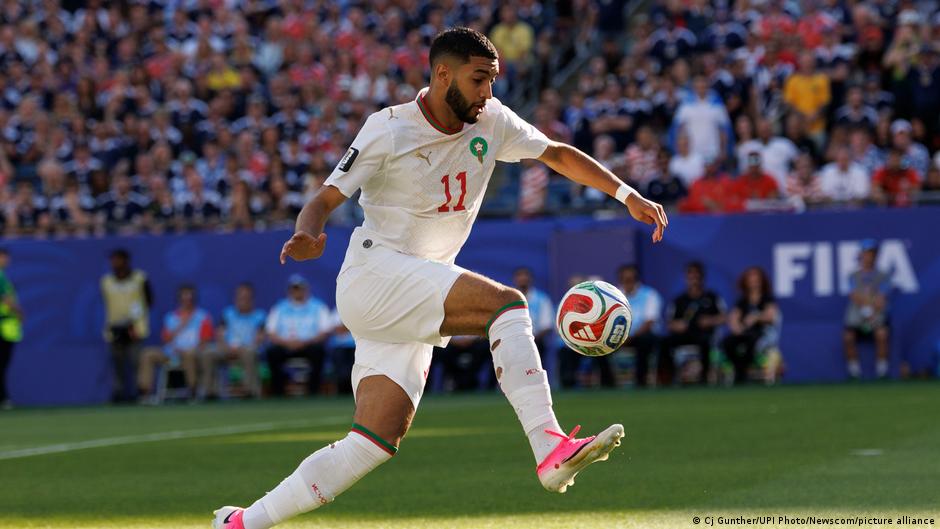
Scotland head coach Steve Clarke knew exactly what to expect from Ismail Saibari.
“He’s fast, he’s powerful and he showed against Brazil that he knows how to take risks,” he told reporters ahead of the World Cup Group C meeting between Scotland and Morocco in Boston last week.
A week earlier, Saibari had put Morocco, Atlas Lions ahead against Brazil with a brilliant chip over goalkeeper, Alisson. Scotland were warned but it didn’t matter, less than two minutes into the game, Saibari again dodged the defense and fired an unstoppable shot into the roof of the net.
A few days later, Saibari was on the scoresheet again when he headed Achraf Hakimi’s cutback into the net against Haiti. It was his 12th goal in his 33rd international appearance for Morocco, and made him the first African player to score in all three World Cup group stage games.
Ismail Saibari: From Eindhoven to Munich
In the Round of 32 on Monday night, Saibari will again lead the line for Morocco against a country with which he has close ties: the Netherlands, where he has scored 42 goals in 142 appearances for PSV Eindhoven since 2020.
Last season, he was voted best player of the season in the Dutch top flight EredivisiePSV won its 27th league title after scoring 15 league goals.
He also scored three goals in last season’s Champions League, including a long-range strike against Bayern Munich in January. According to the German newspaper, PSV would have lost 1–2, but Saibari had caught the attention of Bayern head coach Vincent Kompany. sportimageContacted the player immediately.
A few months later and the German champions have reportedly agreed to pay PSV up to €55 million ($62.85 million) for the 25-year-old, fending off interest from Paris Saint-Germain and Manchester United.
Saibari will have to undergo medical treatment during the World Cup itself, where he will be showcasing his abilities in front of a global audience – but who is Saibari that person?
Saibari: Three Nationalities, Five Languages
Born in Terrassa, near Barcelona, Spain, to Moroccan parents, young Ismail moved to Belgium at the age of six because his mother and father wanted a fresh start after the 2007 financial crash.
It was in Willebroek, between Brussels and Antwerp, that the young footballer learned Flemish, French and English, in addition to Arabic and Spanish, and obtained Belgian citizenship in addition to Moroccan and Spanish.
Regular changes of scenery have made Saibari an important cultural and linguistic medium in the dressing rooms of the various clubs he has played for.
“I’ve moved a lot in my life, so I know how difficult it is to adapt to a new environment,” he told the Dutch football magazine. football international. “So, if I can help, I try. I have experience and I speak several languages. I often act as an interpreter in meetings because I can talk to the young players in their mother tongue.”
“He is very friendly – sometimes too friendly,” said PSV head coach Peter Bosz. “Even when he should be resting, he still goes to meet friends. Because he is very sociable.”
Morocco: Saibari’s ‘love from the heart’
Before joining PSV Eindhoven in 2020, he represented several Belgian clubs at youth level, including Anderlecht and Genk. However, despite former Belgium head coach Roberto Martínez’s approach to playing diables rouge (Red Devils) In 2022, there was only one option for Saibari at international level.
“When such a big name in football contacts you, it was incredible,” he told the Dutch newspaper. Dagsblad of Eindhoven. “But I told them I was choosing Morocco. When it came to the national team, I had to choose the heart rather than the game.”
Saibari made his debut for the Atlas Lions in a friendly against Burkina Faso in September 2023 and scored his first goal a year later in Africa Cup of Nations (AFCON) qualifiers against Gabon and Lesotho.
He started every game of Morocco’s AFCON campaign on home soil earlier this year and scored in the quarter-final win over Cameroon (2-0), but he played a less appreciated role in the controversy that surrounded the final against Senegal.
disciplinary issues
After a stormy evening in Rabat, Saibri was suspended for three games and fined $100,000 for unsportsmanlike conduct after trying to stop a ballboy from passing his towel to Senegal goalkeeper Edouard Mendy in heavy rain.
When asked about the incident by PSV Eindhoven’s club media, he later admitted, “When I got home, I saw how bad it looked.” “I immediately sent someone from Senegal to apologize for me. And then when I saw Mendy at the airport, I apologized to his face. There were a lot of emotions, I had never experienced so many emotions, so it was just the heat of the moment.”
This was not the first mistake in Saibari’s career. As a youth player for Belgian side Anderlecht, he was dropped from the first-team squad a day before the start of the 2015–16 season due to being overweight. He called the club’s handling of the matter “disgusting” at the time, but later admitted that he had been lazy in his preparations and described the incident as one of the biggest disappointments of his career so far.
And last year, he was left out of the Eindhoven squad for the Champions League game at Arsenal for disciplinary reasons after arriving late to a team meeting. “Everyone is allowed to be late occasionally,” head coach Bosz said. “But it wasn’t the first time. Or even the fifth time. I’d been through a lot.”
Bayern Munich: How will Sibarri fit in?
Sabbari will not be able to afford such complacency in Germany, but Bayern coach Kompany – a fellow Belgian multilingual – has proven himself adept at managing young players.
In Munich, Saibari would be an immediate replacement and upgrade for Senegal’s back-up striker Nicolas Jackson, who has returned to parent club Chelsea. But while he won’t necessarily displace Harry Kane from the central striking role, Saibari’s flexibility means he will also provide competition for fellow forwards Jamal Musiala, Lennart Karl, Serge Gnabry and Michel Olise.
However, until then, the focus remains on the Atlas Lions and their last-32 meeting with the Netherlands in Monterrey, Mexico on Monday.
“I think he understands that the priority is currently Morocco,” said national team coach Mohamed Ouahabi, another Belgian-Moroccan who was a youth coach at Anderlecht during Saibari’s time in Brussels, and who knows Kompany “very well.”
“But we would be very proud [of Saibari’s move to Bayern]. “We want the best Moroccan players to play for the best clubs.”
After scoring the only goal of the game against Scotland, Saibari himself said that playing in the World Cup with his country was a “childhood dream”, adding: “I think we can go much further.”
Edited by: Matt Pearson