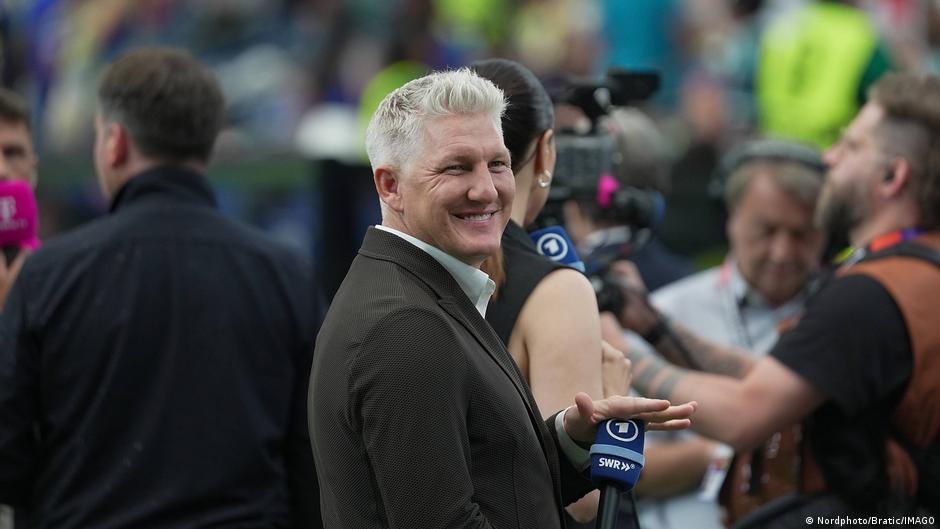
Former Germany international footballer Bastian Schweinsteiger has been accused of using racist stereotypes in his analysis of Germany’s most recent World Cup opponents, Ivory Coast, over the weekend.
Before the Group E tie in Toronto, which Germany won 2–1, Schweinsteiger, in his role as a pundit for German public broadcaster ARD, said that the Ivorians played “African football”, which he described as “sometimes a little unorthodox, a little wild, not as tactical”.
The 2014 World Cup winner said Germany “have to be prepared for the unexpected sometimes.”
Why were Schweinsteiger’s comments problematic?
Schweinsteiger’s comments prompted reactions on social media and in the German mainstream media accusing him of using racist and colonialist elements to limit black people to perceived physical characteristics rather than attributing intellectual ability. The former Bayern Munich and Manchester United midfielder is yet to comment publicly on the matter.
“Behind accusations of ‘wild’ and ‘unpredictable’ lie stereotypes that are older than football and which have racist, colonial roots,” Philipp Awounou, a black German journalist and author, explained in a column. mirror News bulletin.
“In the past, black people of African heritage were stigmatized as uncivilized (‘wild’), different (‘unconventional’), and potentially dangerous (‘unpredictable’).”
“These are racist stereotypes,” sports content creator Patrick Schnitzler told his 50,000 followers on Instagram, referring to recent academic studies which showed that commentators and fans are more likely to comment on the physical attributes of black footballers than non-black players.
“We learn such stereotypes because we grow up in a stereotypical society,” he said. “Schweinsteiger too. You too and me too.”
‘Schwensteiger is not a racist’
Awounu stressed that he does not believe Schweinsteiger is racist. “This is absolutely wrong,” he said. “Despite his problematic comments, Schweinsteiger is not at all a racist and should not be labeled as such.”
However, he suggested that the 41-year-old’s comments “reflect the opinions of many German football fans and experts” – opinions which, incidentally, did not mirror reality on Saturday.
Particularly in the first half, Ivory Coast put in a tactically solid performance against Germany, forcing Julian Nagelsmann’s team into wide areas and limiting them to crosses and long-range shots – this was surprising for a team that did not concede a single goal in qualifying and almost all of whose players have played at top European clubs.
Meanwhile, they posed a threat on the counter-attack and took the lead through captain Franck Kessie (formerly of Atalanta, AC Milan and Barcelona) following good work from in-demand RB Leipzig winger Yann Diomande, who Schweinsteiger also correctly predicted would be “dangerous”.
Even after the break, the “Elephants” could have doubled their lead when Kessie exchanged passes with Manchester United’s Amad Diallo but the shot went over the bar.
‘The wilder team was Germany!’
“Ivory Coast was a tougher opponent than we expected and showed their technical quality and physical ability,” Schweinsteiger wrote on social media, after substitute Deniz Undav turned the game on its head for Germany by scoring twice.
“If I had to make a decision, I’d say the ‘wilder’ team in this game was us: the Germans!” Avonou said in his suggestion mirror The column stated that the most “unorthodox” player on the field who stood out for his physical ability as well as his technique was not the Ivorian but Félix Nmecha.
“A German. A black player. Nigerian roots. Born in Hamburg. Raised and trained in England. What does that tell us?” He said. “Our world, and with it football, has become so global that it is no longer possible to determine qualities based on continent of origin or skin colour.”
Edited by: Matt Pearson