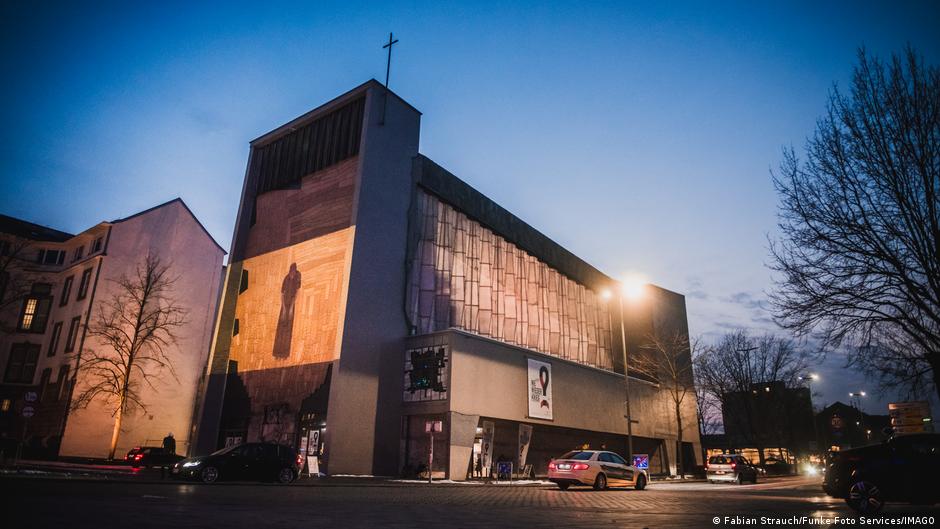
The 16th edition of Manifesta – the European traveling biennial for contemporary art and urban development – is taking place this year in the western German Ruhr region.
Under the title “This is not a church”, the main event sees international artists designing commissioned works of art for 12 churches that have fallen out of use in Bochum, Duisburg, Essen and Gelsenkirchen.
These include German artist Emil Walde’s large-scale installation made from the old, damaged wired-glass windows of Duisburg Central Station – which is being displayed within the church’s confessional booths.
And St. Anna’s Church in Gelsenkirchen is showing an exhibition that includes works by internationally renowned artists such as Ming Wong, Philipp Güfler and Canna Billir-Mayer. The event also provides a rare opportunity to gather at a church and play basketball.
The churches have been in decline for a long time
The decline in attendance at Catholic and Protestant churches underlines the decline in congregations in the Ruhr Area, Germany’s largest metropolitan area. Dozens of places of worship are destroyed every year.
It all started in World War II when the western Ruhr area was frequently hit by Allied bombing – including both industrial sites and city centres.
Its objective was to break the morale of the citizens. The damage was devastating – by the end of the war entire districts of Dortmund, Gelsenkirchen and Bochum were in ruins.
And the churches were not saved. While housing was the focus of reconstruction efforts, churches were also considered important places for people to practice their faith, find comfort, and foster community.
But a new era of church architecture was already emerging.
Post-war church architecture symbolizes modern Germany
The young Federal Republic of Germany – where significantly more churches were built than in the socialist German Democratic Republic – was able to attract a large number of architects who, even before World War II, embraced modernism and moved away from traditional styles.
Driven by social change and the separation of church and state, a highly experimental phase of church architecture had already emerged before the war.
Many of these architects resumed their work in the post-war period – which also proved to be a boon for the country politically.
“The Republic of Germany was able to present itself on the international stage as a progressive, open and modern country,” explains Manuela Klauser, art historian and member of the Sacred Space Transformation research group at the University of Bonn.
Working within ostensibly conservative churches, the architects were able to look back to the pre-Nazi period when Germany adopted “open-minded ideas long before many other countries”.
Thus architects rebuilt destroyed or damaged historic churches, planned new churches, and supervised their construction.
Rudolf Schwarz (1897–1961) was the creative force behind many Catholic churches. He said in 1957, “At the moment, we are almost only building churches. Every time, it is hard and frustrating work. You might think we should be getting better at it, but actually the opposite is true – it gets harder every time.”
The high density of churches in the Ruhr area was apparently driven by the bishops, and about 1,000 were built.
They were nicknamed “slipper churches” because churchgoers could reach them in a matter of minutes – if they slept in on Sunday morning and wanted to get to mass on time, they could still arrive in their slippers.
“The church was supposed to be at the center of people’s lives,” says Clouser. “It was not just about regularly attending services, but also about practical social services that were linked to the neighborhood, such as the municipal library or programs for senior citizens and children.”
Prefab Church: Bartning Emergency Church
New building materials were scarce after the war, so architects used rubble and debris from destroyed buildings.
This approach is clear to see in the Protestant Gethsemane Church in Bochum, one of the 43 so-called “Bartning emergency churches” in Germany, named after the architect Otto Bartning (1883–1959).
Like Rudolf Schwarz, he, too, was a leading figure in modern church architecture during the Weimar Republic and after 1945. What distinguished these churches was how they were distributed as prebuilt kits.
Mass-produced wooden structural frames combined with the roof structure formed the basic structure, and then local guilds would add the foundation and walls.
The community was able to select the infill sections of the wall and the materials to surround the walls themselves and further customize and expand the building according to their needs.
Manuela Clouser states that the emergency church program not only served an architectural purpose but also met social needs.
“People were not disempowered by being given a finished piece of architecture. They were invited to participate in its construction. This shared experience of building helped strengthen the community.”
Democratic Church on equal footing with the people
There were shortages of both money and time, leaving no room for grandeur, while ostentatious display was not in keeping with the times.
Instead, it was intended to mirror the grand, monumental structures associated with the Nazi period.
Modernist churches had nothing to do with the centuries-old grand buildings of the past, seeking to honor God through their beauty. In fact, some appear remarkably plain even today.
“These churches were designed for the newly growing settlements,” explains Klauser. “His aim was to use materials from everyday life to introduce people to a new democratic ideal and help build it on an equal footing with them.”
A 1963 article in a Protestant weekly newspaper said, “A defining feature of contemporary church building planning is undoubtedly the idea that we are not building for eternity … as was often the intention in previous centuries.” way. “Modern church builders build churches for today’s people. They are keeping tomorrow in mind, not the day after tomorrow.”
Fate of disused churches
Now that “the day after tomorrow” has arrived, many communities are asking what should happen to these churches.
The manifesto encourages people to come together to find the answer to this question. As part of its “16+” programme, a jury selected 16 projects to turn into reality in 10 cities in the Ruhr Area.
Among them is “Catch the Light – Build Bridges” in the Christuskirche in Herne, which aims to become an intercultural meeting place through experimental dance theater organized by the Potpourri Young Ensemble.
The second is “Go(o)d Kitchen: Together Building and Cooking Together”, at the Holy Family (Holy Family) Church, which has been distributing food for the Oberhausen Food Bank since 2007. The idea is to host building and cooking workshops for young people to create a space for learning and community.
Manifesta 16 Ruhr is taking place from 21 June to 4 October. Entry is free.
This article was originally written in German