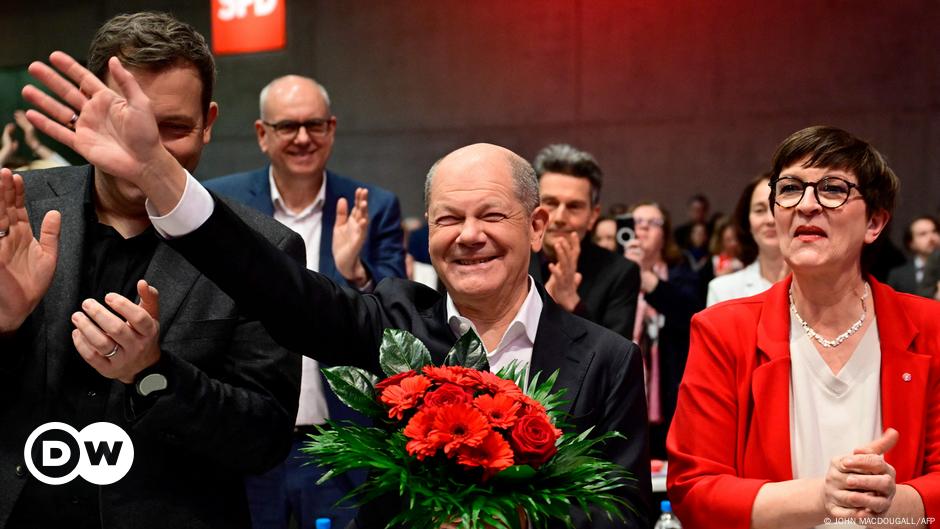
A majority of the 600 delegates at Saturday’s conference of the centre-left Social Democratic Party (SPD) in Berlin officially confirmed Chancellor Olaf Scholz as the party’s top candidate in Germany’s upcoming parliamentary election.
Scholz, 66,’s governing coalition of the SPD, the Greens and the neoliberal Free Democrats (FDP) failed dramatically in late 2024, prompting a vote of no-confidence, resulting in a snap election on February 23.
Now, according to a poll by public broadcaster ARD, 77% of Germans are dissatisfied with Scholz’s leadership, and the SPD has feuded for weeks over whether one of their more popular members should lead the campaign.
ready to fight
Scholz, who possesses a singular self-confidence and avoids basing his actions on polls, may not have been influenced by these concerns. With his political survival at stake, Scholz decided to be decisive and combative at the party conference. If the SPD loses the Bundestag election on February 23, as polls suggest, Scholz’s three-year term will be the shortest in the history of the Federal Republic of Germany.
The SPD currently enjoys less than half the support expressed by survey respondents for the conservative Christian Democrats (CDU) and their Bavarian allies, the Christian Social Union (CSU). But a lot can still happen between now and election day – at least that’s what SPD members are telling each other.
“This is a very serious time, a time when dramatic things are happening,” Scholz said in his nearly hour-long speech to SPD members. “These are things that no one would have thought possible a few years ago, maybe even a few months or weeks ago.”
US relations uncertain
Donald Trump’s inauguration as US president on January 20 is already causing diplomatic concern, as he makes territorial claims on Greenland, the Panama Canal and Canada. He has also made the intriguing demand that each NATO country contribute 5% of its economic output to defence, while currently only two-thirds of members are able to meet their 2% commitment.
Trump’s actions could provide Scholz with an opportunity in the election campaign. At the party conference, he once again rejected Trump’s claims: “The principle of inviolability of borders applies to every country, whether it is to our east or west. Every state must abide by this principle. No The country is not like this.” No small country needs to fear its big neighbour. These are what we call Western values, our values.”
For some, the speech was a hopeful reminder of 2003, when the SPD Chancellor, Gerhard Schröder, criticized US President George W. Bush during his election campaign. Bush’s invasion of Iraq. His opposition gave him enough support to win a surprise victory in the Bundestag elections.
SPD members know that international affairs are likely to become even more turbulent after Trump takes power. “This is also a time when certain forces in America are working specifically to destroy our democratic institutions in the West,” Scholz warned. “A time in which we cannot be certain how our relationship with the United States will develop in the years to come.”
Russia invaded Ukraine about three years ago and the war has continued since then. Scholz said the SPD stands with Ukraine “without any ifs and ends,” but added that as chancellor, he and his party will ensure “that we are not dragged into this war.”
Scholz said, “I will be firm and balanced and all citizens of Germany can count on that.” “My principles always apply. I never apply double standards.”
‘Better for Germany’
The SPD hopes to unite non-voters. In its 63-page program titled “More for you. Better for Germany”, the SPD focuses on a stronger state, equality between rich and poor, and greater investment in the economy, infrastructure and defence, which will benefit the rich. Is financed by higher taxes. A huge national debt. It also includes the reintroduction of the estate tax and increased taxation on large inheritances.
The plan states that the welfare state should be preserved. “Are we now ensuring that ordinary people in Germany can get decent wages, affordable food and affordable rents? Or will ordinary people foot the tax bill for the CDU/CSU’s rich and super-rich? ” Scholz asked the delegates. “Are we now ensuring stable pensions, good health and care, intact schools and daycare centers – or are we cutting these things across the board?”
The SPD wants to set up a “Germany Fund” to invest in electricity and heating grids, charging stations and housing construction. Additionally, the party wants to implement a “Made in Germany” bonus: investments in machinery and equipment that will be subsidized by 10% of the purchase price through tax refunds.
The cost of these proposals has not been fully calculated. The German Economic Institute estimates the funding gap at €30 billion ($30.7 billion) per year, although the gap for the CDU and CSU program is three times that size.
The SPD also warned against moving “to the right” on migration and asylum policy, saying that Germany should remain a country that supports immigration. “Three out of 10 people in our country have a history of immigration. People who live and work here permanently, who are well integrated, who speak German, should be able to belong to our country , They should be able to have their say in our democracy,” Scholz said.
The country is at a “crossroads,” Scholz said. “If we take a wrong step in Germany on February 23, we will wake up in a different country the next morning.”
This article was originally written in German.