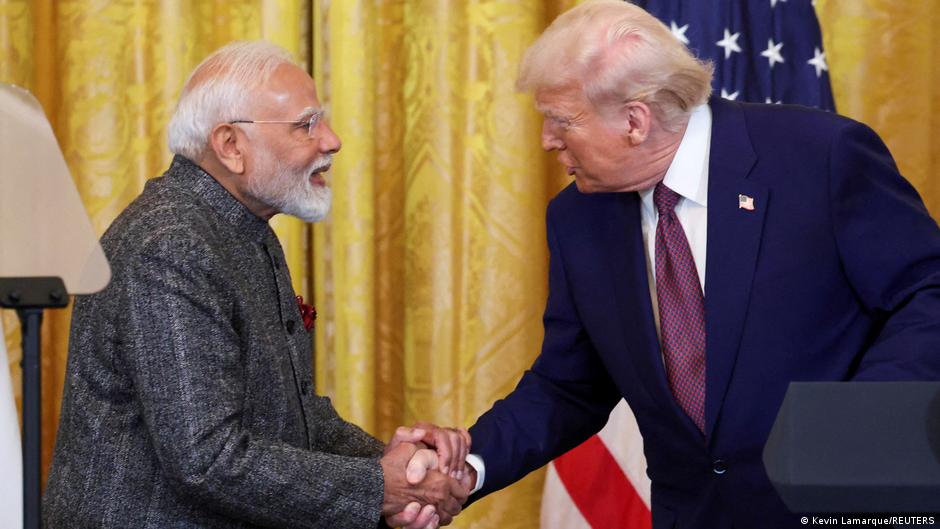
India and the United States have made substantial progress towards signing a landmark bilateral trade agreement (BTA), but there has been no significant breakthrough even after several rounds of talks.
The reasons lie in the familiar fault lines in global trade – market access, tariffs and a negotiation where neither side can appear to blink first.
Relations between Indian Prime Minister Narendra Modi and US President Donald Trump have been strained since talks for a trade deal were first announced in February 2025.
The two leaders were locked in a diplomatic spat in May 2025 after Trump claimed to broker a peace deal between India and Pakistan following the Pahalgam attack in Indian-administered Kashmir.
In August 2025, the Trump administration doubled the duty on select Indian exports to the US upon continued purchases of Russian oil by New Delhi – an additional 25% duty was imposed on top of the 25% reciprocal tariff.
After nearly 18 months of talks, experts tell DW that they believe Indian Trade Minister Piyush Goyal when he says a deal is “very close.” But the deal is unlikely to succeed unless both sides get some important assurances.
US Supreme Court changes leverage
In February 2026, a year after the US and India first announced trade talks, the two sides released a framework for an interim trade agreement that “reaffirms the countries’ commitment to a comprehensive US-India bilateral trade agreement (BTA) negotiations.”
Under the agreement, India will “eliminate or reduce tariffs” on all US industrial products and a wide range of US food and agricultural goods. New Delhi also plans to buy about $500 billion (€438 billion) worth of American goods over the next five years.
The US agreed to reduce Trump’s tariffs to 18% from 25% and cancel the punitive additional 25% tariff imposed on India for purchasing Russian oil.
A few days later, the U.S. Supreme Court struck down the administration’s sweeping tariffs, taking away Washington’s original advantage.
India is determined to achieve competitive advantage
India’s Commerce Minister Piyush Goyal is looking to gain an edge over the country’s global competitors.
“Clearly we have to have some reasons to be able to implement the deal that we have already agreed to,” Goyal said while attending the India Global Forum in London last week.
This cannot be implemented unless India achieves a competitive tariff advantage over its competitor countries. “The day that happens, the deal will be finalized,” he said.
India is rapidly establishing itself as a manufacturing hub in an effort to become a major player in global value chains.
Many Asian economies – such as China, Malaysia and Vietnam – have developed using this model. As New Delhi seeks to take the country into the ranks of the world’s largest economies, it will be important to achieve competitive trade advantages with the US.
access to agricultural markets
Just as Goyal needs to show India a win by securing competitive tariffs, the Trump administration needs to show American farmers some potential in India’s agricultural markets.
American corn, soybeans and dairy are at the center of that discussion.
China has been an important driver of the US agricultural sector, importing a wide variety of commodities. But years of trade wars and geopolitical tensions have forced Beijing to look elsewhere. Chinese purchases of US soybeans and corn have declined sharply as it has turned to other markets such as Brazil.
As a result, Trump is trying to find new markets for American farmers – a key political base for the president.
Washington is also pressing New Delhi for market access for genetically modified crops, pulses, grains, dairy and dry fruits.
However, farm bodies have warned the Modi government that reducing tariff and non-tariff barriers will result in billions in loss of farmers’ income. About 40%–50% of India’s population is directly or indirectly employed in the country’s agricultural sector and farmers hold significant political influence.
In 2021, massive farmer protests in India forced the Modi government to repeal three newly implemented laws that farmers believed would devastate their income. This is one of the biggest defeats of PM Modi’s government in its 12 years in power.
Mark Linscott, former assistant US trade representative for South and Central Asia, believes agricultural access is an important issue, but not a deal breaker.
“I think there’s an understanding on both sides that the most sensitive issues are not on the negotiating table,” he told DW. “Dairy is off the negotiating table. It’s never really been a serious area of negotiation. Genetically modified crops, at least for human consumption, are off the negotiating table.”
He said there is more potential to provide India some market access for pulses and dry fruits.
Deal with an expiration date?
As United States Trade Representative Jameson Greer visited India to clarify details of the phase one US-India trade deal, speculations are rife that the Modi government may seek a sunset clause.
That came after the European Parliament on June 16 approved a deal for lower U.S. tariffs that included a sunset clause that required the agreement to expire on Dec. 31, 2029 — unless both sides agree to extend it.
Vivek Mishra, deputy director of the strategic studies program at the Observer Research Foundation (ORF), a New Delhi-based think tank, said India would benefit from a similar deal as it opens up sensitive sectors like agriculture to the US market.
“We need to be able to go back and say, OK, you know, the deal is over, let’s move on now,” he told DW. “This area is closed at some point. Let’s say 10 years, 15 years. I’m told it’s a conversation that’s happening. And that’s an important point.”
India seeks clarity on tariff risks
Following the US Supreme Court’s ruling on reciprocal tariffs, the Trump administration found a covert way: investigations under the US Trade Act.
In March, the Office of the United States Trade Representative (USTR) launched two investigations covering 60 economies. India was involved in both, and potentially faces additional tariffs on a 12.5% tariff related to a forced labor investigation and another investigation for excess capacity.
“If tariff levels are effectively predetermined and then adjusted through trade bargaining, the question arises whether Section 301 investigations are really about unfair trade practices or merely a tool to extract concessions,” Srivastava said.
In 2017, the USTR used a similar investigation under the Trade Act, previously under the Trump administration, as leverage against China. Talking about Beijing’s dominance in rare earth materials, Mishra said, “It started with China but then China had dominance, which ultimately forced the US to step back.” “India does not wield any kind of influence like China,” warned Mishra.
“India clearly wants some clarity on what will happen in the future on the possibility of an additional 301 cases or the cases that are still pending,” Linscott said. “They want some assurances, ideally, legal commitments that there will be no future actions that are contrary to this agreement.”
Will a deal be possible?
Most experts DW spoke to believe both Washington and New Delhi want a trade deal. And although it is difficult to say how long the negotiations will continue, it is unlikely that they will break down completely.
“India is somewhat unique” in negotiating comprehensive BTA in phases, Linscott said.
“If they can’t resolve something now, they can defer it and put it to the next stage of negotiations.”
Both Linscott and Mishra believe that there is a change in the way the US views India, leading to a growing recognition that India is one of the largest economies and does not need the same concessions as before. It certainly plays an inherent role in trade negotiations.
“Despite what happened last year, there is a recognition in the US administration that from an economic perspective and from a strategic perspective, India is really important,” Linscott said.
Edited by: Keith Walker