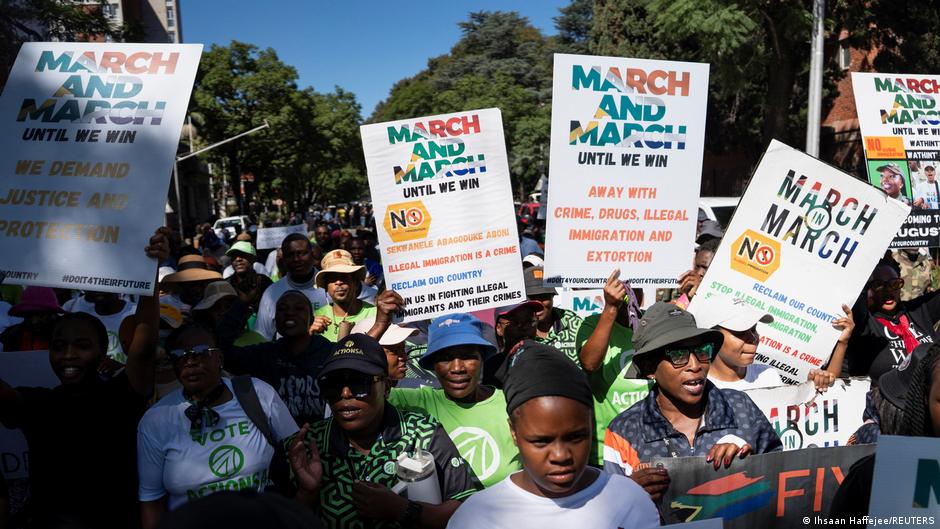
Tension has risen in South Africa over anti-migrant protests planned on June 30, with authorities warning against unrest and preparing for possible violence.
President Cyril Ramaphosa issued a strong message as tensions rose across the country. “We will not tolerate any attempts by anyone to destabilize the country, whether it is the march or anyone else,” Ramaphosa said on Thursday.
Protests have been called by other groups including “March and March” which are campaigning against undocumented migration. These organizations have set an unofficial deadline for migrants without legal status to leave the country, raising fears of renewed xenophobic violence in a country that has experienced repeated outbreaks since the end of apartheid in 1994.
The country’s police minister, Firoz Cachalia, stressed that peaceful protests were protected under South Africa’s constitution, but that any illegal actions would be met with force. He said crime, intimidation, violence, destruction of property and any attempt to undermine public safety will not be tolerated.
South African government admits delayed response
Cachalia also acknowledged that authorities have reacted too slowly to rising tensions and xenophobic rhetoric.
He said, “We have been hesitant to speak clearly on this issue for a very long time. There is no reason why anyone should come to a protest with an object that can be used as a weapon.”
Recent weeks have seen an increase in attacks on foreign nationals. Vigilante groups, often associated with right-wing populist rhetoric, have raided neighborhoods, looted businesses owned by migrants and intimidated people suspected of being foreigners.
While these groups claim to target undocumented immigrants, in practice, their actions often affect anyone considered an outsider, including people of African or Asian descent, regardless of their legal status.
Many African countries, including Nigeria, Ghana and Malawi, have been forced to evacuate their citizens.
Migration has increased steadily for decades. According to Statistics South Africa, the government statistics office, migrants were 2.1% of the population in 1996. By 2022, this figure will increase to 3.9% or approximately 2.4 million people, including both documented and undocumented residents.
Is this a crisis of the government’s own making?
Analysts have pointed to deeper structural problems behind the uncertainty. Political commentator Tessa Dooms has argued that the current crisis reflects long-standing governance failures.
“The South African government has largely created this dilemma for itself,” he told DW.
President Ramaphosa on Friday reiterated the importance of regional cooperation and stressed that no country can prosper alone.
Dooms described a pattern in which officials delay action on major challenges such as unemployment, public services and poverty.
“It ignores problems, tolerates corruption, allows decay to worsen and reacts only when the situation reaches its peak,” he said.
According to Doums, the government has underestimated movements such as “March and March” and “Operation Dudula”, especially their ability to unite different social groups.
“They [government] are unprepared; They are analyzing the problem wrongly. They believe this is merely an anti-immigrant movement, when in reality, migration is being presented as a solution to many other crises facing people.”
high youth unemployment, limited access to health care and education and growing inequality Have disappointed many communities. For some people, anti-immigrant activism provides a sense of being heard.
“So it’s not that people are xenophobic, but they see this particular movement as a place where they can be heard and where they can find simple solutions to complex problems,” Dooms said. He said the government has failed to address these grievances and is “in no way prepared to deal with this on June 30.”
Security measures and public distrust
Authorities have deployed police forces and even hired private security firms to deal with possible unrest. The cost of these measures is expected to reach 600 million rand (€32 million/$36 million), reflecting the scale of the anticipated challenge.
However, skepticism about the effectiveness of such measures is widespread. Doums said that enforcing human rights requires active law enforcement institutions, not just warnings.
Criticizing the lack of prosecution and accountability, he said, “They need law enforcement agencies for this.” “All this is happening in an environment where the country’s top police officers sit on the Madlanga Commission.”
Established in July 2025 and named after Judge Mbuyiseli Madlanga, the commission is investigating allegations of corruption within the police, political interference and infiltration by organized crime.
Trust in law enforcement remains low. Fredson Guillengue of the Rosa Luxembourg Foundation said migrants often see the police as part of the problem.
“The victims of these attacks still view the South African police as a xenophobic institution,” he told DW. “I don’t see any change.”
Guillengue also criticized the government’s reactionary approach. “Until the leaders of these movements realize the full force of the law, they will not stop intimidating immigrants,” he said.
Policy failures and deep inequalities
Apart from policing, systemic issues in migration management are also raising tensions. Guillengue pointed to corruption and inefficiency in immigration systems, which contributes to public frustration and creates opportunities for vigilante action.
He warned that recent government actions – such as increased deportations, workplace inspections and fines for employing undocumented immigrants – risk reinforcing anti-foreign narratives.
“Many political changes have been implemented […] “Which essentially means that the government agrees with the narrative that South Africa is being invaded by foreigners,” he said.
Analysts argue that addressing xenophobia requires tackling its root causes. Youth unemployment remains high. About 61% of young South Africans were unemployed at the start of 2026, while overall unemployment stood at 32.7%.
For Dooms, solutions must involve local communities and policy makers alike.
“You can engage them in conversations about the real problems they face,” he said, emphasizing dialogue rather than confrontation.
As South Africa approaches June 30, the situation highlights not only tensions over migration but also deeper economic and political challenges that remain unresolved.
This article was originally written in German.