When Belgrade police chief Veselin Milic reportedly tried to make peace between two rival underworld figures – Sasa Vukovic and Aleksandar Nesovic – at an upscale restaurant in one of the Serbian capital’s wealthiest neighborhoods on May 12, the meeting ended in bloodshed.
According to a preliminary account by prosecutors, Vukovic shot Nesovic at least ten times. Nesovic’s body was found buried inside a barrel outside Belgrade several days later.
Investigators initially alleged that Milik had helped conceal the crime.
The case came to light in mid-May and soon made headlines in Serbia.
For many Serbs, the most troubling question was why the head of the country’s largest police department was meeting with two prominent figures in the criminal underworld.
However, for Steven Dojinovic, editor-in-chief of investigative outlet KRIK, the case is not that remarkable.
“The fact that a police chief is linked to organized crime and is allegedly involved in criminal activities is, unfortunately, nothing new in Serbia,” Dojsinovic told DW. “We have seen this pattern repeatedly over the last few years.”
changing alliance
Stevan Dojinovic has spent years investigating the connections between organized crime, state institutions, and Serbia’s ruling Serbian Progressive Party (SNS).
In his view, the relationship goes far beyond isolated cases of corruption.
“The Serbian state is deeply entangled in organized crime,” he said. “The ruling party and key people around President Aleksandar Vucic cooperate with various criminal groups depending on political interests and circumstances.”
According to Dojinovic, those changing alliances have helped fuel Serbia’s underworld wars. More than 100 people have been killed in gang-related killings over the past decade, many of them in broad daylight and in public places.
That’s why, he says, the latest murder was not unusual.
“It became a major story because it suited certain factions within the ruling party,” Dozsinovic said. “Different factions within the party have formed links with various criminal groups. Those criminal groups are now at war with each other – and there are also political interests behind them.”
a decade of proof
Over the past decade, allegations of ties between Serbia’s political leadership and organized crime have been strengthened by court proceedings, testimony, encrypted Sky and WhatsApp communications, leaked audio recordings, and years of investigative reporting.
According to Branko Sesen, one of Serbia’s most prominent investigative journalists, the connection between the ruling SNS and the criminal underworld dates back to the beginning of Aleksandar Vucic’s rule.
“People with well-documented criminal backgrounds, such as Zvonko Veselinovic and Milan Radošić [businessmen from northern Kosovo]”They suddenly became major beneficiaries of state contracts and increasingly influential figures,” he said. “For years, they reemerged as key partners of the authorities.”
One of the clearest examples came from the investigation of Veljko Belivuk, the alleged leader of one of Serbia’s most notorious organized crime groups, whose members are on trial for a series of murders, kidnappings and drug trafficking crimes.
According to KRIK court reports, Belivuk told prosecutors that he had decided to “tell everything” about his group’s relations with President Alexander Vucic, then-Interior Minister Alexander Vulin, Vucic’s brother and other officials, “who asked us for help and are now pretending they don’t know us.”
Dojsinovic also points to WhatsApp messages recovered from Belivuk’s phone after his 2016 arrest, which he says revealed a chain of communications.
“Belivuk asked for approval from a senior officer of the Gendarmerie, Nenad Vukovic. Vukovic mentioned approval from the second-highest official at the time in the Interior Ministry, Dijana Herkalovic. In turn, he mentioned approval from the ‘small chief’ – apparently the Minister of the Interior – and the ‘big chief’, who was apparently President Vucic,” Dozinovic explained.
Another piece of evidence emerged in 2023, when KRIK published an audio recording in which Vukovic can be heard allegedly leading a meeting of a criminal group, discussing criminal operations and boasting that his network had “the entire police in its hands.”
A ‘mutually beneficial arrangement’
Both Dojinovic and Sesen say that the relationship between the Serbian state and organized crime is not simply one of corruption, but a mutually beneficial arrangement: the state provides security, they say, while criminal groups provide services.
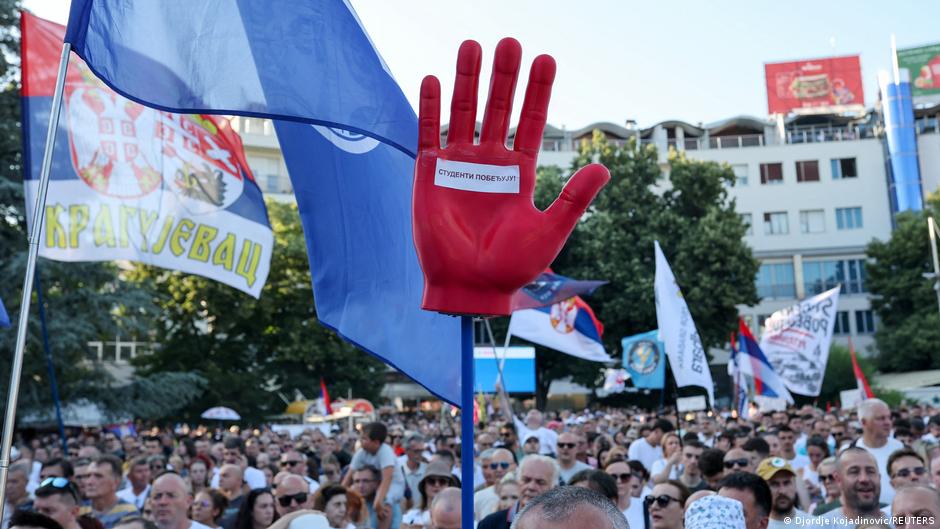
During the student-led anti-government protests that have been ongoing in Serbia for nearly two years, investigative journalists identified members of criminal groups among the men attacking peaceful protesters.
Organized crime figures have also long been linked to football hooligan groups that control stadium terraces and fan organisations, helping to ensure that anti-Vucic chants are kept to a minimum.
“But the state does not protect drug cartels just to keep a few dozen people available to attack protesters,” Dozsinovic said. “People within the state benefit from it – that’s the main motivation. But once this relationship exists, criminal groups can also be called in whenever needed, whether on the streets or in the stadium.”
Why are no state figures facing consequences?
Despite years of investigations, court proceedings and mounting evidence, political accountability has not been held in almost any major organized crime case in Serbia.
According to Dojinovic, prosecutors have used encrypted Sky communications to prosecute gang members while avoiding politically sensitive leads.
“They use Sky messages against criminals,” he says. “But they avoid those parts that implicate politicians or senior state officials. As a result, those at the top remain untouched.”
Serbian officials rejected allegations of links between the state and organized crime, and insisted that the government was waging an uncompromising fight against criminal groups. But according to Branko Sesen, the rhetoric alone is difficult.
“When authorities have to arrest someone, they do. But when the investigation gets too close to people within the system, the story starts to unravel,” he told DW.
political cost
But the walls seem to be closing in. As anti-government protests continue unabated across Serbia and enter their 20th month, pressure on President Aleksandar Vucic is increasing.
“People are demanding respect for the rule of law, functioning institutions, and basic civil rights,” says Sessen.
He believes the issue is beginning to erode support even among voters who are not part of the opposition.
“It’s a thing [for businessmen] To make money under Aleksandar Vucic’s system,” says Sesen. “It’s a completely different thing to feel helpless in the face of organized crime and to feel that the police can’t protect you.”
Vucic announced on Saturday that he would step down from the presidency in a few weeks. However, although he has repeatedly indicated that early elections are imminent, no date has been announced yet.
Edited by: Angiel Flanagan