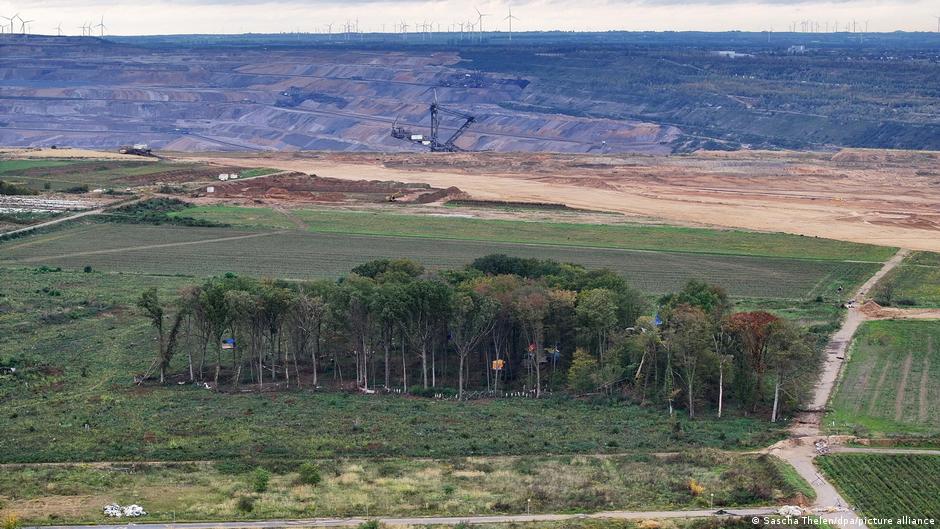
The 12,000-year-old Hambach Forest has lived through many eras, but perhaps none as consequential as the last half century.
Locals and environmentalists have been fighting for 50 years to save the forest – which lies between the western German cities of Aachen and Cologne – from becoming an open-pit coal mine. At times, protesters took over the area, living in tree houses amid the high canopy to protect them from the threat of chainsaws.
Now the fighting is finally ending, with about 14% of the original forest still intact. In June, the local government announced that the remaining woods would be permanently protected and turned into a nature conservation area.
“The climate movement has won the battle,” said Dirk Jansen of BUND, the German branch of the Friends of the Earth environmental group. He spent decades fighting for the forest.
Hambach is one chapter of a much larger story, as similar clashes between governments, private developers and citizens are playing out around the world – including in the US. There, public lands are being taken back for oil and gas extraction at an unprecedented rate.
“It seems like we’re moving aggressively in the opposite direction,” Lincoln Larson, who studies outdoor recreation and public lands at North Carolina State University, told DW.
How Hambach became a battlefield
The battle over Hambach began in the mid-1970s when the German energy company RWE began the permitting process for open-pit lignite mining near the forest. More than 5,200 people from nearby villages were sent for resettlement, provoking initial local resistance over land rights.
In later years environmentalists raised this issue. The first treehouse occupiers set up camp in 2012, triggering a standoff in which they were intermittently evicted by authorities.
The conflict reached a turning point in October 2018, when more than 50,000 protesters flooded the forest. The same month, Friends of the Earth Germany won a court order to stop the clearing.
The following year, Germany’s Coal Commission, made up of energy companies, unions, NGOs and citizens, recommended that Hambach be protected and that Germany begin extracting coal by 2038. The Hambach mine will stop extracting coal by 2029.
And just recently, the government and RWE finalized their agreement to protect what remains of the forest.
Public lands in America are in danger
In the US, this type of fighting is common over public lands, from copper-nickel mining in Minnesota’s Boundary Waters to oil and gas drilling in New Mexico near sacred pueblos and Navajo lands.
Public lands account for about 30% of the country, totaling about 640 million acres (259 million hectares). These range from America’s most popular national parks – like Yosemite and Yellowstone – to wilderness and wildlife refuges.
They came under the control of the federal government through the Antiquities Act of 1906, which allows the President to designate lands for protection. But U.S. President Donald Trump is attempting to reverse that legacy, shrinking the government’s public lands portfolio and opening protected lands to drilling, mining and private development.
Larson said, “For 100 years, presidents have simply been using it to add land to our protected area portfolio. Trump is the first person who has actively tried to do the opposite.” “So this is unprecedented.”
In June, Trump opened 500,000 square miles (1.3 million square kilometers) of protected Pacific Ocean waters to commercial fishing.
The President’s so-called One Big Beautiful bill created an accelerated calendar for the Interior Department to sell leases of public lands for oil and gas development. And he has called for an expansion in timber production with the US Forest Service and has promised to increase timber sales by 25% over the next four to five years.
Losing Public Lands Is More Than Nature
Selling public land for development impacts far more than any one ecosystem. Its most obvious impact is on climate. RWE was clearing Hambach to harvest the dirtiest types of lignite or brown coal.
It’s not just that fossil fuel extraction is increasing global temperatures, leading to more intense storms, droughts, floods and extreme weather around the world. Public lands are also important for watershed management.
In the United States, many public lands are located at high altitudes and capture water that lowland communities depend on for their drinking supplies.
A 2022 study by the US Forest Service found that national forests in the US West cover about 20% of the total land area, but contribute 46% of the surface water supply.
Then there is biodiversity. Forests, wetlands and protected marine areas are ecosystems that exist in a delicate balance. Cutting trees or overfishing can disrupt the entire system.
Loss of biodiversity can disrupt the food supply chains on which billions of people depend and create resource shortages that lead to political instability. The United Kingdom acknowledged this year that vanishing global biodiversity has major national security implications
Why do communities fight to keep public lands public?
Furthermore, people often feel an intrinsic connection to the nature around them. This is especially true for indigenous communities who have often led the fight to protect the natural world from oil and gas extraction.
One of the biggest battles over public lands has taken place in Alaska, the state with the highest proportion of Native people. Local communities there largely oppose drilling, as many still depend on traditional hunting and fishing for livelihoods.
That personal stake transcends party lines. Surveys show that nearly three-quarters of those asked oppose the closing of national public lands and their sale to the highest bidder.
The country’s national parks, often called “America’s best idea,” welcomed a record 331.9 million visitors in 2024.
“The attachment to these unique places is what drives people to fight to protect them,” Larson said.
The economic stakes are equally high. Outdoor recreation supports a $1.2 trillion industry and five million jobs. In many communities, public lands attract tourists, sustain small businesses, and keep the local economy going.
In Hambach, the remaining forest will become a publicly managed forest development area from 2035. Two new corridors will connect it to neighboring woodland in an effort to restore the ecology and biodiversity of the landscape. A bicycle and walking path will also be built so that residents can safely visit the forest.
Janssen of Friends of the Earth said, “Not a single tree will be cut, not a single road will be built and even the remaining forests will be designated as nature reserves.” He said the entire region now has an ecological future. “This is a time of peace and this time will remain a forest and nothing else.”
Edited by: Tamsin Walker