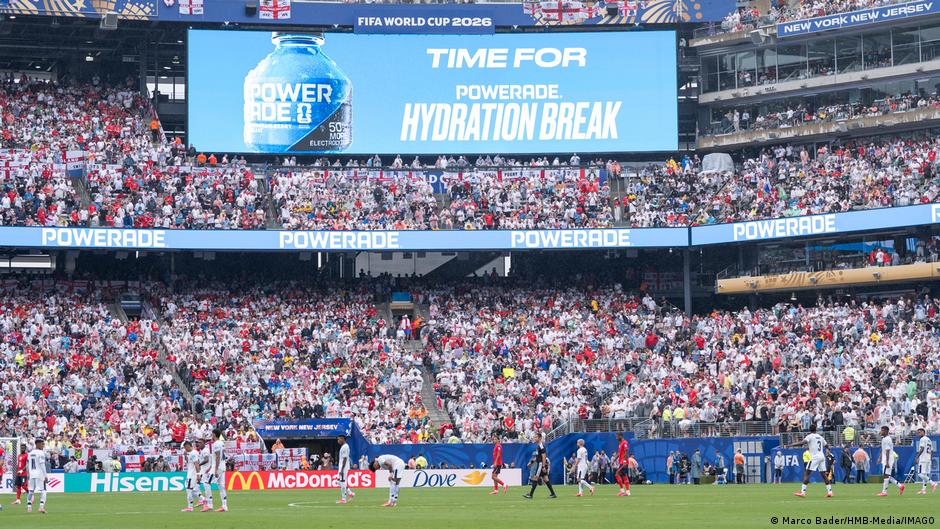
When the group stage match between England and Ghana was stopped for a “hydration break” after 22 minutes, a loud booing was heard from the stands at Boston Stadium. Players moved to the sidelines, and coaches gathered their teams around them for brief tactical instructions. It had only been a few days since the World Cup started that this became clear; No change is polarizing fans like these mandatory pauses in sports.
“As a coach, I would have liked it,” Jurgen Klopp told DW. A few extra minutes for tactical instructions gives a team a clear advantage.
However, the former Liverpool and Dortmund manager also drew criticism.
“There is an issue with the length of the water break and what TV broadcasters or FIFA do during it.”
From protection from heat to the root of controversy
This rule was officially introduced to help players deal with the heat. In this World Cup, matches are stopped twice in addition to the halftime break, at approximately the 22nd and 67th minutes. Unlike previous major tournaments or league games, the decision to call water breaks is not based on how hot it is, although the idea of introducing them came up during last summer’s Club World Cup, when extremely high temperatures were a problem.
However, in this World Cup, hydration breaks have become a major point of contention.
“I don’t like this water break,” an Iraqi fan in Philadelphia told DW.
“If players really need a drink, they should do so before taking a corner kick.”
At the match between Argentina and Austria, another fan pointed out the fact that it was being played in a covered stadium in Dallas: “The air conditioning is on here, so where’s the heat?”
not just water breaks
It is mainly the impact on the game that is giving rise to debate. In many cases, what was supposed to be a brief opportunity to hydrate has turned into a strategic timeout. Coaches adjust formations, give instructions to players and disrupt the opponent’s rhythm.
“On the one hand, the breaks have changed the game by giving more influence to the coaches; on the other hand, they have disrupted the flow of the game for the fans,” an Argentina supporter told DW.
Research conducted by the English newspaper “The Times” shows that this perception is not merely subjective. Using Opta data, the paper evaluated each group-stage match. There was a significant change in momentum in 32% of the matches after the first water break and in 26% of the matches after the second. Match speed dropped by an average of 17% after the interruption. Particularly surprising was the finding that the team with the higher pace before the break experienced a much sharper drop in pace afterwards.
Players and coaches also take this trend seriously. Netherlands captain Virgil van Dijk said the interruptions were far from ideal for neutral spectators watching on TV. While water breaks in extreme heat are understandable, he argued that decisions regarding their use should be made on a match-by-match basis.
England manager Thomas Tuchel criticized the break as unnecessarily prolonging matches. Paraguay coach Gustavo Alfaro even said that soccer is increasingly evolving into a game played in four quarters – a comparison that comes naturally in North America, given that popular American sports, such as basketball and American football, are structured this way.
Financial windfall for FIFA?
It is precisely here that another point of criticism arises. In many countries, broadcasters are using these guaranteed stoppages for commercial breaks, which was previously almost unheard of in football.
“They have to fit it into their advertising; from a corporate perspective, it probably makes sense,” one American fan told DW.
The hydration break also has its own sponsor, whose name appears on the stadium’s big screen at the beginning of the break.
FIFA president Gianni Infantino has denied that football’s global governing body was benefiting from the introduction of hydration breaks.
“We don’t make a single extra dollar from Hydration Break because all the contracts were signed before the start,” he told SNTV.
Additionally, he announced plans to carefully evaluate the experience gained during this World Cup. Only after that will a decision be taken on the future of the water break.
medical benefits
Sports medicine experts are sensitive to additional opportunities for players to hydrate during extreme heat.
“The data is showing that the so-called ‘cooling break’ has a beneficial effect on body temperature,” sports physiologist Tim Meyer told Germany’s “11 Freunde” football magazine.
“In extreme circumstances, players run less – and above all, less intensely – and play more safe passes. From a health point of view, this is probably sensible, but it is certainly not in line with the spirit of the game.”
The debate has long shifted from the question of whether players need protection from the heat to the question of what protection should look like — and whether breaks should apply to every match, no matter the temperature.
This article was originally published in German.