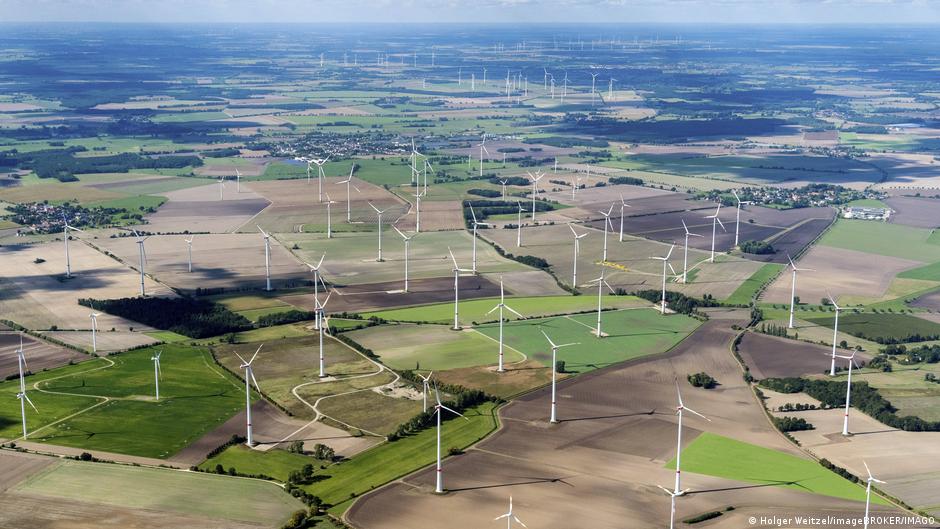
Hannes Loth drives an electric car and wants to install wind turbines in his municipality.
Loth, Germany’s first full-time mayor from the right-wing, populist Alternative for Germany (AfD), is promoting the expansion of renewable energy – even though it contradicts his party’s platform.
Farmer is mayor of Raguhn-Jaenitz from 2023 and has ambitious plans. In the town of about 8,600 people in the eastern German state of Saxony-Anhalt, he wants to build a battery storage facility along with a substation and six new wind turbines.
Tilo Hortz, local councilor of the conservative Christian Democratic Union (CDU) in Raguhn-Janitz, confirmed the plans. “Mr. Loth is not a person who brings ideology into everything,” the owner of a local electrical engineering company told DW. “We need these key technologies in Saxony-Anhalt – they are vital.”
fear of policy reversal
With the AfD’s polling numbers rising ahead of state elections in Saxony-Anhalt on September 6, Hartz fears the state could change direction politically.
“I’m concerned that we may have to take a step back,” he said.
Their concerns are not unfounded. In its election manifesto for Saxony-Anhalt, the AfD has promised to “stop the coal phase-out, start a return to nuclear power and end energy-related sanctions against Russia”. It also wants to ban new wind turbines and bar entry to non-EU citizens.
According to the latest opinion polls, the AfD – led by its top candidate Ulrich Sigmund – is polling at around 41% in Saxony-Anhalt. The CDU candidate, outgoing state premier Sven Schulze, is at around 26%, according to Infratest Dimap, a polling institute.
Saxony-Anhalt is one of Germany’s pioneers in the transition to renewable energy. According to this, due to its extensive wind and solar energy potential, renewable sources were to contribute 57% of the state’s gross electricity consumption in 2025. German Environment Agency. By comparison, the nationwide figure was 55%.
Wind energy faces political headwinds
This is somewhat of a paradox: the East German states of Saxony-Anhalt, Brandenburg and Mecklenburg-Western Pomerania are among the country’s leaders in the expansion of renewable energy, yet they are also places where the AfD has made significant electoral gains.
For pollster Roland Abold, managing director of Infratest Dimap, economic issues such as the state’s energy mix “play a relatively small role in the voting decisions of AfD supporters in Saxony-Anhalt.”
“According to our latest survey for May 2026, the issues voters in Saxony-Anhalt consider most important are refugee and asylum policy, followed by education and the economy,” he told DW.
Johannes Kees, a researcher specializing in right-wing extremism at the University of Leipzig, offers another explanation.
“When it comes to energy policy, the AfD’s electoral success has not been driven by creative or innovative policy proposals,” he said. Instead, he argues, the party’s appeal is built on emotions that generate resentment against both “the people at the top” – the political establishment – and “the people at the bottom” – perceived outsiders.
Coal instead of wind energy
The picture is different when it comes to the economy. Businesses say their biggest challenges are a shortage of skilled workers and high energy prices.
While Saxony-Anhalt’s coalition government of the CDU and Social Democrats (SPD) is betting on the expansion of renewable energy to reduce dependence on fossil fuels and unstable energy prices, the AfD is supporting fossil fuels instead.
Business leaders and economists have therefore warned against the AfD entering government.
For Daniel Hanemann, chief executive of battery storage manufacturer Tesvolt, based in the East German city of Wittenberg, the party’s migration policy is “economically damaging”. He recently told the newspaper voice of the people That “an environment of isolation” would make it difficult to recruit staff and maintain international business relationships.
However, in his view, the party’s energy policy proposals would be even more harmful.
“Anyone who slows the expansion of wind energy, questions the legal support framework for renewable energy or wants to roll back climate commitments is directly hurting companies like Tesvolt,” Hanemann said.
Damage to the economy?
According to right-wing extremism researcher Keyes, the AfD’s program is not only “unrealistic,” but “it will have serious negative consequences for the economy and energy security of Saxony-Anhalt,” he told DW in a statement.
At a state parliament session in late June, state Prime Minister Schulze took aim at his election opponent, Ulrich Sigmund. He argued that many of the AfD’s campaign promises concerned issues that could not be decided at the state level.
“Eliminating CO2 taxes and subsidies for electric cars, withdrawing from the Paris climate agreement, or bringing back nuclear power – if you want to get it through the Bundesrat (parliament’s upper house), you need 35 votes. Saxony-Anhalt has four.”
Meanwhile, AfD mayor Hannes Loth is trying to win state approval for the construction of wind turbines in his municipality before it is too late. Under Saxony-Anhalt’s rules, municipalities receive €0.3 ($0.34) per kilowatt-hour generated by approved wind farms.
Loth’s request reached Schultz’s desk for approval. “At first I thought it was a joke,” Schultz told state parliament. “But the letter in which Mr. Lowth asks me to support his plan to build six new wind turbines in his forest actually exists. It is right here in front of me.”
This piece was originally published in German.