Exactly a year ago, Hamid Nangiale Kabiri found himself stuck in a difficult situation: after working at the Afghan Consulate General in Bonn for six years, most recently as their head, he decided to step down in September 2025 rather than comply with the German government’s demand to cooperate with Taliban representatives.
“I said: I’m sorry, but I can’t do this. They are terrorists. I grew up in Afghanistan under their government, and I saw many of my classmates killed. I can’t accept them as colleagues,” he told DW.
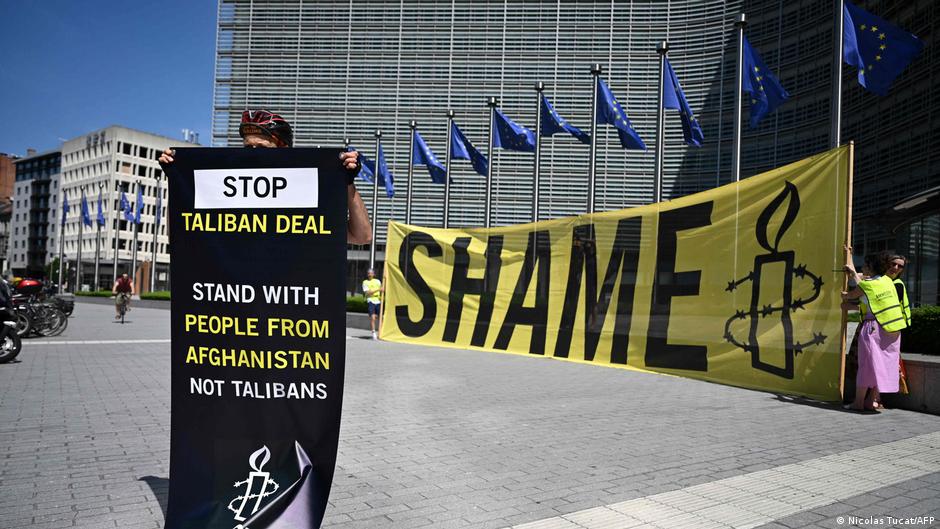
Only nine months later, this has become reality: both the Afghan Consulate General in Bonn and the Embassy in Berlin are now led by Taliban representatives. The federal government has confirmed that four more diplomats are expected to reach Germany.
Meanwhile, Kabiri, who had consistently refused to cooperate with the Islamist group, now never leaves his apartment out of fear for his safety. He has also been forced to apply for asylum so he can remain in Germany.
“I lost my first homeland, Afghanistan, and I don’t want to lose my second home, Germany, because it’s where I really feel at home,” he said. “In the past, anyone applying for asylum was thoroughly scrutinized to make sure they did not collaborate with the Taliban. Now I may have to leave the country because I refused to collaborate with them. This is a double standard.”
More deportations to Afghanistan
The German government is committed to increasing deportations to Afghanistan, with Interior Minister Alexander Dobrindt of the center-right Christian Social Union (CSU) proposing three charter flights per month, complemented by individual deportations on scheduled commercial services.
To facilitate those withdrawals, Berlin is opening channels of communication with the regime against which German troops have been involved in a war for nearly two decades. 59 German soldiers lost their lives on that mission, and Germany still does not officially recognize the Taliban as the government of Afghanistan.
In response to DW’s inquiry, the German Interior Ministry said: “By accepting returnees from Germany, the government of Afghanistan is in fact fulfilling its obligation under customary international law to treat its citizens with respect. At the same time, the functioning of Afghanistan’s diplomatic missions in Germany is a prerequisite for issuing the necessary replacement travel documents for deportation.”
Chancellor Friedrich Merz of the center-right Christian Democratic Union (CDU) recently said in a parliamentary question session: “We are not extending a hand to the Taliban regime.”
However, he said Germany was seeking cooperation with the Taliban “at the necessary technical level” where doing so would serve the country’s interests, especially with regard to the deportation of criminals. Merz also expressed his “full and unequivocal support” for Interior Minister Alexander Dobrindt’s handling of the case.
Taliban repression of women and girls
Refugee organizations are important. “The decision to accept Taliban representatives into Afghan diplomatic missions in Germany marks a new phase in relations between Germany and the Taliban,” said Helene Regen, executive director of the NGO. Prof SharanTold DW. “It provides greater legitimacy to an oppressive regime that violates fundamental human rights, excludes women and girls from education, employment, and public life, and systematically deprives them of their rights.”
“My first thought was that Germany has opened the door to these negotiations,” Reisen said. “From our perspective, the debates in recent months about normalizing relations with the Taliban, the replacement of embassy personnel in Bonn and Berlin, and deportations to Afghanistan are clear signs that Germany has helped pave the way for this. The fact that developments have progressed to the point where Taliban representatives are being invited and included in talks shows that these contacts are increasingly institutionalized.”
Are the Taliban using deportation flights as leverage?
Recent fears that giving the Taliban an inch would allow the regime to take a mile, and its concerns, may be justified. According to a recent report by the public broadcaster NDRTaliban officials canceled a deportation flight to Kabul, even though German Federal Police officers assigned to transport the deportees had already been issued visas. The Afghan Foreign Ministry reportedly justified the decision by saying that it did not have enough diplomatic staff in Germany.
“Alexander Dobrindt is pursuing an extremely radical policy and in doing so he is collaborating with a regime that violates fundamental human rights standards and strategically exploits every new dependency,” Regen said. “What the interior minister is doing is short-sighted: the Taliban will not be satisfied with a limited deportation arrangement but will use every recourse to extract further political concessions.”
Afghans should report to the same authorities from whom they fled
Kabiri also believes that whenever their demands are not met, the Taliban will leverage their influence and continue to obstruct deportations. He insists that his voice will never be silenced.
“When people flee the Taliban and are then forced to hand over documents, it becomes easier to track people living in Germany,” he warned. “The Taliban can easily identify and trace their families in Afghanistan. Who are their parents? In which province do they live? In which village?”
This article has been translated from German.