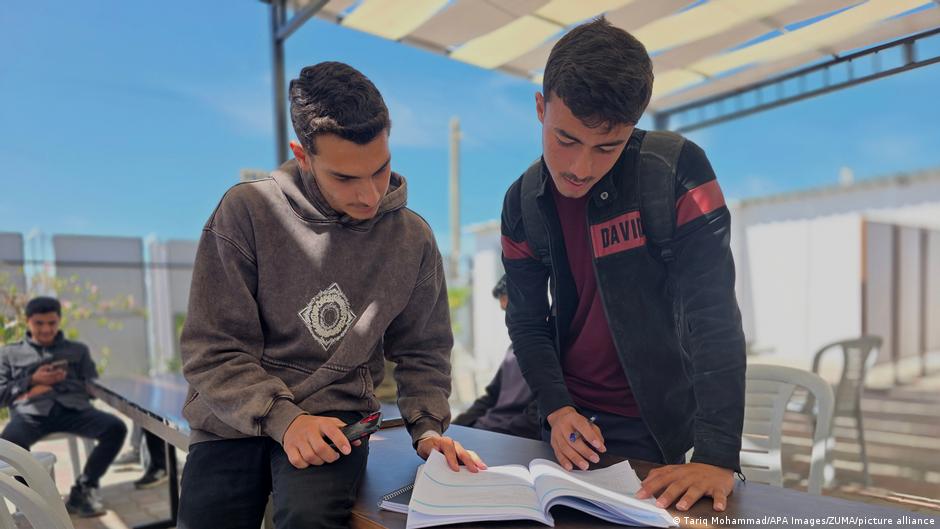
When 24-year-old Amira al-Khatib arrived in the Netherlands from Gaza last week to start her master’s degree at Radboud University, the joy of finally reaching safety and the sadness of leaving home came together.
“I am very grateful to everyone who supported me and yet, leaving Gaza was one of the hardest moments I have ever had,” she told DW from her new home in the city of Nijmegen.
Al-Khatib earned a bachelor’s degree in computer systems engineering from Gaza’s Al-Azhar University in 2025. “For the last two years, I have studied in an environment where internet connectivity cannot be taken for granted,” he said.
The only place where he could get an internet signal was the rooftop of his house. She recalled, “I completed my graduation project with a drone flying overhead, holding my hand over my heart every few minutes, hoping I would live long enough to complete it.”
He said, “Engineers who have experienced combat probably understand better than anyone else what our communities really need.” “So I decided to continue my education in Data Science and Artificial Intelligence. My dream is to help create technological systems that remain reliable even during humanitarian crises and emergencies.”
Mohammad Harjallah, a 20-year-old engineering student, also left Gaza last Monday to enroll at The Hague University of Applied Sciences. “Before the war I never thought about leaving Gaza,” he told DW.
“When the bombs were falling I stopped thinking about studies or my career,” he said. He hoped to resume studies in Gaza after the war. “But the situation got worse, so I applied abroad, even though I didn’t want to leave my family.”
Students face many ‘bureaucratic hurdles’
Both students received scholarships through the Gazan Student Support Network (GSSN), an Amman-based NGO established in January 2024 to help Gazan students continue their higher education.
“There are a lot of bureaucratic hurdles and every country has its own challenges,” said Mabrouka Henedi, executive director of the GSSN. For example, getting approval for students in the Netherlands took more than eight months and involved court cases brought by the universities.
As for the other 62 Palestinian students on Malaysian scholarships, their departure date remains uncertain. “They have received transit approval from Jordan but they cannot leave Gaza because Malaysia does not have diplomatic relations with Israel,” Hennedi said.
He explained that all students must pass through the Kerem Shalom crossing on Gaza’s border with Israel. However, so far, COGAT, the Israeli military body responsible for coordinating civilian affairs in Gaza, has not responded to requests to approve the students’ departure.
Asked by DW, COGAT spokespeople said in a written statement that “the departure of residents from the Gaza Strip is subject to the submission of a request by a third country willing to receive the person, as well as the completion of the necessary security checks by the competent Israeli authorities. The majority of requests submitted are approved.”
In its statement, COGAT said that since the beginning of the war approximately 50,000 Gaza Strip residents have moved to third countries for a variety of reasons, including medical treatment, foreign citizenship, residence visas and academic studies.
COGAT did not provide any details regarding permits for scholarship students from Malaysia.
UN warns of ‘systemic destruction’ of Gaza schools
During the war, which was triggered by Hamas attacks on Israel on October 7, 2023, most of Gaza’s 88,000 university students enrolled in the 2022–23 academic year advanced their education. As well as widespread death, repeated displacement and a prolonged humanitarian crisis, many people also lost their educational and personal records as Gaza’s higher education system was destroyed.
In April 2024, UN experts warned of the “systemic destruction” of Gaza’s education system. “With over 80% of schools in Gaza damaged or destroyed, it may be fair to ask whether there has been any deliberate attempt to comprehensively destroy the Palestinian education system, known as ‘scholasticside‘,” Experts said.
Last June, the U.N. update This figure is in its latest report. “By November 2025, 95% of campuses have been affected: 22 of 38 campuses have been completely destroyed, and an additional 14 campuses have suffered varying levels of damage.”
In an October 2025 report, UNESCO estimated that approximately 745,000 schoolchildren and students in Gaza were out of school by October 2023. “The prospects for resuming education remain highly uncertain due to extensive damage to Gaza’s educational infrastructure,” it said.
Meanwhile, online courses and limited in-person classes have resumed at Gaza’s largest universities, including al-Azhar University and the Islamic University of Gaza.
No official enrollment figures exist, but Dean says the numbers appear to be higher than in 2022-23.
Despite the war, many students never stopped learning
The war in Gaza also greatly disrupted Ahmed Zohair Abu Dakka’s education. “The war took everything, but I kept my laptop with me – my only means of learning,” the 20-year-old told DW.
During two years of war, and despite numerous displacements, his daily routine was to leave the family tent in the morning and look for internet and electricity. “Sometimes I’d find a signal in the corner of a destroyed building, or in a hospital kitchen, or next to a broken streetlight pole,” he said, adding that none of these places were safe, and it was dangerous to go between them. “But connecting with the world was the only way I could continue my education.”
He not only earned top grades in high school during the war, but also “completed more than 15 professional online courses after downloading them wherever I could.” His family supported and encouraged him all the time. “He always said this was the only way forward,” he said.
Despite his efforts, Abu Dakka feels trapped. He said, “I contacted more than 200 academics and sent more than 1,000 messages to universities and organizations around the world. So far, no door has been opened.”
He still hopes to get a scholarship abroad to study engineering and practice creative design, participate in competitions and build his future.
He said, “My story is personal, but it reflects the reality of an entire generation of students in Gaza who refuse to surrender.”
Edited by Ben Knight