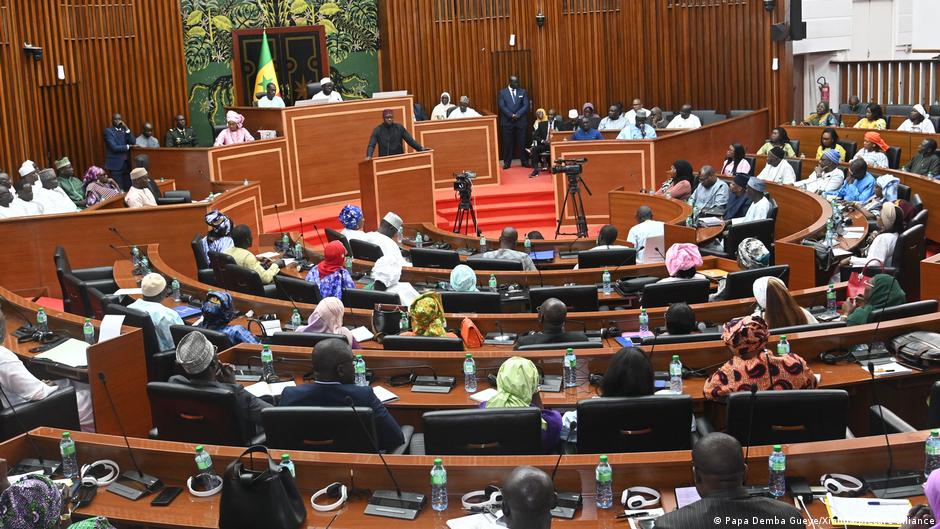
Senegal’s constitutional reform continues to divide the country’s political landscape: Outside the parliament building in Dakar, angry protesters marched against the country’s proposed new constitution last week.
However the situation deteriorated when security forces used tear gas to disperse the crowd.
Meanwhile, inside the building MPs held a heated debate, with opposition politicians boycotting the vote on the reform; Some were also seen creating ruckus on the stage. Security forces had to forcibly remove one MLA from the House.
Despite all this, amid great confusion over who supports whom in the escalating power struggle in Senegal’s top political positions, the controversial constitutional reform was ultimately passed in parliament with a majority from the ruling PASTEF (African Patriots of Senegal for Work, Ethics and Brotherhood) party.
However, there is no victory for anyone worth celebrating yet: President bassirou diomaye Faye refused to sign the bill and announced that a referendum would be held instead.
He did not give a date when the public would vote on the proposed amendments.
Plans for the President’s presidential powers
Initiated by former Prime Minister and current parliamentary leader Ousmane Sonko, the legislative amendment apparently aims to reduce the powers of incumbent President Faye.
According to media reports, the new constitution aims to replace the Constitutional Council with a Constitutional Court, which will include more members and strengthen parliament’s oversight powers.
Under the changes, Parliament should be “automatically informed” of investment agreements related to natural resources in the country, with a view to improving oversight of public finances.
Another provision states that the sitting President of Senegal cannot simultaneously serve as president of a political party.
“Parliament is being used to weaken the president,” says Aminata Touré, chair of the presidential coalition. “The proposals appear to be aimed at limiting the influence of the President of the Republic by expanding the powers of the President of the National Assembly.”
Imbalance of power?
The growing power struggle between President Faye and his former ally Sonko has become evident in parliament and beyond.
Despite coming to power together in 2024 and taking over from the government of former President Macky Sall, former allies within the PASTEF party have now become bitter rivals.
Both promised their voters a long list of sweeping reforms aimed at tackling corruption in the country while boosting the economy and providing better prospects for young people.
But relations between the president and his now-former prime minister deteriorated, with Sonko openly criticizing Faye’s handling of Senegal’s debt problems.
As tensions escalated in May, disagreements over governance intensified: Faye removed Sonko as prime minister and dissolved the coalition government.
Although Sonko enjoys widespread support in parliament; Since PASTEF holds the majority of seats in the National Assembly, Sonko was swiftly elected party chairman and Speaker of the National Assembly by members of parliament.
Thus, he was able to regain a position of power and continue to influence the country’s politics for some time.
According to analyst Malao Kante, this could trigger a direct confrontation between the two former allies: “We could actually see Ousmane Sonko as the new face of the opposition, although this opposition now has a parliamentary majority,” Kante told DW, highlighting the changing power dynamics in the country.
“There is a danger of a no-confidence vote against the next Prime Minister. It is clear that this will put the country in somewhat of a complicated situation and will hinder the proper functioning of the state,” he said.
Feedback on referendum welcome
Faye’s decision to hold the referendum was welcomed by protesters, most of whom belonged to former President Macky Sall’s party “Alliance for the Republic” (APR).
Pape Abdou Ndiaye was one of the protesters outside the parliament building in the capital Dakar. “If we want to change something, we have to discuss it and be a referendum hero,” the 23-year-old told the Frenchman. Agence France Presse (AFP) News agency.
He believes that any reform should be “based on consensus”, which reflects the sentiment of many Senegalese.
Moussa Niang joined the demonstration and said that people were “marching in the streets of Dakar to defend our constitution.”
He said, “What they want to establish today under the guise of a constitutional amendment is a dual leadership system; a powerful National Assembly that can also rightly or wrongly limit the powers of the President of the Republic to impose his will on other institutions.” AFP.
Mor Fall, 27, also insists that the final decision should be that of the public. “There is a very clear desire to monopolize power and create a situation that favors the Prime Minister or the National Assembly,” he said.
But there is also support for constitutional reform among the ruling party. For PASTEF member Foday Mane, the proposed reforms are a direct result of an election pledge: “When we run in the presidential elections, we commit to adapting the constitution to current needs,” he told DW.
He believes that that is why this amendment is necessary. “This includes aspects that will rebalance the power dynamics between the President and the Prime Minister. For example, the latter will have the opportunity to chair the Council of Ministers and formulate government policy in consultation with others.”
Sackou Seydi in Dakar contributed to this article.
Edited by: Serton Sanderon