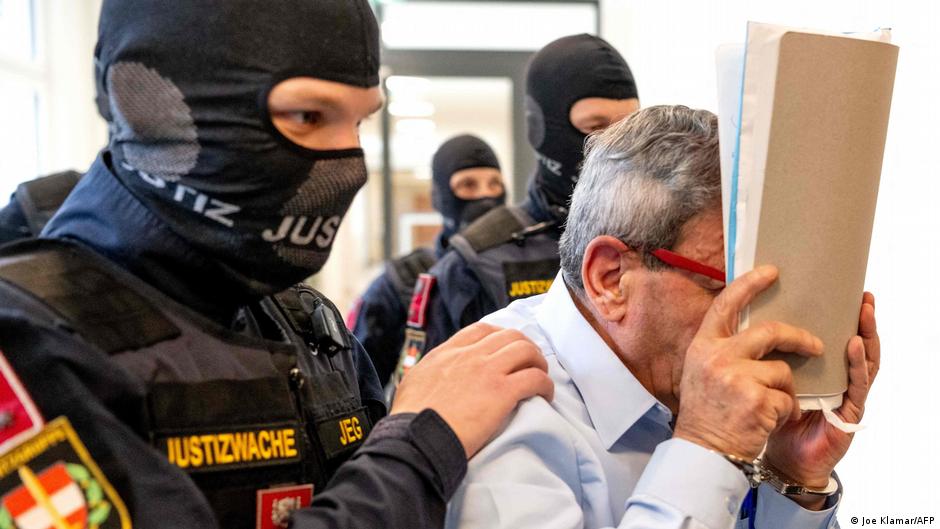
An Austrian court on Monday convicted two officials under former Syrian dictator Bashar Assad of torturing opponents of his rule.
For more than a decade the crimes were being prosecuted on the basis of universal jurisdiction, by which courts could investigate and prosecute certain serious crimes – such as genocide, war crimes and crimes against humanity – regardless of where they were committed or the nationality of the perpetrators or victims.
It is the latest of several cases in European countries against individuals accused of wrongdoing amid Syria’s long civil war, whose roots can be traced to the so-called Arab Spring uprisings that began in 2010.
Who was tried and what was their punishment?
The primary defendant, Khalid al-Halabi, was a general who led the General Intelligence Directorate in Raqqa city from 2011 to 2013.
Based on the testimony of more than a dozen victims, he was sentenced to eight years in prison. The court had previously found him guilty of torture, grievous bodily harm and sexual assault against 21 people between 2011 and 2013. Witnesses spoke of ill-treatment including kicks in the head, electric shocks on their genitals, and water-based torture.
The second person to stand trial in Vienna was Musab Abu Rukba, a criminal police investigator from the city who was convicted on the same charges except those related to torture. Prosecutors said he was nicknamed the “Angel of Death.”
The court said that both men sometimes ordered these crimes, sometimes failed to prevent them and in some cases committed them themselves.
Austrian prosecutors said the two men initially fled to Austria in 2015 under a secret deal between Israeli and Austrian intelligence services. They were living as refugees in Austria before the development of the case.
The decision can be appealed. Both defendants pleaded innocent.
The former intelligence boss questioned the witness’s testimony and said he was acting under orders, leading government prosecutors to say the comments were made by war criminals in the Nazi era and the so-called Nuremberg defense, which was rejected as a valid excuse for war crimes in those cases.
How did Raqqa get involved in the Syrian civil war?
Raqqa, an ethnically diverse city on the Euphrates east of Aleppo, has seen much conflict since the Syrian civil war began in 2011.
In 2013, rebels from several Islamist groups – including the al-Nusra Front led by Syria’s new president at the time, Ahmed al-Sharaa – overran government loyalists and took control of the city. It was the first provincial capital to fall under the control of opposition fighters.
Fighters began arriving from other war-torn cities such as Aleppo, Homs and Idlib, and in 2014 the so-called “Islamic State” group (IS) declared the Syrian city its headquarters.
Raqqa remained more or less under IS control until 2017, when Kurdish-led fighters backed by the US claimed control of the city, much of which had been destroyed after heavy bombardment from all sides over the past few years.
The political wing of the Kurdish Syrian Democratic Forces (SDF) retained control of Raqqa until January 2026, well ahead of the fall of Bashar Assad’s government in December 2024. But al-Sharaa’s government claimed about 80% of Kurdish-run territory in the north and east, including Raqqa, in an intensified offensive in mid-January.
Edited by: Zack Crellin
Don’t let algorithms hide news. If you trust our team for reliable reporting, please take a moment to select us as your preferred source on Google click here And press the “Star” or “Favorite” button so you always see our verified news first.