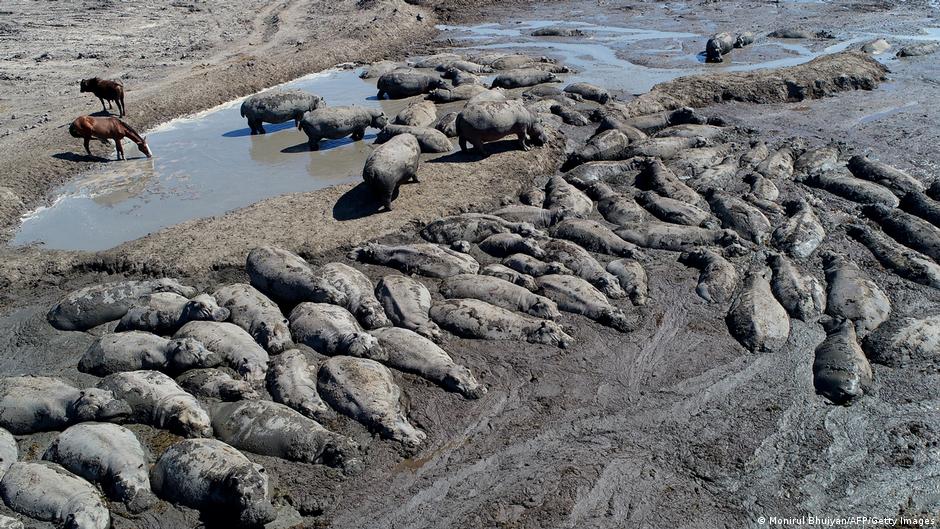
The UN Food and Agriculture Organization (FAO) and the World Food Program (WFP) have appealed for more than $200 million (€175 million) to help 8.8 million people in 22 high-risk countries protect against the imminent return of the devastating El Niño weather pattern.
Support will include cash transfers, climate-resilient seeds, livestock protection and flood-control measures, as extreme weather patterns already affect much of the world.
“El Nino conditions have developed in the tropical Pacific and are projected to rapidly strengthen over the coming months, increasing the likelihood of extreme weather events in many parts of the world,” the World Meteorological Organization (WMO) warned.
In Africa, the countries most at risk include Cameroon, Ethiopia, Kenya, Madagascar, Malawi, Mozambique, Nigeria, Somalia, South Sudan, Sudan, Uganda and Zimbabwe.
What does El Nino mean across Africa?
El Niño is a naturally occurring increase in sea surface temperatures in the central and eastern Pacific Ocean, typically occurring every two to seven years.
This may last for nine to 12 months. In some areas, El Niño can bring hotter and drier conditions; In others, it could lead to increased rainfall and flooding.
“For Africa, this is not one climate story. It’s actually going to have much more diverse impacts,” Kgougelo Makumbeni, a research officer at the Climate Risks and Human Security Project at the Institute for Security Studies in Pretoria, South Africa, told DW.
Southern Africa has experienced “hotter and drier conditions” during El Niño events in the past, Makumbeni said, increasing the risk of “drought, water scarcity and general food insecurity.”
However, the situation in East Africa is more complex, as El Niño can have different impacts depending on the season.
Global warming: from bad to worse
“El Niño reshapes rainfall and temperature patterns around the world, although its impact can vary depending on the region and what season it occurs,” Bhargabi Bhardwaj, a research associate at Chatham House’s Center for Environment and Society, told DW.
“Some areas will face drier conditions, increasing the risk of drought and wildfire events, while other parts of the world will experience severe weather conditions and the possibility of storms and floods,” Bhardwaj said.
Scientists like Bhardwaj say climate change does not directly cause El Nino, but it can make its effects more severe.
“We are dealing with a warmer baseline temperature of about 1.4 degrees (Celsius, or 2.5 F) compared to pre-industrial levels. This means that, when an El Niño event occurs, there are more extreme consequences,” Bhardwaj said.
Some experts are also concerned about the possibility of a very strong — or “super” — El Niño this year, he said, “when your average temperature difference will be about 2 degrees higher, or is projected to be at least 2 degrees higher.”
act before disaster strikes
The real challenge is whether governments and aid agencies can act fast enough, because “science is ahead of policy,” Bhardwaj said.
In northern Kenya, Abdikadir Aden Hassan, founder of Garissa Million Trees, told DW that the danger is not just the possibility of heavy rains and subsequent floods, but also the fact that they could come after months of drought.
“We are in drought conditions and heading towards drought in August and September,” Hasan said. “Then, in October, November and December, we expect less rainfall. People will be coming out of drought and then directly hit by floods. This means their livelihoods will be affected for the second time.”
With lives and livelihoods at stake, experts say Africa’s climate preparedness cannot be left to individual governments or ministries.
“It must be embedded within agriculture, within health, within water, within energy, education and social security,” Makumbeni said.
climate related displacement
Conflict, high energy costs, debt pressures, fertilizer disruptions and cuts in international aid are already weakening the ability of many countries to respond to external shocks. Bhardwaj said this makes the forecast for 2026 particularly worrying.
“The concern is not just about El Nino,” Bhardwaj said. “This is happening at a time when the global system is already very fragile. Many vulnerable populations are living in areas that are burdened by import costs as well as high debt.”
Amy-Noelle Mbiozo, a senior researcher at the Institute for Security Studies, said climate-related events are already forcing people to leave their homes.
“Cyclones and floods have been the biggest drivers of mass displacement in Africa,” Mbiozo said. “There is also drought, but drought does it a little more slowly.”
“People don’t want to leave their homes,” Mbiozo said. “Most people want to stay where they are.”
Cities on the front lines of the climate crisis
Drought and desertification are increasingly driving people to Africa’s towns and cities, which are increasingly facing climate-linked migration – even as many grapple with broader issues such as a lack of housing and public services and widespread informal employment.
“The bulk of the movement that’s happening, whether it’s sudden or slow or just general population growth, is in the cities,” Mbiozo said.
According to the World Bank, climate change alone could drive an additional 86 million internally displaced people into African cities by 2050.
Concern for Lake Chad and Southern Africa
In the fragile Lake Chad basin, research on displacement patterns from 2008 to 2024 found that disasters displace more people than conflict and violence, Mbiozo said. “We are also finding that violence is being linked to disasters,” he said.
Mbiozo said the region has become a “perfect storm” in which border vulnerabilities, violent extremism, pastoralism and climate shocks all collide.
Meanwhile, Southern Africa is another major area of concern. The region has suffered repeated cycles of drought and cyclones, with countries such as Mozambique, Malawi, Zimbabwe and Madagascar repeatedly affected in recent years.
“At this point Madagascar is hit by cyclones almost every year,” Mbiozo said, and Mozambique has repeatedly faced “never-before-seen-powerful cyclones” in recent years.
Are early warning mechanisms sufficient?
Some countries have made progress in better preparedness: Mozambique has invested in early warning systems and climate literacy in coastal communities. South Africa has passed the Climate Change Act, which experts see as a positive legislative step.
Hassan said Kenya has improved coordination between government agencies and humanitarian organizations, including emergency operations centers and efforts to move people to higher ground in flood-prone areas.
“As a country, we are in a better position this time and are much more organized,” he said. “But the challenge is that, if we don’t get external support, the available national emergency funds may not be enough.”
Hassan said early warning systems must be matched to available funding before disasters escalate: “Money can be allocated,” he said, “but delays in releasing it can make a disaster worse.”
Cai Nebe contributed to this article.
Edited by: Serton Sanderson