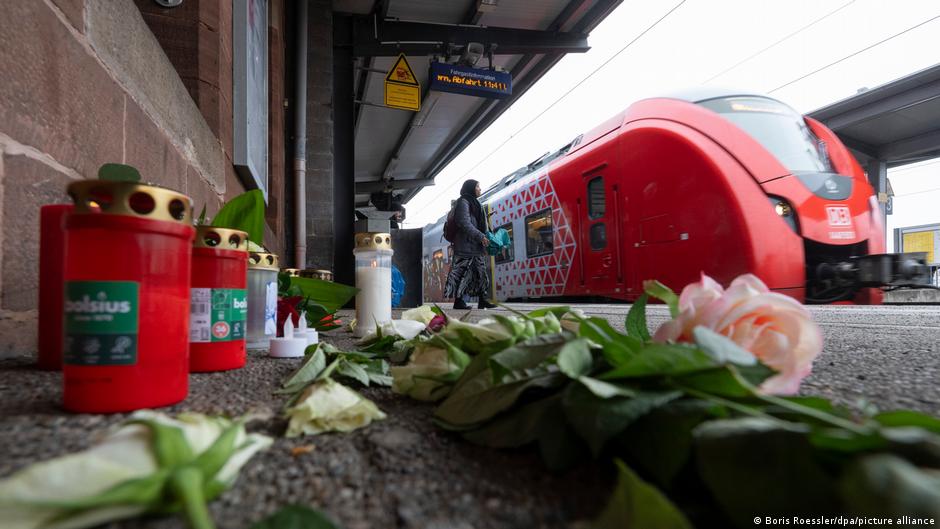
Five months after a fatal attack on a train conductor, the Zweibrücken Regional Court found the defendant guilty of assault resulting in death and sentenced him to 10 years in prison.
In February a routine ticket inspection on a regional train in Rhineland-Palatinate proved fatal for 36-year-old train conductor Serkan Callar.
The 24-year-old defendant was traveling without a ticket and refused to show his ID. When Kailar asked him to leave the train and lightly touched him in the process, defendant struck Kailar’s head with his fists with such force that the conductor died of a cerebral hemorrhage in the hospital two days later.
During the test, footage from the train’s surveillance camera was shown.
The victim’s family considers the guilty verdict too lenient and intends to have it reviewed by the Federal Court. His lawyer Yalcin Tekinoglu said the family was not concerned about an entirely harsh sentence. Rather, he said, the decision should send a clear message against increasing violence towards public transport workers.
significant increase in aggression
A member of the Federal Police testified at the trial that the defendant had already been removed from a high-speed train in Kaiserslautern from Paris to Frankfurt am Main on the same day. The reason given was “verbally aggressive behaviour”. “It was just another random incident for us,” the officer said. The Federal Police is responsible, among other things, for railway security.
New figures from the Interior Ministry also suggest it was another “irregular incident”. According to statistics, threats and attacks against railway workers and federal police officers are common in Germany. In the first five months of the year alone, 1,630 railway employees and 4,672 federal police officers became victims of criminal crimes. Last year, an average of five physical attacks on railway employees were recorded every day. This year this number has increased to eight.
a reflection of high levels of stress
Where does this aggression come from, especially in trains?
Leon Walter, a violence researcher at the University of Bielefeld, told DW: “These trends are in line with what people in the healthcare system, the fire department and the police say: They all report an increase in hostility.” He says this is a phenomenon affecting society as a whole, linked to the high levels of stress experienced by many people in their daily lives. For some people violence is a “last resort”.
Added to this is the enclosed space of the train, which, according to Walter, can create a “perfect storm” during ticket inspection. People who have already been subjected to aggressive behavior and are caught without a valid ticket cannot run away – they cannot “escape the situation.” In rare cases, this may lead to violence.
Train conductors also often share passengers’ frustrations over increasing delays on Deutsche Bahn: “Railway workers are the most accessible targets.”
Employees offered more body cams
Walter says Deutsche Bahn is now facing increasing difficulties in finding train crew members due to the aggressive behavior of passengers. “Many are considering whether they should look for another job. Workplace violence is a major factor here. Many of these employees also feel that they lack the support they need to deal with such situations.”
Deutsche Bahn chief Evelyn Palla has already taken a step forward in response to the deadly incident. Staff interacting with customers can be equipped with a camera attached to their uniform – if they request it. Till now, this applied only to regional trains, but now it has been extended to long distance services as well. This applies to train attendants, employees of on-board restaurants and employees of so-called DB lounges in train stations.
Its purpose is to help staff better document assaults by passengers. According to Deutsche Bahn, body cameras “have a deterrent effect and serve to prevent and reduce acts of violence as well as preserve evidence.”
This measure is one of several included in the so-called Action plan for greater safety on railways. Others include the appointment of 200 additional security personnel and further development of an emergency button, which staff can use to alert the control center in already dangerous situations.
‘Never touch a passenger’
Meanwhile, Walter places special emphasis on training employees. He says the most important factor is how train attendants behave in conflict situations. It is especially important that “no passenger should ever be touched or restrained.”
Conductors should also have the option to refuse to check tickets if they feel the situation may get out of control. “Our research shows that many people believe they have to go through with it regardless of the consequences,” Walter said.
This is where employers and lawmakers must step in: “Railroad companies and the federal government must establish rules that make it clear that safety always takes priority.”
This article has been translated from German.