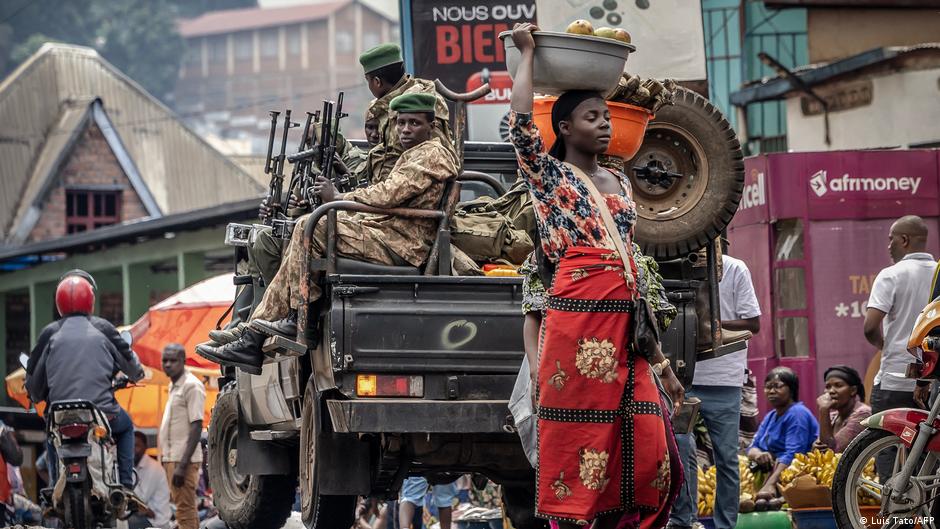
UN High Commissioner for Human Rights Volker Turk on Thursday called on all parties to cease hostilities in eastern Democratic Republic of Congo (DRC).
Fighting between DRC armed forces and the M23 armed group, backed by the Rwandan military, in the border region of South Kivu has intensified over the past two weeks.
It is part of a conflict that has at least subsided since the re-emergence of the M23 in 2021 and the capture of large swaths of territory in a border region ravaged by conflict for decades.
What does the UN human rights chief say about the fighting?
Turks condemned the impact on civilians of recent clashes in South Kivu, and called for concerted national and international efforts to de-escalate tensions.
Turki said, “It is deeply troubling that, despite agreements reached as part of ongoing peace processes, fighting continues unabated in eastern DRC – killing, injuring and displacing civilians and destroying livelihoods.”
Intense clashes broke out around Fiji’s Mulima village on July 4 and 5, while a framework peace deal agreed in Doha late last year and praised by US President Donald Trump has done relatively little to stop the fighting.
“I urge the Congolese armed forces and M23 to immediately desist from further violence and take immediate action to de-escalate tensions,” Turki said.
“I also call on both sides to take meaningful steps to protect civilians in Mulima and the wider Fiji and Mwenga Plateau region. The use of explosive weapons with mass effect in populated areas has devastating consequences and must be stopped.”
Turk’s office also said in its statement that he “urged Rwanda to end its support for the M23 and withdraw its troops from the DRC,” as well as urging the DRC to “step up its efforts to demobilize, disarm and repatriate members of the Democratic Forces for the Liberation of Rwanda (FDLR),” though without directly quoting the Austrian official.
The United Nations suspects both sides of the recent fighting in South Kivu of being guilty of war crimes.
What is happening in South Kivu and the DRC more broadly?
South Kivu is a border region of the DRC on the border with Rwanda, rich in gold, tin ore and coltan reserves, between two countries with a highly tense recent shared history.
Following the Rwandan civil war and especially the genocide in the early 1990s, millions of ethnic Hutu – some of whom were involved in mass killings of Tutsi – fled to what was then known as Zaire. This resulted in an offensive by Rwanda and allies in 1996, and Kigali was also heavily involved in the First and Second Congo Wars between 1997 and 2003.
They reached an uneasy peace in 2003 but tensions remained high. Rwanda has accused the DRC of showing no desire to weaken or eliminate groups like the FDLR, while the DRC says the same about Rwanda and groups like M23, which is part of the broader Alliance Fleuve Congo.
The fighting coincides with widespread public protests in the DRC and growing dissatisfaction with the government of Félix Tshisekedi. He is planning a set of constitutional reforms, which the opposition coalition called C64 says is a thinly veiled effort to reset presidential term limits and extend his time in power.
Finally, although it is well south of the epicenter of the outbreak in Ituri Province near the DRC’s eastern border with Uganda, South Kivu is also one of four provinces in the DRC that have been affected by the ongoing Ebola outbreak. Health officials have warned that armed conflict in the country’s east could hamper prevention and response efforts.
Edited by: Zack Crellin
Don’t let algorithms hide news. If you trust our team for reliable reporting, please take a moment to select us as your preferred source on Google click here And press the “Star” or “Favorite” button so you always see our verified news first.