Michelle Dugan-Delgado has had asthma for as long as she can remember. That’s why she always carries an inhaler and a face mask with her when she leaves the house – in case the wind picks up and a dust storm hits.
“I know it’s not safe for me to go out,” she told DW. “It’s like I live in a bubble. I really have to protect myself.”
If the dust enters his lungs, it may cause an asthma attack. Invisible bacteria, fungal spores, and viruses carried by dust can also cause life-threatening infections.
“If I’m outside and there’s a dust storm, there’s a high chance I’ll catch something, which means I’ll end up in hospital,” the 35-year-old said.
Dugan-Delgado knows the dangers well. He has been admitted to hospital several times. Asthma has also taken a devastating toll on his family. In 2009, his younger sister Mary died of an asthma attack at the age of 16.
“There was nothing we thought about that would take his life,” he said. “It’s painful to talk about because I have a lot of survivor’s guilt.”
Dugan-Delgado lives in the Coachella Valley, an agricultural center in the far south of California that is surrounded by desert. He believes that the poor air quality there is responsible for making him and Mary ill.
Dusty air near an evaporating lake
Dust storms are common in the region, which is home to about 500,000 people.
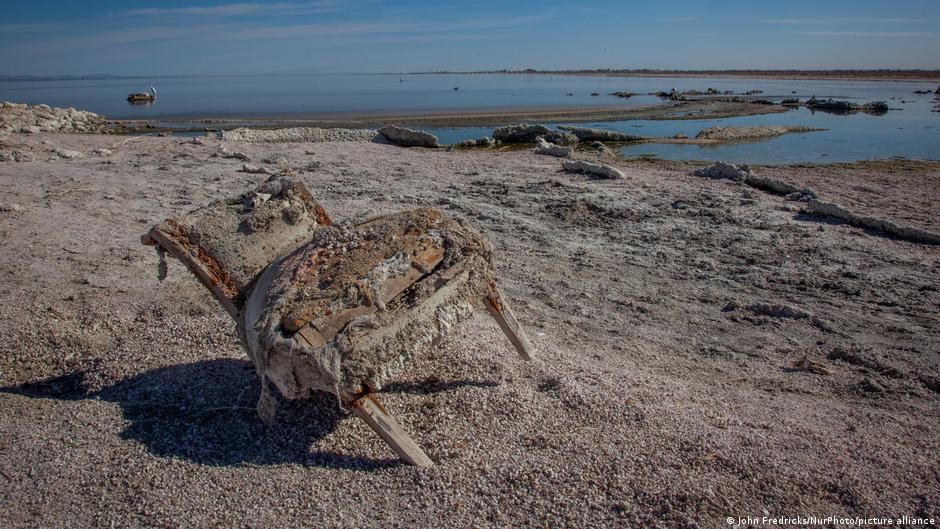
A major source of that dust is a huge lake that is constantly drying up. Covering approximately 343 square miles (888 square kilometers), the Salton Sea is California’s largest lake. But it is shrinking rapidly. When winds blow over the open lake bed, they pick up dry sediment, creating harmful dust storms.
Rates of asthma have been found to be very high among children living near the lake. A study of more than 700 primary school-aged children over several years found that 24% reported suffering from the condition – far higher than the national rate of about 7% for boys and 5.5% for girls. More than 70% had allergies – more than three times the national average.
“Most families I know will have at least one child suffering from respiratory diseases,” Dugan-Delgado said. “It’s really heartbreaking.”
His own 13-year-old daughter has asthma and his 11-year-old son has allergies.
From heaven to environmental crisis
The Salton Sea was accidentally formed in 1905 when the Colorado River broke an irrigation canal gate and flooded the area. Since then, the water body has been continuously maintained by agricultural runoff/irrigation waste water and local rivers.
It became a popular holiday destination in the 1950s, with modern lakeside resorts attracting tourists and celebrities. But then water levels began to fall, partly due to a warming climate and water diversion policies. Over the past 30 years, the lake has shrunk by about 20%, or 70 square miles.
However, there is more to the exposed lake bed than just dust. Pesticides and other toxic chemicals from farms are also left to be picked up by the wind, worsening the air quality in the area.
Climate change caused by the continued burning of fossil fuels is causing rising temperatures and longer droughts, making desert areas around the world even drier. This makes it much more difficult for plants to grow and puts a strain on water resources, according to Amato Ivan, a climate science professor at the Scripps Institution of Oceanography at the University of California, San Diego.
“Dust storms are definitely becoming more frequent over time,” he said.
Globally, at least a quarter of the dust in the air comes from human activities, including off-roading, deforestation, and unsustainable agricultural practices such as plowing and overgrazing.
Lakes that are drying up are also major producers of dust – from California’s Salton Sea to Iran’s Lake Urmia. For example, the shrinking Aral Sea has made Central Asia 7% dustier over the past 30 years.
Harmful to the economy and human health
More than half of the world’s dust emissions come from the Sahara Desert in North Africa. If the wind is strong enough, that dust can rise up to 5 miles into the sky and travel vast distances – across the Atlantic to the Americas, or across the Mediterranean Sea to Europe.
The World Meteorological Organization says sand and dust storms affect about 330 million people every year. They can engulf entire cities, fly at ground level, destroy crops and cause fatal traffic accidents.
And then it has adverse effects on human health.
“That’s the number one adverse effect: It’s humans breathing dust,” says Ivan.
Dust particles can penetrate deep into the lungs and are linked to serious respiratory illnesses and heart disease. It causes about 721,000 deaths worldwide each year, with children, the elderly and people with lung conditions most at risk.
live with dust
Dugan-Delgado says his lungs continue to deteriorate. Meanwhile, the Salton Sea is projected to continue shrinking.
State and local officials have launched a series of projects as part of a plan to restore 30,000 acres of the lake’s dusty shoreline by 2028. Thousands of hay bales have been laid on the banks to prevent dust. They have also planted native vegetation in an effort to stabilize the soil and added water to create artificial wetlands for wildlife.
Ivan says that initiatives such as planting native vegetation at some sites could work well to combat desertification. But he points out that it requires a lot of investment, water and time.
“All of these things are resources that don’t have an infinite supply,” he says. He and his team are currently developing an early warning system to alert communities when a dust storm is approaching.
“Just like you get a weather forecast, you should be able to get a dust forecast,” he says.
Dugan-Delgado says she would welcome a warning system for dust storms. She would like to see more efforts to raise awareness about the risks of living with dust pollution, so that others know how to protect themselves and their children.
“I think families need more education here in the Valley about respiratory diseases and how they can impact your health,” she said. “One death is too many and we have to find a way to stop it.”
Edited by: Tamsin Walker
This article was adapted from the DW Living Planet podcast. Click here to listen to the full episode.