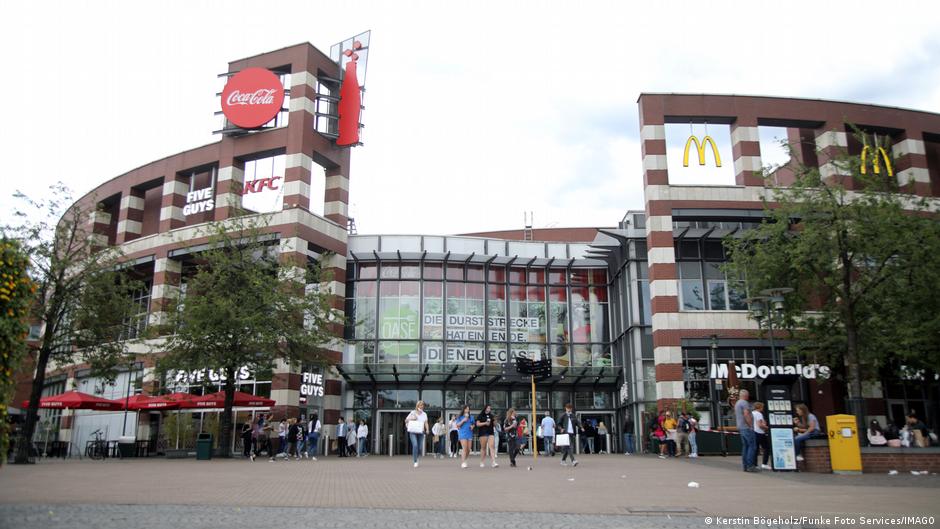
Centro Mall is the place for which the city of Oberhausen is famous nowadays. The shopping and entertainment centre, with its 250 stores and restaurants, is located next to a promenade marina and right next to Germany’s largest Sea Life Aquarium.
The complex was built in the mid-1990s on a site where 32,000 people previously worked in the steel industry, which was once the cornerstone of Europe’s manufacturing base.
“Thanks to Centro, we have again created almost the same number of jobs, but they are all in the service sector, where people do not earn as much,” said Apostolos Salastras, Oberhausen city treasurer.
Demise of the Ruhr region
The average income in the city is now the lowest in Germany: “The GDP we generate here is one of the lowest nationwide,” the treasurer admits.
The Ruhr Valley in the western state of North Rhine-Westphalia was shaped by the coal-powered industrial revolution of the 19th century, which became vital to Germany’s arms production in the two world wars. After the wars, factories were destroyed and then rebuilt to fuel what was called Germany’s economic miracle of the 1950s. A serious crisis began in the 1970s, when crude steel production declined due to inflation and overcapacity, leading to plant closures in the region and increasing structural unemployment.
There are some remains of the steel industry in Oberhausen, including a company that made turbines for ships and power plants. But all this is on a smaller scale than before, Tsalastras tells DW.
Structural economic problems have been taking a long toll since the collapse of the coal and steel industries. “We have no reserves, no capital investments that we can liquidate, no assets that we can sell, etc.,” Tsalastras said. “We have been saving for 40 years; we have already sold everything: we have nothing left.”
Oberhausen ranks among the cities with the highest debt in Germany. “We are in a really serious situation,” Mayor Thorsten Berg of the center-left Social Democrats (SPD) told DW.
“The biggest burden we face is paying for youth welfare and long-term care,” Berg said. “Municipalities are expected to pay, but we don’t get paid to do so. That’s a flaw in the logic.”
weak economy, low revenue
In Germany, decisions taken at federal and state level oblige municipalities to, for example, pay housing costs for welfare recipients or provide social assistance for people with disabilities. In Oberhausen, 50% of expenditures are earmarked for social services.
The cost of long-term care is rising as older people are unable to pay for nursing home care and cities are having to step in.
Expenditures for youth welfare have also increased rapidly as children and adolescents are increasingly being removed from their families because either they or a parent are struggling – often with mental health issues. Oberhausen’s treasurer says the COVID-19 pandemic has left its mark, but the impact of social media is particularly worrying.
Municipalities are feeling helpless
The largest sources of revenue for municipalities are business taxes and property taxes on land and real estate. 15 percent of income tax is added to this. However, the economic crisis, which has gripped Germany for the past seven years, has hit tax revenues.
Tsalastrass has been in charge of Oberhausen’s finances since 2010. “Our annual budget is currently €1.2 billion, and our revenues are about €100 million short,” the economist reports from his office in City Hall. By the end of 2025, Oberhausen had accumulated €2 billion in debt. A cash injection from the state government of North Rhine-Westphalia reduced this to €800 million.
Cultural programs have long been subject to budget cuts. Oberhausen’s famous theater has to make do with less money every year. Due to necessity, urgently needed renovations to the building are being carried out until the theater remains open. During this time the audience is required to sit on the stage.
Parking fees have been increased by 50%, and more traffic checks are being conducted to collect fines.
The city administration is expected to make further cuts, with 5% of jobs likely to be lost. As a result, citizens will have to wait for a long time in government offices.
“Local citizens find it absolutely terrible, but they know we have no other choice,” Tsallastras said.
Cuts in culture and services
How long can Oberhausen continue without more significant cuts to services? This is the question a growing number of mayors in Germany are asking themselves as expenditures now exceed revenues in almost all municipalities.
About 10,700 municipalities in Germany are in debt. By 2025, local governments in Germany will have collectively taken on nearly €30 billion ($34 billion) of new debt – a historic record. The current mountain of debt now exceeds €200 billion. According to local government financial projections until 2028, equally high levels of new debt are expected each year.
AfD will benefit
“If we don’t make sure that people at the grassroots level see that our state and our democratic system is actually working, we can forget about all other efforts to protect our democracy,” Berg said, referring to the rise of the far-right Alternative for Germany party (AfD).
It’s a warning that has certainly been heard in state capitals and in Berlin too. “Municipalities are in a very precarious financial situation,” Chancellor Friedrich Merz of the center-right Christian Democratic Union (CDU) said in late June. He agreed with the state prime ministers to reorganize the distribution of public responsibilities. “We have agreed that, as of September 1, we will no longer pass laws that do not provide municipalities – and, where applicable, states – with fair remuneration,” Merz said. “It follows the principle: whoever assigns the work gets paid for it.”
This only applies to future laws: services that must already be provided will remain in place.
Berg welcomes that decision. “But that only helps us a little bit, because it doesn’t change the basic situation. If you want to change it, the federal government really has to put money on the table,” he adds.
One demand is to increase the share of municipalities in total national tax revenue. Additionally, municipalities are demanding full debt relief. “I would say it’s a bit like collective bargaining,” Berg said. “Those conversations are often difficult, too. So we keep highlighting the plight of municipalities, and slowly things start to move.”
This article was originally written in German.