EU forces are heavily dependent on American weapons. This was evident again at the NATO summit in the Turkish capital Ankara in July, which also included a high-level defense industry forum, at which US companies were able to secure lucrative contracts.
It was also decided that European governments would play a larger role in the production and maintenance of the missiles which are so vital to the defense of the continent. Lockheed Martin and Rheinmetall signed a memorandum of understanding to jointly produce ATACMS missiles in Germany. This is a step toward increasing reserves without upsetting the United States, but in the long term Europe is aiming for greater independence.
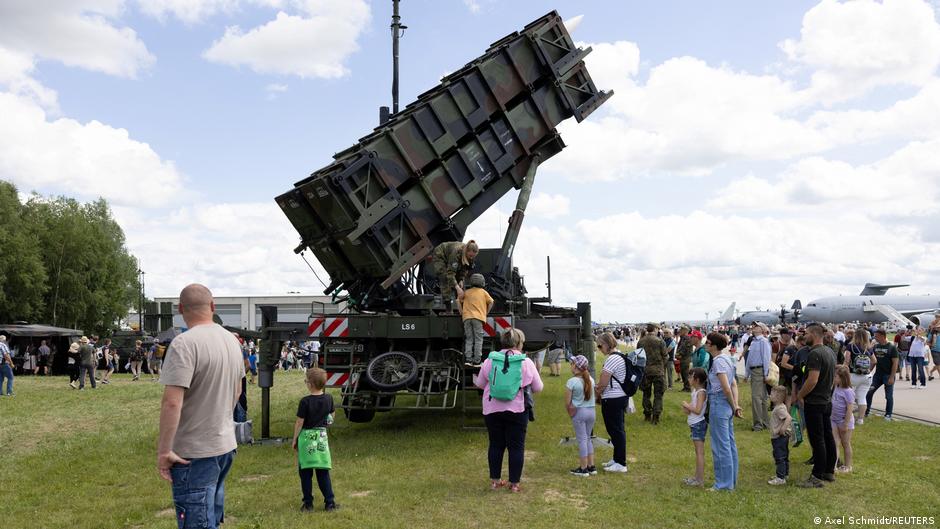
Patriot air and missile defense systems best symbolize the dependence of European NATO members on the United States. For decades, missiles have been used in NATO countries, and more recently they have been used to protect strategically important targets in Ukraine.
European governments have chosen to develop a number of systems to reduce reliance on patriots. France and Italy have created the SAMP/T NG system to prevent threats at high altitude. The new generation will be able to detect ballistic missiles thanks to additional sensors. The first units are due to be available from 2027.
IRIS-T, developed by the German company Diehl, is one of the systems created for medium-range defense. It is already in use in Ukraine, operating at a maximum range of 40 kilometers (about 25 miles) and an altitude of 20 kilometers. The IRIS-T SLX, which is expected to be available from 2029, will have a range of 80 kilometers at an altitude of 30 kilometers.
Although European governments cannot yet replace American patriots, in the long term they hope to be able to use EU systems to defend the bloc’s airspace, for example from Russia.
Germany will buy more Tomahawks from America
European governments are not only considering defence. When European armies plan precision strikes deep behind enemy lines, they also currently rely on American systems such as Tomahawk cruise missiles.
As it became clear at the NATO summit, Germany is counting on this solution in the short term. The German government has signed a memorandum of understanding with Washington regarding the purchase of Tomahawk cruise missiles and ground-based Typhoon launch systems. German Chancellor Friedrich Merz said it would “close an important strategic gap in our security.” But once again, this highlights the fact that as long as European systems remain in development, Europe will remain dependent on the US.
The European Long-Range Strike Approach (ELSA) is an international project involving six governments, including France, Germany and Britain, to develop a conventional ground-launched missile system. In addition to the Euro Multi Missile Launcher, several highly complex cruise missiles as well as more affordable long-range drones with a range of 500 to 2,000 kilometers are being developed.
Although efforts are underway toward an interim solution, true independence on the battlefield is not expected to be achieved until 2030.
Optimism for Decoder
When it comes to the “kill chain,” a military concept that identifies the structure of an attack that involves identifying a target, sending troops to it, launching an attack, and destroying the target, the EU is also dependent on the US. Without a combined self-sufficient network of sensors, satellite reconnaissance and command structures, European missiles will not be able to identify targets on their own.
Drones are being used on an unprecedented scale in the Russia-Ukraine war. They are shaping the situation at the front and also behind enemy lines.
The Drone and Counter Drone European Resolution (DECODER) aims to equip EU militaries with drone and counterdrone systems to help make them less dependent on the US.
At present, most of the development in this area is taking place at the national level. German defense companies and startups making drones have benefited from the Ukraine war as well as new contracts with the Bundeswehr. The DECODER project can help to align national developments on a European scale. All 26 EU member states are currently involved, along with Norway and Ukraine, whose experience is considered valuable.
The European Commission has estimated that DECODER, which is not yet a fully developed program but a framework, will require an investment of €3.5 billion to €5 billion ($4–5.7 billion) by 2033.
IRIS²: Europe’s answer to Starlink
Starlink, an American telecom subsidiary that provides broadband internet service around the world, has been vital in Ukraine’s warzones. The bloc is currently developing IRIS² to have its own multi-orbit satellite service. It will consist of 290 satellites that will be used for defense purposes as well as to enable secure communications between government agencies. At a cost of over Rs 10 billion, it is planned to be operational by 2030.
NATO operates a fleet of Airborne Warning and Control System (AWACS) aircraft for aerial surveillance, command and control, battlefield management and communications. Some of these aircraft, which were derived from US Boeing 707s, operate from the NATO air base at Geilenkirchen, West Germany.
In Ankara, NATO announced it has entered into formal talks with Swedish company Saab to replace the Boeing-derived system with the GlobalEye early-warning aircraft, which could be ready by 2030.
FCAS project failed
In recent years, many European countries have purchased the fifth-generation F-35, which is currently the most advanced fighter jet in the West. They are state-of-the-art but are another sign of European dependence on America.
The Future Combat Air System (FCAS), a sixth-generation fighter jet incorporating swarming drones and a “combat cloud”, was supposed to be the EU’s response, but the project collapsed due to a number of disputes over management, division of labour, key technologies and national interests, particularly between France and Germany.
This is a major blow to the EU’s autonomy at a time when the bloc is trying to become less dependent on the US.
This story was originally published in German.