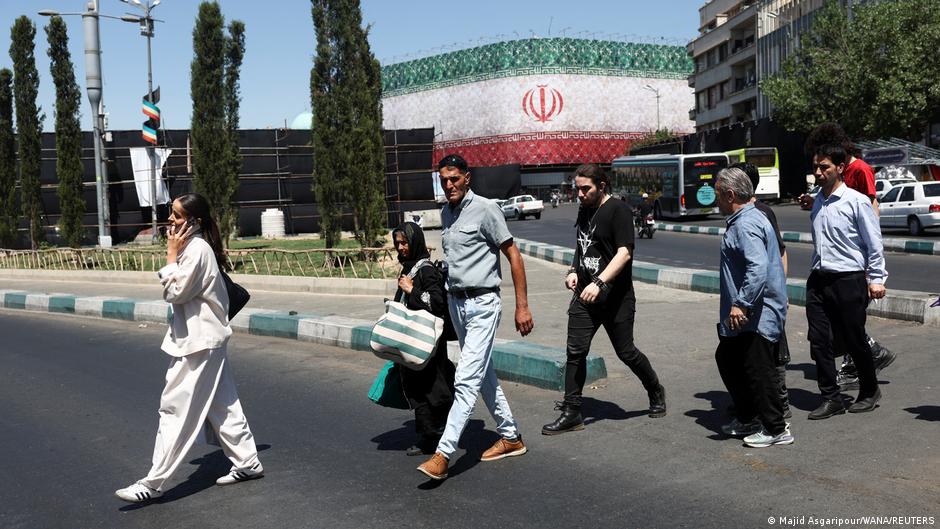
Since the announcement of the armistice between Iran, the United States, and Israel, Iranians have been repeatedly told that the war is over.
But at the same time attacks, threats and diplomatic talks are also continuing. Iranian officials talk about talks, progress and even sanctions relief one day, but warn of retaliation, further attacks and threats to Iran’s critical infrastructure the next.
This constant oscillation between war and diplomacy has left many in Iran torn between hope and fear.
For many people, that uncertainty has become psychologically more damaging than the war itself. The problem is no longer just the fear of violence, but also the inability to imagine a stable future.
society incapable of planning
A Tehran-based lawyer told DW on condition of anonymity that the hardest part of the current times is not knowing when the crisis will end. He said, “The most important characteristic of this moment is that the end of the war is unknown.” “When you can’t plan how to endure a hardship, it puts a tremendous amount of pressure on you.”
He said he no longer has the motivation to work or start anything new. Even speaking in society seems difficult. She said she now feels a sense of isolation from some of the people around her in the city where she grew up.
The feeling of paralysis appears to go far beyond personal despair and affect basic decisions about work, family, and the future.
Economic instability, coupled with the constant fear that violence could return at any moment, has resulted in a widespread climate of fatigue and social stagnation.
“We are completely disappointed,” a resident of the city of Isfahan told DW. “This instability between peace and war has turned our mental state into a game, and we have no clear vision for our future, or our psychological and financial security.”
The same person said that the whole experience had been extremely poor, with confidence on both sides of the war, or the possibility of a durable agreement, largely collapsed.
Generation without template for war
The current uncertainty may weigh especially heavily on young Iranians, many of whom have no direct memories of the 1980–88 Iran–Iraq War or life under prolonged military threat. For them, this is their first experience of living under the shadow of open regional conflict.
A nurse in western Iran told DW that when a society enters such a situation, it begins to rely on future vulnerabilities and people start postponing long-term decisions. “People start living as if their only goal is to achieve everything today,” he said on condition of anonymity.
He further said, for a generation without direct experience of prolonged war, the situation is more disorienting, not necessarily because they are weak, but because they have no mental model for how to go through such a period.
What many people are experiencing now, he said, is less a fear of war in the narrow sense and more of an exhaustion generated by uncertainty.
The change is visible in hospitals and clinics, the nurse said, with patients becoming increasingly angry, dissatisfied and easily agitated. He said, even though the services are good, many people remain troubled. In his view, anger is inseparable from the broader social environment.
Anger, frustration and emotional burnout
Saeed Pavandi, a professor at the University of Lorraine in France, told DW that available data and regional research point to two overlapping trends in Iran today: widespread pessimism about the future, and intense anger over the government’s inability to cope with normal life and govern effectively.
Referring to a survey conducted by Iran’s Interior Ministry in May 2026, he said it found that about 60% of the population felt pessimistic about the future. He also cited recently published survey findings iranwireHe said anger was seen in 64% of the respondents, frustration in about 50%, depression in 48% and fear and anxiety in about 45%.
According to Paivandi, these figures represent a clear decline compared to the last survey available before the massive anti-government protests and harsh crackdown by authorities earlier this year.
He believes anger, depression and anxiety have all increased by about 10 to 12 percentage points. This shows that state actions following the US and Israeli attacks on Iran have left a serious mark on how people feel about life, politics, and the future.
Pavandi also said the data points to another startling trend: Nearly one-third of Iranians now express a desire to migrate, with the figure rising among younger and more educated groups.
External deals unlikely to solve internal crisis
Against this backdrop, experts argue that Iran’s current psychological crisis extends far beyond ceasefire, diplomacy and military escalation.
While external conflict matters, it is exacerbated by a society already worn down by high inflation, repression, mistrust and a long-running sense of blocked opportunity.
What makes the present moment particularly difficult is that neither side has provided the people with a clear and credible horizon.
Instead, they are faced with contradictory messages every day, making uncertainty a fact of daily life.
And the longer it remains in limbo, the harder it becomes to restore confidence – or sustain the energy of people needed to imagine any future.
Edited by: Srinivas Majumdaru