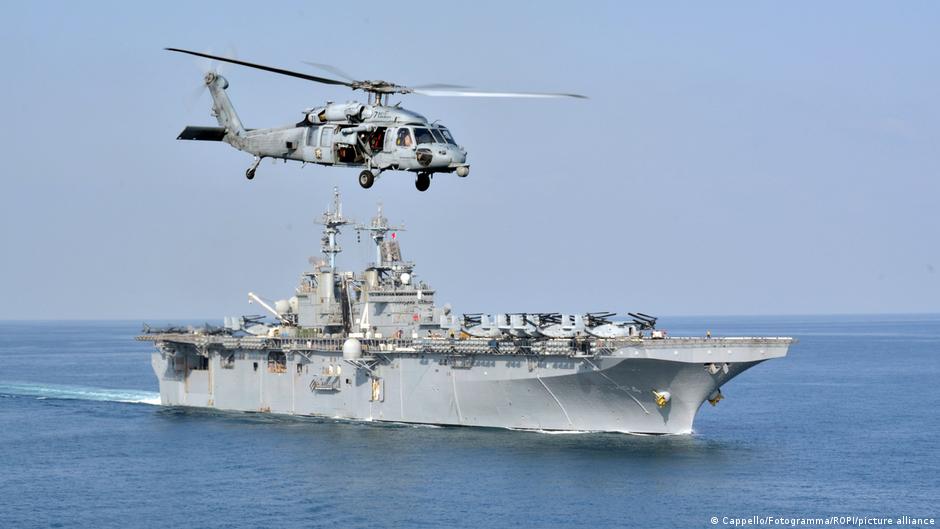
Once again, the Gulf region countries find themselves on the front line between the United States and Iran.
The war began in late February when the US and Israel attacked Iran. In June a memorandum of understanding was signed by the US and Iran aimed at stopping the fighting. However, both countries have since accused each other of not adhering to the agreement and fighting has resumed. The US has bombed Iran, and Iran has retaliated by attacking US allies in the Middle East – that is, mostly the Gulf countries.
Even if they are not directly attacked, all countries in the Gulf region have something to lose if fighting escalates again.
bahrain
Bahrain is home to a major US Navy base. Iran’s recent attacks had a direct impact on the country.
Since Bahrain is one of the smaller Gulf countries, US military installations are closer to residential and commercial areas than those of its neighbors. Even limited fighting disrupts civilian life.
Politically, Bahrain is in a particularly difficult position. Like other Gulf countries, Bahrain is a monarchy and represses most political dissent. But, unlike other Gulf countries, Bahrain’s royal family is Sunni. Estimates suggest that the majority of the population is Shia.
Iran is a Shia theocracy. The ongoing fighting between Iran and the United States could create tensions within Bahrain, where the government has arrested hundreds of people who allegedly posted anti-war messages online, expressed “sympathy” with Iran or participated in demonstrations, or whom the government claims were “spies” working for Iran.
Kuwait
Kuwait hosts the largest number of US bases in the Middle East. It involves two airports and approximately 13,500 employees, including contractors. This has made Kuwait a target of Iranian attacks.
Previously, Kuwait was more cautious about its foreign policy, often positioning itself as a mediator and insisting that it did not want to play any role in the current conflict. 1990 invasion of Iraq It was a factor in shaping Kuwait’s foreign policy, which is much less active than that of its neighbors. However, the fact that Iran attacked Kuwait because of its US bases makes this view likely to evolve. Observers have already noted that the Kuwaiti government’s opposition to the Iranian attacks has become more pronounced.
saudi arabia
Saudi Arabia is home to a major US Air Force base.
After years of competition with Iran for regional influence, Saudi Arabia has insisted that diplomacy must be the answer if Gulf states are to co-exist in relative peace.
And Saudi Arabia would like to focus on its economic goals for its Vision 2030 plan, rather than getting involved in a war it says it never wanted.
Experts say Saudi Arabia’s priority is to prevent the conflict from spreading and protect its vital oil infrastructure. Iran’s blockade of the Strait of Hormuz has forced Saudi Arabia to divert some of its vital oil exports – the country’s main revenue source – to another pipeline connecting to the Red Sea.
In general, Saudi authorities have tried to maintain a careful balance in the current conflict. He has spoken directly to Iranians and Americans. At one point, Saudi Arabia denied the United States the use of its airspace to bomb Iran, but later reports revealed that the Saudis also conducted unprovoked attacks of their own on Iran.
united arab emirates
The UAE also hosts an important US airport.
Still, renewed fighting in the Middle East threatens to further damage the reputation of places like Abu Dhabi and Dubai as financial and commercial centers, a reputation that is essential to the emirate’s economic future that is not dependent on oil exports.
The UAE is also able to divert some of its oil exports from the Strait of Hormuz via inland pipeline, but prolonged conflict could hinder this.
Queue
Qatar is home to Al Udeid Airport, the largest US military installation in the Middle East. At the same time, Qatar has comparatively good relations with Iran, with which it shares a large natural gas field. Iran’s previous attack on a Qatari ship at sea was one of the incidents that triggered the latest round of bombings.
Some analysts describe Qatar’s diplomats as the best in the world. They have regularly served as mediators during the US-Iran war, including crafting the memorandum of understanding that first stopped fighting in June.
oman
Oman, which does not host a major US military installation, has maintained good relations with both the United States and Iran and has served as a facilitator for backchannel diplomacy between the governments. Like Qatar, the options that Oman can offer for further negotiations between the parties to this conflict could be useful in the near future.
This article was originally published on July 8 and was updated on July 13 to reflect the new attacks on Iranian and US targets in the region.