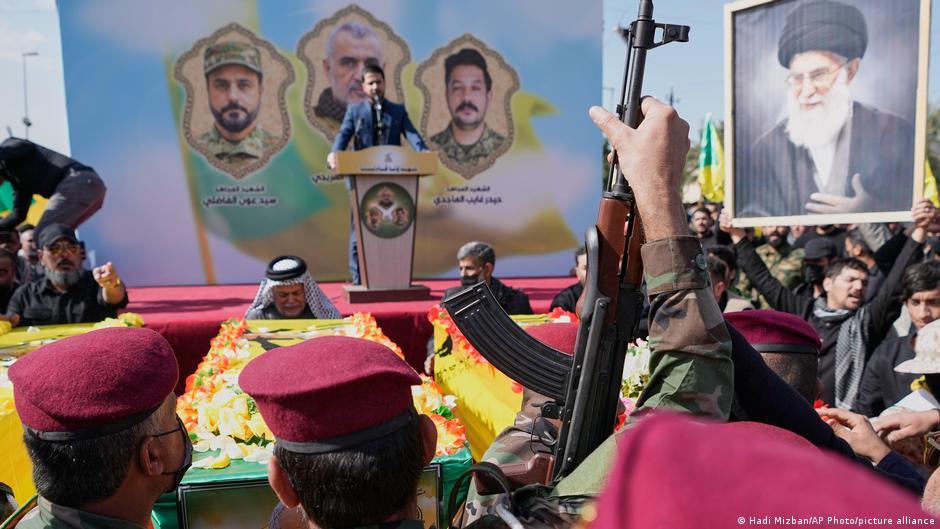
When Iraq’s new Prime Minister Ali al-Zaidi speaks at the White House on Tuesday, it’s likely he will discuss more than one uncomfortable topic. Given the US-Iran war, potentially the most uncomfortable topic on the table: the role of Iran-allied paramilitaries in Iraq.
Most paramilitary forces, often grouped together as the Popular Mobilization Front, or PMF, were first formed in 2014 when religious leaders called on able-bodied people to fight the extremist group known as “Islamic State.” They now number around 240,000 fighters and have an annual budget of around $3.5 billion (€3 billion).
Some – but not all – PMF factions are considered part of Iran’s so-called “axis of resistance”, which also includes Hezbollah in Lebanon, the Houthis in Yemen, and Hamas in Gaza. During the ongoing conflict between Iran and the US, some PMF groups are believed to be behind attacks on US targets in Iraq, Kuwait and Jordan.
This is why America wants to see them unarmed.
US Secretary of State Marco Rubio addressed the issue in the UAE last month.
“You cannot have an end to hostilities and conflict in the region as long as Iranian proxies are launching missiles and drones from Iraq and participating in terrorism.” Rubio told reporters.
Putting pressure on Iraq, withholding oil revenues
Over the past year, the US has increased pressure on the Iraqi government to deal with the issue, including designating several more PMF factions as “foreign terrorist organizations”, imposing sanctions on PMF-linked businesses, threatening to block Iraq’s oil revenues through US banks, and blocking foreign currency shipments.
The Iraqi government responded by saying that, by the end of September, all weapons must be brought under state control and that any groups that did not agree would be prosecuted.
In late May, influential cleric Moqtada al-Sadr ordered his armed faction, Saraya al-Salam (in English, Peace Brigades), to hand over weapons to the state. About a week later, the Iraqi government said it had received information about personnel, weapons and equipment.
In early June, two other Iraqi paramilitaries – Asaib Ahl al-Haq (in English, League of the Righteous) and Kata’ib Imam Ali (Imam Ali Brigade) – also agreed to sever organizational ties with the PMF and eventually transfer weapons and personnel to the state.
But as quickly as the announcements came, doubts also increased.
Assaib Ahl al-Haq, or AAH, has been active since 2006 and was known for attacking US troops occupying Iraq after the 2003 invasion of the country. Even after most American troops left the country, the AAH retained a reputation for criminal activities, including theft, violence, kidnapping, and murder. AAH and its proxies, often known by other names, have also been accused of targeting US targets inside Iraq and US allies during the ongoing US–Iran war.
Sources close to the PMF told the London-based Pan-Arab newspaper that this promise of disarmament meant “taking whatever you put in your right hand to your left”. Asharq Al-Awsat.
Other commentators argued that it is reasonable for the groups to turn over their weapons to the state since they are de facto the state. Some described the move as “rebranding”.
From violence to politics
Several PMF groups also have political representation and their parties currently hold a majority in the Iraqi parliament overall.
“After last year’s parliamentary elections, the political wing of the militias holds a quarter of the seats in parliament, controls ministries, influences the judiciary and captures significant economic resources,” analyst Omar al-Nidawi wrote for the Washington-based think tank. Stimson Centre, In June. The new prime minister, he said, “works for the pleasure of these powerful militia-aligned groups.”
So if that happens, it becomes very difficult to monitor any disarmament, al-Nidawi, director of programs at the Enabling Peace in Iraq Center, told DW.
Al-Nidawi argues, “In a complex environment like Iraq, where the state is weak, you ideally need external observers who can verify that…weapons are not just going from warehouse A to warehouse B, both are under the control of the same group.”
Sajjad Ziad, an Iraqi political analyst and fellow at the Washington-based Century International think tank, agreed, saying that in some ways the criticism is valid.
But in other ways, AAH has been changing for some time, Ziad told DW. They have seen real political success and want to focus on that.
“They [AAH] They believe they can increase their influence and their power by becoming more fully involved in politics and less involved in the earlier resistance agenda,” says Ziad.
Iraqi analysts point out that AAH was never the closest PMF group to Iran. Other PMF members close to Kata’ib Hezbollah, have vowed not to give up their weapons or their “resistance” activities. Ziyad said, Kataib Hezbollah does not even have a political wing.
Iran approved?
Both Ziad and al-Nidawi say this is probably why groups like AAH within Iran-aligned factions may make some concessions.
“Iran needs influence and power and the ability to operate in Iraq,” Nidawi explains. “So they need people who can move weapons to other Iranian allies, they need people in business suits who can create shell companies and launder money, and they need people who can fire at Iran’s adversaries in the region. AAH’s steps don’t mean they are abandoning their relationship with Iran. In the bigger picture, it needs to be done through assets. “Can be seen as a strategic allocation. Like, do we have three people fighting and five people trading?”
Ziad argues that it also means the latest changes are unlikely to achieve the US’s ultimate goal of neutralizing the threat posed by Iran’s allies in Iraq.
Ziyad concluded, “Unless we achieve sustained stability and peace in the region, there is a strong possibility that anti-American activities will still emerge from Iraq – even if some groups disband, or focus on politics.” “Pro-Iran sentiment is quite strong among various groups and large numbers of the population in Iraq.”
So is there anything positive in the promises to disarm the militias?
Al-Nidawi argues that in some ways, these pledges and a paramilitary force that wants to be more political and civilian could be good because it portends a “less confrontational future”.
But, he adds, “This is still a future that places Iraq firmly within Iran’s orbit, but in a way that is perhaps more palatable to the US. It also completely ignores the question of accountability for past crimes by these groups,” al-Nidawi adds. “It is not easy to normalize these groups that engage in mass murder, ethnic cleansing, enforced disappearances, and terrorist acts within Iraq and abroad.”
Edited by: Jess Smee