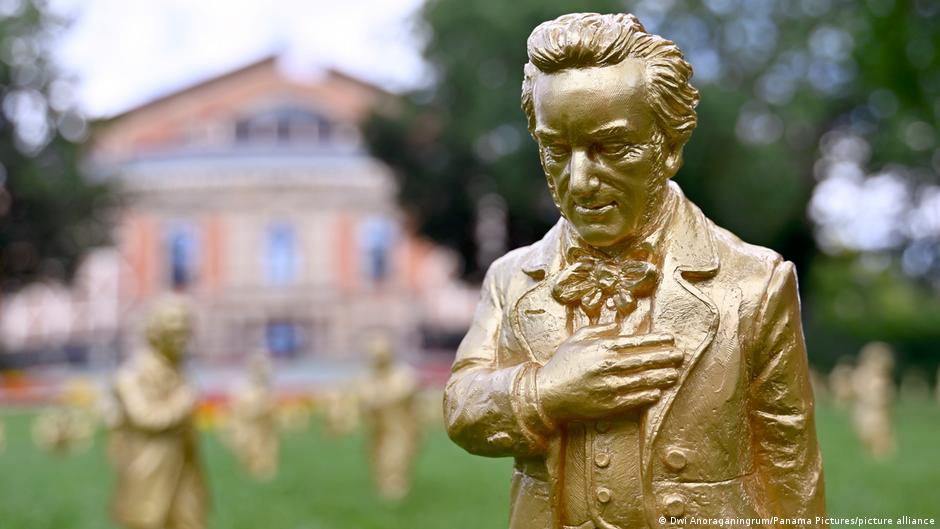
The Bayreuth Festival celebrates its 150th anniversary from July 25th. But in the lead-up to the milestone, some observers have criticized how Bayreuth deals with the festival’s anti-Semitic legacy.
Jewish public intellectual Michel Friedman was invited to speak at a memorial ceremony honoring the victims of National Socialism at the festival’s opening. At the event, scheduled to discuss Richard Wagner’s anti-Semitism and the festival’s historical ties to the Nazis, Friedman was suddenly disinvited – only to be reinstated after a series of public backlash and reversals.
german newspaper south german newspaper The episode was described as reflecting “the old German desire to avoid confronting one’s own history”.
Ano Mungen, director of the Research Institute for Music Theater Studies at the University of Bayreuth, also criticized the festival’s leadership in an interview with the weekly newspaper. TimeAccused the organization of being “historically oblivious”. His criticism focused on the decision to stage Wagner’s opera “Rienzi” in Bayreuth for the first time during the 150th anniversary season, despite the fact that it was Adolf Hitler’s favorite opera.
And Richard Wagner himself remains a controversial figure. He was not only a revolutionary opera composer, but also an outspoken anti-Semite.
What makes the Bayreuth Festival unique?
Richard Wagner (1813–1883) conceived his operas as Gesamtkunstwerke – “total works of art” in which music, drama, staging and design created a unified whole under a single artistic vision. To bring that concept to life, he built his own opera house, the Bayreuth Festspielhaus. He inaugurated the venue in 1876 with the 16-hour opera cycle “The Ring of the Nibelung”.
Wagner designed the theatre’s architecture, wrote his own librettos, directed productions, and oversaw the stage design. He took many of his heroes from Germanic and Norse mythology, particularly “The Ring of the Nibelung”. Unconditional love carried to death is another recurring theme in his works.
Bayreuth’s enduring appeal
In keeping with Wagner’s wishes, only a selection of 10 of his mature operas are performed at the festival each year. Approximately 60,000 tourists from around the world make the pilgrimage to Bayreuth’s “Green Hill” festival to experience the venue as Wagner intended. Despite high ticket prices, audiences willingly tolerate uncushioned hardwood seats, limited leg room, and a stuffy auditorium with no air conditioning.
The orchestra is hidden beneath the stage, the performers are illuminated while the audience sits in complete darkness, and the wood-paneled auditorium creates remarkably clear acoustics even in the uppermost seats. Together, these elements create the distinctive atmosphere of the Festspielhaus.
“In a younger age, sitting on the sofa and watching fast reels on a smartphone, it may seem anachronistic,” said Sven Friedrich, director of the Richard Wagner Museum in Bayreuth. “But maybe that’s what makes it attractive again.”
Wagner’s influence on Hitler
Long after Wagner’s death, Hitler became fascinated by Wagner’s dramatic use of light and darkness in his productions. Wagner was Hitler’s favorite composer, and “Rienzi” was his favorite opera.
“What Hitler liked about ‘Rienzi’ was the central figure – a man who reaches great power through his charisma,” Friedrich told DW.
Hitler admired Wagner’s monumental musical style and its recurring leitmotifs. The Nazi regime employed Wagner’s music for propaganda films and used it as part of the psychological torture administered in concentration camps. During the Holocaust approximately 6 million Jews were murdered in concentration camps and through mass executions carried out by the Nazi regime.
Wagner’s opera “The Mastersingers of Nuremberg” was traditionally performed on the eve of the Nazis’ annual Nuremberg Party Rally.
These associations, along with Wagner’s own anti-Semitism, continue to cast a long shadow over Bayreuth.
This is an issue that artistic director Katharina Wagner has addressed on several occasions – notably by inviting German-Australian director Barry Koski in 2017. In his production of “Die Meistersinger”, Kosky demonstrated that, in his view, Richard Wagner’s character “Beckmesser” embodies the stereotypical qualities of the Jew and the singer is forced to serve as a “scapegoat for the trauma of an entire people”.
Wagner and antisemitism
Richard Wagner was a committed anti-Semite. In 1850, he published the essay “Judaism in Music”, in which he argued that Jews lacked authentic artistic identity and merely imitated others.
“There was always anti-Semitism in Bayreuth and Wagner’s wife Cosima was also anti-Semitic,” Friedrich said. “Children and grandchildren growing up here in provincial Franconia have, with few outside influences, partly internalized those attitudes.”
Hitler developed a close friendship with Wagner’s son Siegfried, and especially with Siegfried’s wife Winifred Wagner. The dictator frequently visited the Wagner family villa – now home to the Richard Wagner Museum – where he found both refuge and a sense of belonging. “The Festspielhaus was like his royal court theatre,” Frederick explained.
Post-World War II festival
After World War II, Winifred Wagner and her son Wieland had to go through the Allied denunciation process. To protect the festival from Nazi associations, Winifred officially handed over her rights to her sons, Wieland and Wolfgang,
But the decision to hand over the artistic leadership of the festival to the brothers also proved controversial, as Hitler had given Wieland special privileges during the war.
Facing financial difficulties and eager to distance the festival from its past, Wieland Wagner re-invented his grandfather’s operas with the sparse, minimalist productions that came to define the “New Bayreuth” style.
After Wieland’s death, Wolfgang Wagner assumed sole leadership and began inviting outside directors to stage productions. “He opened the festival to outside directors and paved the way for a broader range of artistic styles,” Frederick said.
Bayreuth looks to the future
In recent years, Catharina Wagner, Richard Wagner’s great-granddaughter, has sought to bring the festival into the 21st century.
In 2022, he invited director Valentin Schwarz to reinterpret “The Ring” as a contemporary family saga inspired by Netflix’s storytelling style.
A year later, director Jay Scheib staged “Parsifal,” using augmented reality to add a digital visual layer to the production.
This year’s new “Ring” production features a stage design created with the help of artificial intelligence.
As for the new production of “Rienzi,” it remains to be seen how Hungarian directors Alexandra Szemerédi and Magdolna Parditka will adapt the opera. They plan to reinterpret “The Rienzi Case” as a courtroom drama, drawing parallels with today’s populist societies.
Before the performance, the festival will feature a concert of music by Jewish composers, followed by a lecture by Michelle Friedman.
This article was originally written in German.