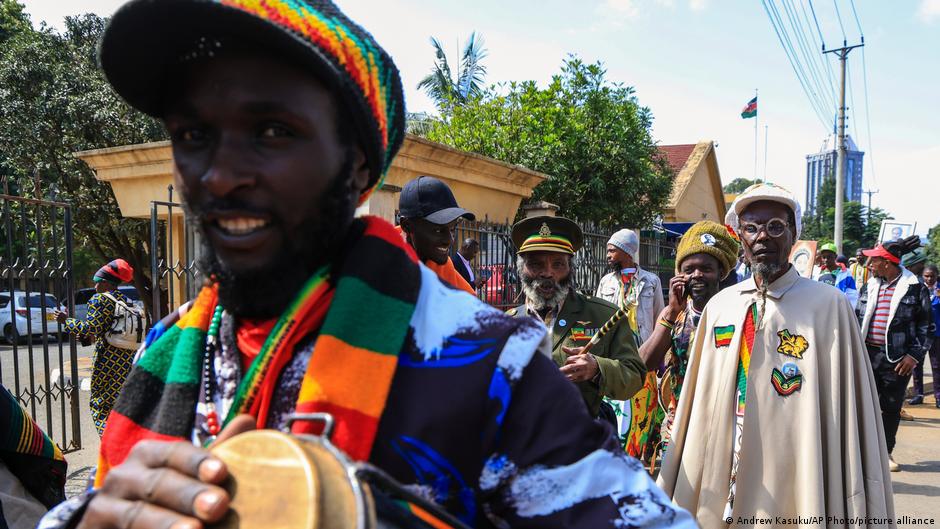
A Kenyan court on Wednesday denied Rastafarians the right to smoke marijuana on religious grounds, after members of the religious minority sought exemption from the country’s harsh drug laws rooted in British colonial rule.
Rastafarians, who often use cannabis as part of religious meditation, had been pressuring Kenyan courts since 2021 to allow them to use the herb.
They argued that it should be protected under their constitutional rights to religious freedom.
What decision did the court give?
The Kenyan High Court in Nairobi ruled that the community failed to demonstrate during the hearing that marijuana was an essential part of their religious practice, and were therefore not given the right to circumvent the country’s drug laws.
While all the witnesses “agreed that cannabis is used as a sacrament, they could not agree whether its use is necessary or merely preferred,” said Judge Bahati Mwamuye.
The community’s lawyer, Shadrack Wambui, said they planned to appeal the decision.
What did the judge say about broader questions about cannabis laws?
Despite ruling against the specific case on Wednesday, Judge Mwamuye said Kenya should hold a broader national debate on its drug policy.
“This is not just a question for the Rastafari community, but a question for society as a whole,” he said.
“It is beyond dispute that cannabis use has become ubiquitous in this country and has arguably been so for many decades,” the judge said, quoting Peter Tosh’s seminal reggae song, “Legalize It,” which includes the lyric: “Judges smoke it, even lawyers smoke it.”
Kenya has strict drug laws, many of which ultimately have their roots in the laws of colonial power the United Kingdom in the early 20th century.
Possession and smoking of marijuana is punishable by a fine of up to $2,000 (more than 6 months’ salary for an average earner based on per capita GDP figures), up to 10 years in prison, or both. Offenses related to plant smuggling or cultivation may face even more severe penalties.
Mwamuye said that “the status quo appears to be untenable,” and argued that “there needs to be a full and frank conversation on cannabis and what direction we should take.”
What does Rastafarianism have to do with Kenya?
Rastafarianism formed in Jamaica in the 1930s, and most consider it to be based on the Christian interpretation of the Bible.
It had a deep association with colonial culture and resistance to British rule and was strongly influenced by Ethiopianism and the Back-to-Africa movement.
The movement has a special connection to East Africa because of its reverence for the former Ethiopian Emperor Haile Selassie, either as a prophet or the second coming of the Messiah.
Its tradition of wearing dreadlocks also resonates in parts of Kenya, given that many Mau Mau – Kenyan independence fighters who resisted British colonial rule in the 1950s and 60s – also wore them.
Rastafarians are a minority religion in Kenya and there is no official data on their prevalence or numbers.
The East African country effectively recognized the movement as a religion in 2019 after a court ruled that expelling a schoolgirl because of her hair was a violation of her religious rights. Last August, the community opened its first temple in the Nairobi area.
Edited by: Rana Taha
Don’t let algorithms hide news. If you rely on our team for reliable reporting, please take a moment Choose us as your favorite source on GoogleThat’s why you’ll always see our verified news first.