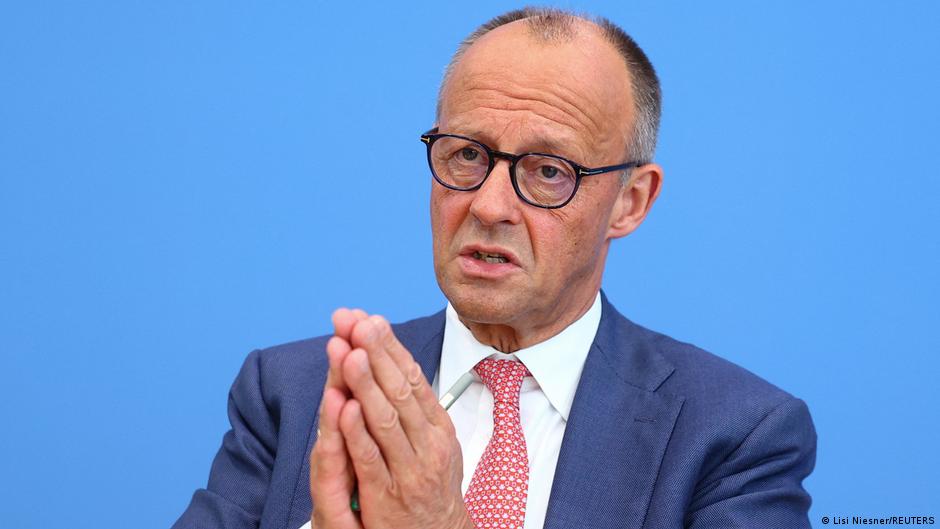
The annual summer press conference with Chancellor Frédéric Merzare is one of the last public events before he goes on leave. And the federal press conference room was packed for the occasion.
Journalists were greeted by a chancellor who seemed quite satisfied with himself – and despite poor polling numbers, only between 13% and 20% of people in Germany were satisfied with how he and his coalition of conservatives and social democrats are doing their job.
“The coalition has gained its base,” Merz said. “The results have been positive,” he added. “The federal government has found its groove despite some criticism. We’ve got the job done.” Merz was referring specifically to reforms in the areas of pensions, health care and taxes – which have already been adopted but not yet approved by Parliament, which he elaborated on.
He particularly mentioned reforms to the pension system, which for the first time will allocate a smaller portion of retirement funds to investments. Merz said: “We should have done this 30 years ago, just as the Swedes, Danes, Dutch and many others around the world did it long ago. But at least we are starting now.”
Journalists mainly asked about the AfD
But despite all the improvements, journalists’ questions turned to Alternative for Germany (AfD), a party that the domestic intelligence agency has found to be somewhat far-right extremist. The party is currently leading in two state elections in East German states this September. So how does Merz hope to stop far-right extremists from seizing power in Germany?
Merz began to dodge the question, but when pressed, the chancellor surprisingly addressed voters directly in Saxony-Anhalt and Mecklenburg-Western Pomerania: “Look carefully; do not let information from social media – no matter where it comes from – become your only source. Instead, look at what the federal government is trying to achieve,” Merz said.
In response to a question from a journalist from the Netherlands, Merz argued that it would actually be “something else entirely” if right-wing extremists were once again able to seize power in Germany, of all places, given its Nazi past.
Despite all the polls, Merz remains confident ahead of the elections in September. “The election campaigns are just beginning. I am confident that we will succeed in preventing the AfD from gaining a majority of seats in the three state legislatures – especially in Saxony-Anhalt and Mecklenburg-Western Pomerania,” he said. Elections will be held in September not only in those two East German states but also in the German capital Berlin, which is a federal state in its own right.
Criticism of American policy
A question from DW addressed a report about a plan by the US State Department to launch a $5 million (€4.3 million) grant program designed to support groups in Europe, which could also include those associated with the AfD. In response, Merz said: “I have always said that we, for our part, do not interfere in American elections. We have always adhered to that principle. And on the contrary, I do not want American institutions to interfere in German elections. And perhaps an additional point: It is illegal in Germany to finance political parties from abroad.”
Despite all these problems, Merz showed confidence, even though issues like crumbling infrastructure, increasing polarization of society and – last but not least – a sluggish economy are a major cause of concern for many. On this last point, Merz acknowledged that he still sees a significant need to catch up. Economically, the country is not where he would like, the Chancellor said: “We have achieved a lot, but it is still far from enough.” The main issue, he said, is how to restore the competitiveness of the German economy. Only at this point did Merz reference unexpected US President Donald Trump – though still without naming him. The US government has “damaged” the German economy through its tariff policy, Merz said.
Merz defends Ukraine’s EU accession proposal
In response to another question from DW, Merz repeated his initially controversial proposal to give crisis-hit Ukraine only the possibility of association with the EU (without voting rights). Merz said that we should be honest with Ukrainians and tell them that the path to Europe is much more difficult than initially thought, but he, Merz, is now in favor of taking small but steady steps:
“At the moment, there are basically five Western Balkan states, Moldova and Ukraine that we are considering as potential new EU members. They are waiting for the EU to take the next step.” Merz acknowledged that it has been 13 years since the EU took in any new members, although many have promised to do so. Small but serious steps are now needed to ensure that the EU maintains its credibility, Merz said. “If we lose this credibility, we lose these countries.”
some temporary soul searching
At one point, Friedrich Merz offered a moment of self-criticism: during the election campaign about a year and a half ago, Merz had promised a moratorium on taking out new loans. Shortly thereafter a massive loan package was launched to finance the rearmament of the Bundeswehr, climate protection and infrastructure. It has now also become a “significant burden on my personal credibility”, he said.
However, this was one of the few moments in which Friedrich Merz showed any hesitation about his politics. He said the coalition of conservatives and social democrats would continue to govern peacefully and firmly.
This article was translated from German.