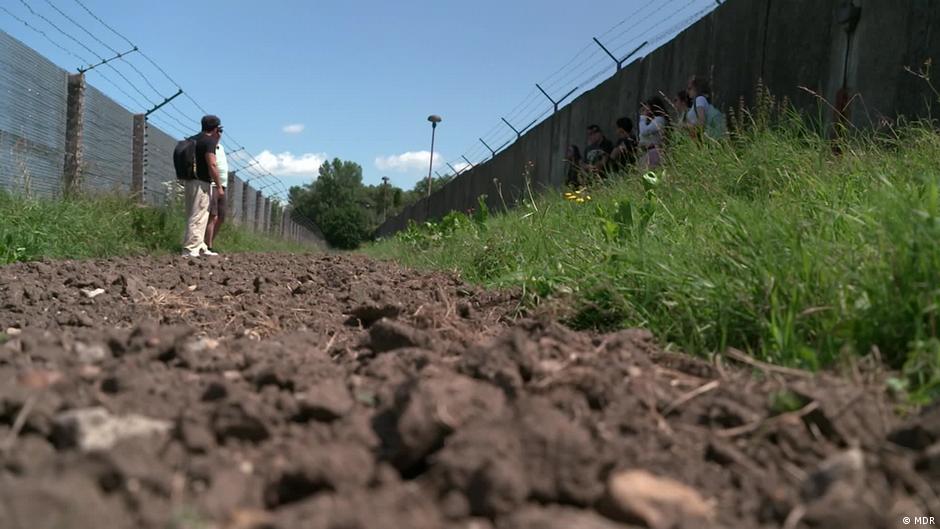
At one point, the tour bus carrying representatives of the German Environment Ministry and journalists from the city of Rostock in the German state of Mecklenburg-Western Pomerania to Salzwedel in Saxony-Anhalt passed through an almost deserted area.
This is where the border between the Federal Republic of Germany (or FRG, commonly known as West Germany) and the German Democratic Republic (or GDR, commonly known as East Germany) used to be. It was effectively the border between two global power blocs: the West with NATO, and the East with the Warsaw Pact. Until the fall of the Berlin Wall in 1989, that is.
a former dividing line
Andreas Heil of Germany’s Environment Ministry is responsible for the “Green Belt”, a unique nature reserve in the area that was once used to prevent East German citizens from fleeing to the West. It is about 1,400 kilometers (about 870 mi) long and 50 (164 ft) to 200 meters wide.
“It was a death strip that was impassable and served as a dividing line,” Heil said on the bus. “Today, it’s quite the opposite: something that brings people together.”
Environment Minister Carsten Schneider, who is from Erfurt in the state of Thuringia, which used to be part of the GDR, explained how important the former military border strip is for nature today. “Because the military road was closed and no one was allowed to come here – at least not me, as an ordinary GDR citizen – species that were not found anywhere else were able to establish themselves in this area even after reunification.”
hundreds of endangered species
According to his ministry, about 7,500 species of insects and spiders have been registered in the “Green Belt”, of which 580 are endangered or threatened. Otters, European wild cats, whinchats and lapwings, which are in danger of extinction, also inhabit the region, 88% of which are now under protection so that these species survive.
Moors, who are almost insignificant in Germany, also survive in the region. Thanks to the boardwalk, visitors can now explore a large peat bog that covers 400 hectares (1.5 sq mi) near Salzwedel.
“In the 19th and 20th centuries, before the fall of the Wall, many areas were dry. They were completely converted to agricultural use,” said Nathalie Niederdrenck, who also works at the Environment Ministry.
Throughout the “green belt”, where there are now cycle paths, there are signs indicating where the previous boundary was or panels with information about the fauna and flora.
against encroachment on agriculture
There are other former border areas in Europe that have been converted into nature reserves, such as the areas between Finland, Norway and Russia. Germany’s “Green Belt” continues along the borders with the Czech Republic, Slovakia and Austria, as well as between Croatia and Hungary.
Olaf Bandes, head of the German Federation for the Environment and Nature Conservation, or BUND, explained to visitors in Salzwedel that the organization, which has about 520,000 members in Germany and is financed by donations and state subsidies, has a special relationship with the region. “This is where we started in 2000 using BUND donations and funding from the Ministry of the Environment to purchase the first plots along the ‘green belt’. It has become our largest project covering 1,000 hectares.” He said.
BUND warns that it is important to protect the area from encroachment by industries which could be harmful to it. Bandes said that six years ago, the Bavarian faction of the Bund complained that the road was “dominated” by agriculture along the “green belt”, which meant that “animals and plants are repeatedly cut out of their way, or pedestrians and cyclists suddenly find themselves in the middle of a corn field.”
In early July, the states of Thuringia, Bavaria and Saxony decided to permanently protect an approximately 95-kilometre-long section of the “green belt” until 2028 with the help of a special million-euro management plan, 75% of which will be covered by the German Environment Ministry.
Bavarian state Prime Minister Markus Söder said it was an important environmental project, especially in the face of drastic climate change.
This article was translated from German.