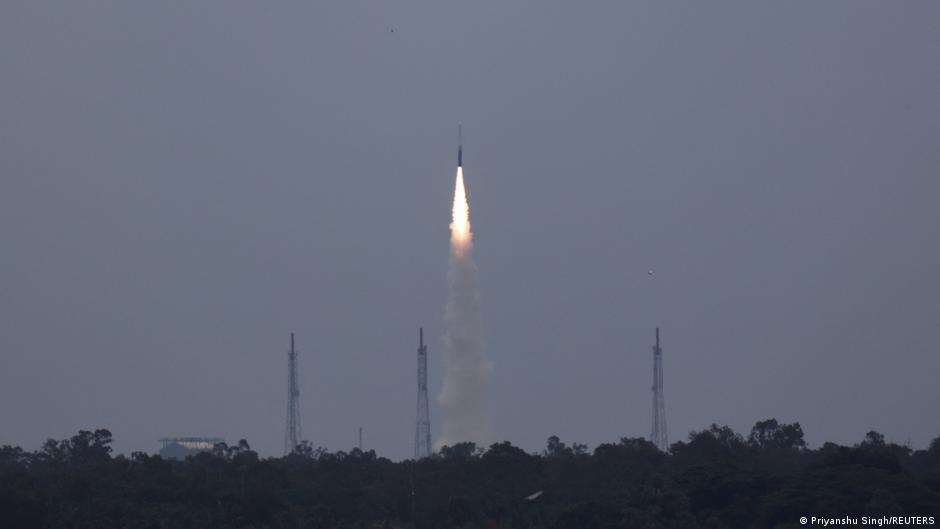
India’s first privately developed orbital rocket was launched into space on Saturday, a feat that Prime Minister Narendra Modi hailed as “opening new frontiers and accelerating innovation”.
Following a surge in investment in the space sector since the pandemic and the creation of over 400 startups, the South Asian country has become the third country to achieve this feat after the US and China.
What happened?
Skyroot Aerospace, the company behind the launch, said the Vikram-1 rocket lifted off from the Satish Dhawan Space Center on Sriharikota island in the southeastern state of Andhra Pradesh.
The launch, called “Mission Arrival” after the Hindi word for “Aagaman”, occurred at 0635 UTC/GMT (11:05 a.m. local time).
“Hello space, we have arrived!” “The test flight of Vikram-1 has completed its mission. The first launch of the Indian private sector has been successfully completed,” the company wrote on Twitter.
In a separate statement, the company described the launch as a “huge success”, noting that further test flights would take place “before moving to regular commercial flights”.
Vikram-1 is approximately 22 meters (72 ft) long and can carry a payload of up to 350 kilograms (711 lb) into low Earth orbit.
Skyroot said the rocket is carrying several experimental payloads from Indian and foreign customers, including a lab-grown diamond and robotic arms capable of removing space debris.
The company said the mission is intended to test the rocket’s propulsion, avionics, telemetry and guidance systems in flight while gathering critical data for future commercial launches.
Modi congratulated the X, calling it a “defining moment in India’s space journey”.
“The growing involvement of our private sector is opening new frontiers and accelerating innovation. This achievement will encourage countless youth to dream big and innovate fearlessly.”
A smaller rocket, Vikram-S, made its first sub-orbital mission in 2022.
India’s growing role in private space sector
India opened up its space sector to private investment in 2020, allowing startups to build rockets, satellites and launch services.
These activities were once under the tutelage of the government’s ISRO space agency.
In August 2023, India became the fourth country after Russia, the United States and China to successfully land an unmanned spacecraft on the Moon.
According to government agency IN-SPACe, the Indian government wants to increase its global share in the space economy five times from the current 2%, aiming to reach a valuation of $44 billion by 2033.
Skyroot is one of hundreds of Indian space startups that have attracted global investment. Earlier this year, the Hyderabad-based company became the first company in India’s space sector to achieve a valuation of $1 billion.
Meanwhile, ISRO this week said it was concerned about the exodus of scientists From state space agencies to the private sector.
The private race to space is becoming more competitive globally, with governments across Europe and Asia trying to take share of the market dominated by Elon Musk’s SpaceX.
These include China, Japan, South Korea, Germany, France and Netherlands.
Edited by: Sam Dusan Inayatullah
Don’t let algorithms hide news. If you rely on our team for reliable reporting, please take a moment to choose us as your Click here to view your favorite news sources on GoogleThat’s why you’ll always see our verified news first.