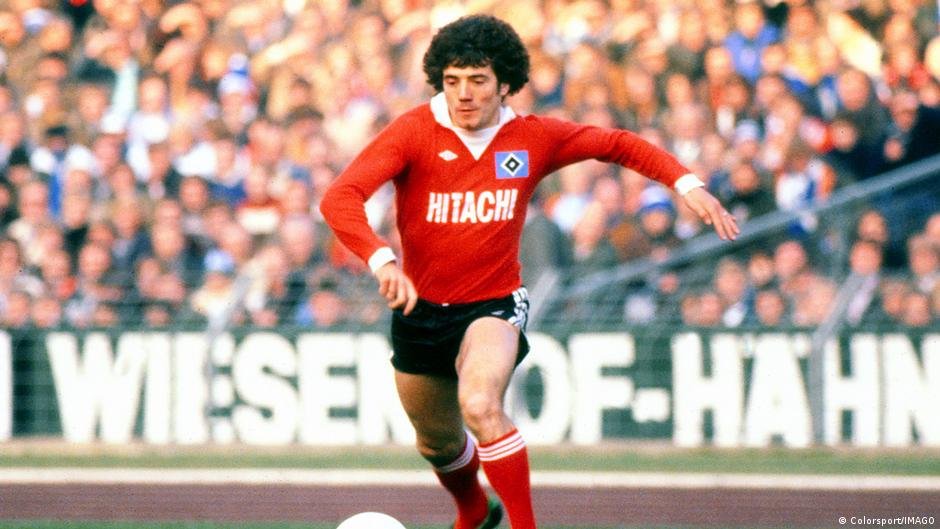
The death of Kevin Keegan, considered one of the greatest football players of his generation, was announced in a statement issued by his family on Monday.
“It is with great sadness that we announce that Kevin Keegan has passed away at the age of 75,” the statement said.
“Kevin was battling cancer and was surrounded by his wife and daughters in his final moments. A double Ballon d’Or winner, Kevin was a much-loved husband, father and grandfather.”
Born on 14 February 1951 in Doncaster, South Yorkshire, Keegan got his big break when he was signed by legendary Liverpool manager Bill Shankly in 1971.
At Anfield, Keegan formed a formidable partnership with Welshman John Toshack, and won the First Division title three times, as well as the FA Cup, the UEFA Cup twice and the 1977 European Cup. He played 323 matches for Liverpool, scoring 100 goals.
Success in the Bundesliga
From Merseyside, Keegan moved to Hamburg of the Bundesliga, where he was twice named European Footballer of the Year, now called the Ballon d’Or, in 1978 and 1979. With Hamburg, he won the Bundesliga in 1978–79 and played in one more European Cup final, losing to Nottingham Forest in 1980. He left the club after scoring 32 goals in 90 matches.
Hamburg was one of the former teams to pay tribute to Keegan in a statement on their website on Monday.
“In Kevin Keegan, world football has lost one of its most important personalities. Hamburger SV will always cherish the memory of its former title-winning player and two-time Ballon d’Or winner,” the statement said.
Our thoughts are with his family, his friends, and everyone who shared his journey. Rest in peace, “Mighty Mouse.”
return to england
Following his stint in West Germany, Keegan returned to England with Southampton in the summer of 1980 and then moved to Second Division Newcastle, helping the club achieve promotion to the top flight before retiring as a player.
He won 63 England caps, scoring 21 goals, playing in the 1982 World Cup and later became captain of the national team.
steps into management
In 1992, Keegan moved into management at Newcastle, leading them into the Premier League and coming close to the 1995–96 title, but missed out on defeat to Manchester United.
The club paid tribute to Keegan in a statement released on Monday afternoon, describing him as “the beating heart of Newcastle for generations of supporters”.
After leaving St James’ Park in January 1997, he spent a brief stint at Fulham before becoming England manager in 1999. After overseeing a disappointing Euro 2000 campaign, Keegan resigned minutes after a 1–0 defeat to Germany in World Cup qualifying, the last match played at the original Wembley Stadium.
He later managed Manchester City before returning to Newcastle.
Keegan’s family revealed in January that he had been diagnosed with cancer, which later spread to stage four.