As China narrows the artificial intelligence (AI) gap with the United States, Beijing is promoting a narrative focused on “open source” and “inclusive AI” as a rationale for its approach to global governance.
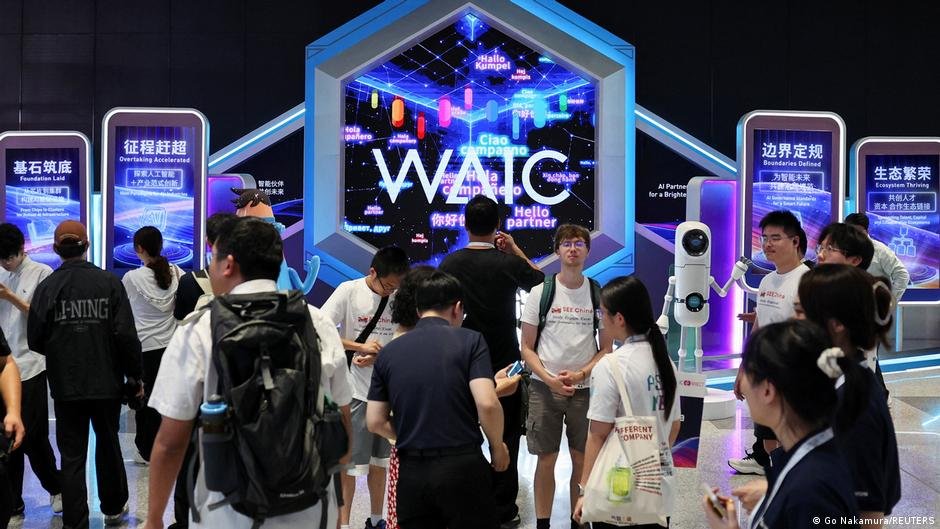
During his keynote address at the World Artificial Intelligence Conference (WAIC) in Shanghai on Friday, Chinese President Xi Jinping expressed China’s ambition to take a leading role in setting global standards in AI. He criticized it as “an overextension of the concept of national security”.
Xi did not openly reference the United States. However, Beijing’s attempt to position itself as a supporter of the new AI order and challenge US dominance was unremarkable.
This year’s Shanghai summit sent several important signals, says Rogier Cremers, an assistant professor at Leiden University in the Netherlands who specializes in China’s digital technology policy. Creamers told DW that WAIC indicates that artificial intelligence is now one of Beijing’s political priorities, and China intends to compete with the United States by supporting open-source AI models and promoting AI-driven industrialization. He also said that China hopes to get support from countries in the global south for this effort.
Beijing is closing the AI gap
China is continuously narrowing the gap with the United States in AI model development, and its efforts in AI application in industrial processes are gradually maturing.
Paul Triolo, senior vice president and head of technology policy for China at DGA-Albright Stonebridge Group, told DW that Chinese AI model developers continue to keep pace on the global stage, primarily by training open-weight models on limited but advanced computer hardware.
Triolo believes that the deployment of AI in Chinese enterprises may advance faster than in the United States.
Additionally, there is less fear of AI among the Chinese population than in the US, leading to more rapid adoption of AI applications at the consumer level.
Earlier this year, Chinese state media claimed that the performance gap between Chinese and American AI models “has largely disappeared.”
Many experts broadly agreed with this assessment and said that some benchmark tests of China’s large language models (LLMs) such as GLM-5.2 and KMK3 have shown the gap to be narrowing or even closing completely.
For most applications, China’s leading open-weight AI models are cheap to run and capable of handling most tasks, Triolo said.
At the same time, advanced proprietary models from leading US companies such as Anthropic, OpenAI and Google still retain advantages in areas such as security and scalability.
Has the US ‘AI Firewall’ worked?
In January 2025, the US Department of Commerce expanded AI-related export controls through its “Framework for Artificial Intelligence Diffusion”, to include advanced computing chips, certain AI model weights, and access to large-scale AI computing infrastructure.
The US also boosted export controls on advanced chips and semiconductor manufacturing equipment aimed at China.
Laila Khawaja, research director at Gavekal Research, told DW that the US has been partially successful.
The controls have really hurt China’s ability to make chips domestically, cheaply and at scale.
However, as for export controls on advanced AI chips, Khawaja says that large quantities of chips are still entering China through the gray market, while Chinese companies can still access computing resources through foreign cloud services.
According to Triolo, the evidence so far suggests that the US strategy to slow China’s advanced AI development has failed on multiple levels. At the same time, it caused massive losses to American companies, especially their budgets for research and development and their supply chains, such as those that distribute rare earths.
China’s open source AI push
In his keynote speech, Xi stressed the importance of “encouraging open-source development.”
Chinese state media have similarly promoted the message that China “does not pursue technological disruptions.”
Analysts say Beijing is framing “open source” and “inclusive AI” as its own narrative to counter the United States’ largely closed-source AI ecosystem.
Chinese AI models are largely open-sourced, with major offerings such as DeepSeq, Zipu’s GLM 5.2, and KMK3 released under the MIT license that allow users to download, deploy, modify, distribute, and commercialize them.
Creamers noted that, at the moment, Chinese AI models are quite open in weight, but slightly less open in source.
According to Creamers, China hopes to encourage the rest of the world to adopt the Chinese AI model, which will create foreign markets for Chinese technology and ensure that China remains part of the next wave of technological development.
China’s WAICO challenges Pax Silica
In Shanghai, Xi also announced that the World AI Cooperation Organization (WAICO), an initiative launched by China, has already attracted 29 member countries.
He described the organization as “an important milestone in the history of AI development” and said it responds to calls from Global South countries for a greater role in AI governance.
WAICO is seen as an initiative to counter the US-led Pax Silica international initiative which aims to secure global AI and critical mineral supply chains.
According to Triolo, the real competition lies in which parts of the American and Chinese AI technology stack are ultimately adopted by countries in the Global South.
He believes China has a significant advantage due to lower costs and the extensive digital infrastructure already built by Chinese companies like Huawei in many developing countries.
looking ahead
Overall, experts believe the US will continue to be the leader in AI hardware design and computing capacity, while China may take the lead in model innovation and come to lead in AI diffusion.
Creamers argue that China’s biggest structural disadvantage is the lack of trust from countries in the global North.
At the same time, Chinese companies are facing a shortage of advanced AI computing hardware due to US export controls, limiting their ability to rapidly scale projections to meet growing demand.
Looking ahead, Creamers argues that the rise of China’s AI sector represents a broader historical shift.
“We need to understand that for the first time in modern history we are facing a non-Western technological superpower,” he said.
In his view, the future will not be defined by a single global technological sector, but by “a complex of overlapping technological networks and processes”.
Edited by: Keith Walker