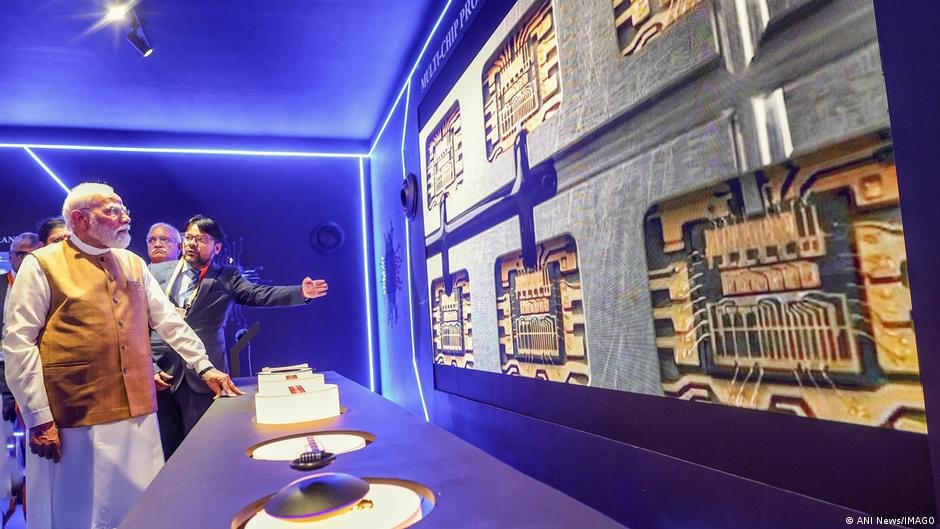
More than 90% of the world’s most advanced semiconductor chips are made in Taiwan, an island at the center of the ongoing rivalry between the US and China.
Any disruption in Taiwan’s chip industry is likely to be a shock to the global economy, as modern semiconductors are used to make everything from smartphones and electric vehicles (EVs) to aircraft and military systems.
During the COVID-19 pandemic, chip shortages have forced automakers to halt production — highlighting how dependent the world has become on a handful of manufacturers in East Asia.
As a result, there has been a global race to create more flexible semiconductor supply chains. The US, Japan, South Korea and the European Union have launched multi-billion dollar programs to attract chip makers.
India is now making its biggest efforts to be a part of that network and enter the global arena as the next electronics powerhouse.
India’s chip manufacturing ambitions
Last week, the Indian government approved a $13.2 billion (€11.4 billion) semiconductor program called Semicon 2.0. The project builds on the $9 billion India Semiconductor Mission (ISM) launched in 2021 and aims to develop the entire chip ecosystem – from chip design and manufacturing to advanced packaging, specialty materials, device manufacturing and workforce training.
Thousands of engineers working for companies like Nvidia, AMD, Qualcomm and Texas Instruments already design some of the world’s most sophisticated chips from research centers in the Indian cities of Bengaluru, Hyderabad and Noida.
But analysts warn that India is lagging behind in large-scale manufacturing. In the semiconductor industry, this is the sector that brings both economic value and strategic importance.
“India already has the expertise to design sophisticated semiconductor chips,” said V Kamakoti, director of the Indian Institute of Technology in the city of Madras.
“Indian engineers working for both domestic companies and multinationals have successfully designed and delivered complex chips,” Kamakoti told DW. “The big challenge is building them.”
So far, India’s progress has focused on chip packaging and testing rather than manufacturing the chips themselves.
Kamakoti said the next step is to build a domestic manufacturing ecosystem that can translate those design strengths into mass production.
Expectation of $100 billion market by 2030
Micron Technology, an American memory chip maker, Kynes Semicon and CG Semi, two Indian semiconductor assembly and packaging companies, have started commercial production under the first phase of the India Semiconductor Programme.
Indian Electronics and Information Technology Minister Ashwini Vaishnav says the next phase aims to move further up the semiconductor value chain in India.
“It is no longer that difficult to convince global companies,” ISM chief executive Amitesh Kumar Sinha said, pointing to 12 approved fabrication and packaging projects, three of which are already in commercial production.
The government wants to create a domestic semiconductor market worth between $100 billion and $110 billion by 2030 and meet three-fourths of India’s electronics demand through locally designed and manufactured chips.
an expensive industrial leap
However, becoming a major chip manufacturer is one of the toughest industrial challenges for any country.
A lead manufacturing plant can cost more than $20 billion, requiring uninterrupted power, large quantities of ultra-pure water and an extensive network of suppliers making specialty chemicals, silicon wafers and precision equipment.
Kamakoti argues that India should first prove that it can manufacture mature 28-nanometer (28 nm) chips on a large scale before attempting the most advanced 3 nm processors used in high-end smartphones and AI systems.
“28nm [chips] Will meet most of the needs of India. Once this is successful, we can gradually move on to more advanced technologies,” he said.
riding the ai boom
India’s ambitions are being fueled by forces beyond its control.
At a time of geopolitical tensions and the rapid growth of AI, companies are rethinking their supply chains and demand for semiconductors is expected to grow rapidly in the coming decade.
Sambit Sahu, a semiconductor industry veteran with over three decades of experience at Qualcomm and Intel, says India must build capabilities across the semiconductor value chain, from chip design and intellectual property to fabrication and manufacturing.
“The rapid development of artificial intelligence will drive demand for semiconductors in the coming years, creating opportunities for India,” Sahu told DW.
“Building a semiconductor manufacturing ecosystem will be costly and technically challenging, but with sustained investment and supportive policies, India can emerge as a significant manufacturing hub over the next decade.”
However, not everyone is convinced that India can close the manufacturing gap quickly.
A senior semiconductor industry official, who preferred to remain anonymous, says India is likely to remain stronger in chip design than manufacturing in the near future.
“India has built world-class capabilities in chip design, but manufacturing is a different challenge,” he said. “The biggest near-term opportunities are in packaging, testing and mature-node manufacturing.”
Semicon 2.0 is India’s most ambitious attempt yet to enter the semiconductor race.
Whether it succeeds will depend less on the billions of dollars promised by India and more on its ability to translate those commitments into factories, skilled workers and a competitive manufacturing ecosystem.
Edited by: Keith Walker