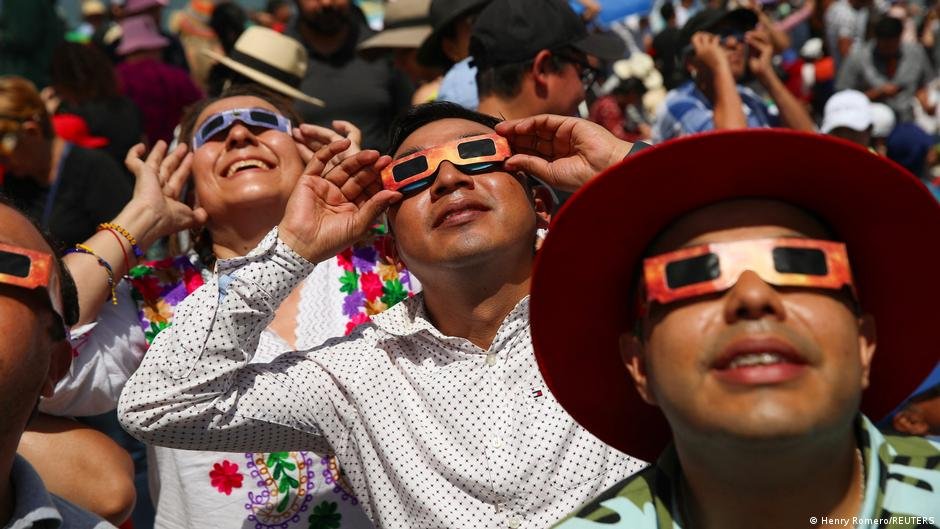
When Josep Massels was 17 years old, he was mesmerized by a partial eclipse of the sun over Barcelona, where he lived in northeastern Spain. It sparked a lifelong fascination that took him around the world. In the 53 years that followed, Masales has observed 43 eclipses, including 22 total solar eclipses.
“The beauty of the eclipse is incomparable,” Masales told DW at the headquarters of the Barcelona Astronomical Society, or ASTER, where he is president. “For me, it also means a way to travel, see other societies and cultures, and meet other astronomers.”
Masales, along with other astronomers, are now preparing for a rare trio of solar eclipses over Spain and North Africa – Morocco, Algeria, Tunisia, Egypt – between August 2026 and January 2028.
What can you expect from the solar eclipse trio
On August 12, the total eclipse will pass from Galicia in the northwest of Spain to the Balearic Islands in the east, as well as the western edge of Greenland and Iceland.
The second total eclipse will occur on August 2, 2027, visible from southern Spain, North Africa and parts of the Middle East.
And in January 2028, an annular eclipse will pass from southwest to northeast Spain.
During an annular eclipse, the Moon is too far from Earth to completely cover the Sun – hence, it is not a total eclipse – but it produces a visible “ring of fire”, where only the outer edge of the Sun can be seen.
Two to three solar eclipses occur every year. But most occur over oceans or in less populated parts of the Earth. A total solar eclipse usually occurs every 18 months.
A total solar eclipse occurs when the Moon completely blocks the Sun’s light, plunging an area of our planet into darkness.
Sandra Benítez Herrera, head of science communication and education at the European Space Agency (ESA), said it is extraordinary for Spain to see three solar eclipses, including two total solar eclipses, within about a year and a half.
“It’s really very, very unusual,” Benitez Herrera said. “The configuration of the Sun-Earth-Moon system and the inclination of the orbits allowed Spain to create this trio.”
A total eclipse has not been seen in the Iberian Peninsula since 1912, and the next eclipse to pass over any part of Europe after 2027 will not occur until 2053.
At the moment of “totality” – when the Moon completely eclipses the Sun – the sky darkens, and the outer layer of the Sun’s atmosphere – known as the corona – becomes visible to the naked eye.
Totality usually lasts only a few minutes, but a solar eclipse “doesn’t leave anyone indifferent,” Massels said. “In the face of that beauty, the grandeur of the universe, there’s also the realization of how small the planet is and how vast the universe is.”
Total solar eclipse is a ‘magical moment’
A total eclipse gives scientists a chance to study the Sun’s corona – its atmosphere – and its effect on Earth. This is an area called space weather and it has become increasingly important, the more we rely on satellites for Earth observations, for communications, financial transactions and for monitoring climate change.
Space weather includes solar winds and storms, which can disrupt those satellites and even power grids on Earth.
By combining data from ground-based observations with data from space probes such as ESA’s Proba-3 spacecraft, which creates artificial solar eclipses in space, or its Solar Orbiter, scientists hope to calculate space weather risks.
But perhaps the biggest impact of the solar eclipse on everyday life is educational. They inspire millions of people to learn about astronomy and other aspects of science.
“Even the smallest cities are eager to welcome visitors, celebrating with star parties and music and concerts,” Benitez said.
Hundreds of public events will take place across Spain along the eclipse path this August. With just a few months to go before the first of three eclipses, you could sense that scientists were excited to share their excitement.
“I’ve seen people cry. I’ve seen people laughing. I’ve seen people doing strange things because it’s a very magical moment,” said Valentin Juan Martínez Pilate, director of the Institute of Astrophysics of the Canary Islands (IAC), Spain’s largest astronomy institute.
Eclipse of the century: a collaboration across continents
Many people are already looking forward to the eclipse of 2027. It has been dubbed the “eclipse of the century” because the moment of totality is predicted to last more than 6 minutes at its peak in Egypt.
Unlike the 2026 eclipse, which occurs near sunset, the 2027 eclipse will occur in the late morning, when the Sun is high in the sky.
A citizen science project led by IAC, in collaboration with Mohammed VI Polytechnic University in Morocco and the US National Solar Observatory (NSO), is laying the groundwork for observing that eclipse.
The North African Telescope Eclipse Project (NATE) aims to bring together scientists and high school students from Spain, Morocco and the United States. They will get a chance to observe Corona from ten telescope locations in northern Morocco.
“It means a lot to me,” said Youssef Maulane, an astrophysicist at Mohammed VI Polytechnic University.
Moulane, who grew up in a small village near Marrakesh, said that as a young boy his community was afraid of eclipses, fearing they could be dangerous.
“They told us to hide inside because they didn’t understand what was happening,” he said. “Now, we’re doing the opposite. We’re inviting people to go out and watch the eclipse, put on their glasses and enjoy it.”
Images will be collected from each location in Morocco and stitched together to create an expanded picture of the Sun’s atmospheric activity.
The US had a similar project for total eclipses of 2017 and 2024.
“I want to see a coronal mass ejection, a big flare that occurs when we’re observing the sun from Morocco,” said Martínez, who runs the Native American experiment. “In any case, there will be some science, but mostly it’s about getting students interested and excited about science.”
A small group of students will travel to northern Spain in 2027 as a training exercise for the main event for the 2026 eclipse.
Edited by: Zulfikar Abbani