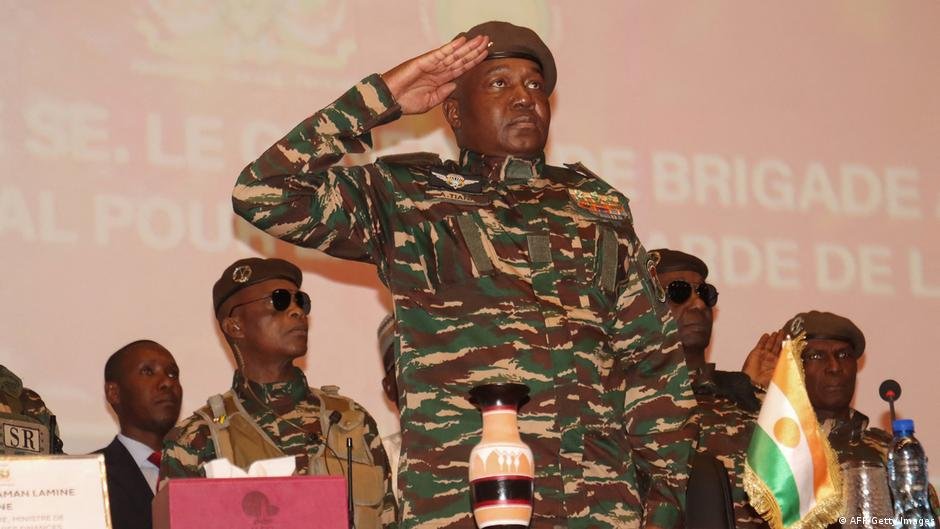
The military seized power in Niger on July 26, 2023. General Abdourahmane Tchiani, who became head of state, justified the coup by citing the poor security situation, which he said continued despite international support.
In the weeks that followed, the military government announced a transitional period that was to last a maximum of three years.
However, the political promises made when assuming office have not been fulfilled. The transitional government remains in full control of power and the security situation in the Sahel country remains critical.
Jihadis attacks are increasing in the Tillaberi region of south-western Niger. Thousands of people have been forced to flee their villages, plunging the region into a severe humanitarian crisis.
“Today, attacks on armed forces and the civilian population are significantly more frequent and violent than three years ago,” Maiga, who lives in the town of Terra, population 30,000, told DW. MAGA wished to remain anonymous for security reasons.
“Despite insecurity, life used to be better; Weekly markets functioned normally and supplies arrived regularly, he said, adding that entire villages had fled and schools were closed.
Independent conflict monitor ACLED also said the security situation had deteriorated since the 2023 coup.
According to the organization, the Tillaberi region remains the main center of clashes between two rival Islamist groups, Jamaat Nusrat al-Islam wal-Muslimeen and the so-called Islamic State in Sahel Province (formerly ISGS). This rivalry has resulted in many military and civilian casualties.
In 2025, approximately 1,200 deaths were recorded in the region. For Henny Nsaibia, a staff member at ACLED, these figures confirm the scale of the security crisis affecting Niger.
The most recent major attack, according to Niger’s state media, ANP, occurred on July 17, killing at least 16 soldiers and 15 militants.
“The situation in Niger has worsened, especially in the Tillaberi region, which has the highest death toll in the Central Sahel,” Nsaibia told DW.
Insecurity is taking its toll on citizens
“We live in makeshift shelters and are helpless against the elements; we do odd jobs to survive,” one woman told DW.
A local shepherd said, “I was able to live with dignity from my work, but right now it is very difficult; even drinking water is a problem for us.”
Young Nigerians are torn between despair and optimism: This topic continues to be discussed at youth meetings, known as “Fadas”. Some, like Fadila, believe that the situation is gradually stabilizing after the first few years of turmoil.
“For some time, it was not easy at all: salaries were not paid on time, food was not supplied… It was not easy. But for the past some time, things have been going very well overall,” Fadila told DW.
General Tchiani has emphasized that youth can once again participate in politics. “Before the coup, youth were excluded from decision-making bodies.” But in the meantime, he said, an advisory commission has been set up that includes young people. “So this means that youth concerns are now being taken into account in decision-making bodies.”
Just two days after the ouster of President Mohamed Bazoumin in 2023, junta leader Tchiani announced plans to tackle corruption and boost the economy.
But three years later, the situation of Niger’s people is no better, said Tahirou Garka, a close ally of Bazoum and spokesman for the G25, a movement advocating a return to constitutional order in Niger.
“They have failed economically and socially,” he said, referring to the military government. “People are struggling for drinking water; there is no water, no electricity, no fuel.”
However, Hamani Oumarou of LASDEL, a social science research institute based in Niamey, takes a different view. According to him, socioeconomic conditions have improved for a large portion of Niger’s population, especially those who are not part of the middle class or elite.
“Low-income families have more money left over to feed their families,” Omrau told DW. However, Niger is also forced to import food at certain times of the year, causing sharp increases in prices.
Rebuilding relations with ECOWAS
Along with Mali and Burkina Faso, Niger is a founding member of the Alliance of Sahel States (AES), which was formed in 2023 after the three countries withdrew from the West African regional organization ECOWAS.
AES has distanced itself from Western partners and is seeking closer ties with Russia.
Pep Ibrahima Kane, an expert on international organizations, now hopes for rapprochement between AES member states and their longtime allies in West Africa.
He sees a positive sign in the fact that a few days ago Guinea’s former Prime Minister Lansana Kouyaté was elected chief negotiator for ECOWAS. According to Kane, it appears that Couette has been accepted by AES.
“We are at the beginning of a promising process, because both sides are really on the same page when it comes to starting negotiations,” he told DW.
For them, economic talks should also play a role. Niger depends on access to the port of Benin and electricity supplies from Nigeria and Benin, both of which are ECOWAS member states.
Riliou Kubakin and Ali Abdu contributed to this article, which was originally written in German.
Correction, July 24, 2026: A previous version of this article stated that Lansana Kouyaté is the current Prime Minister of Guinea. This has been fixed.