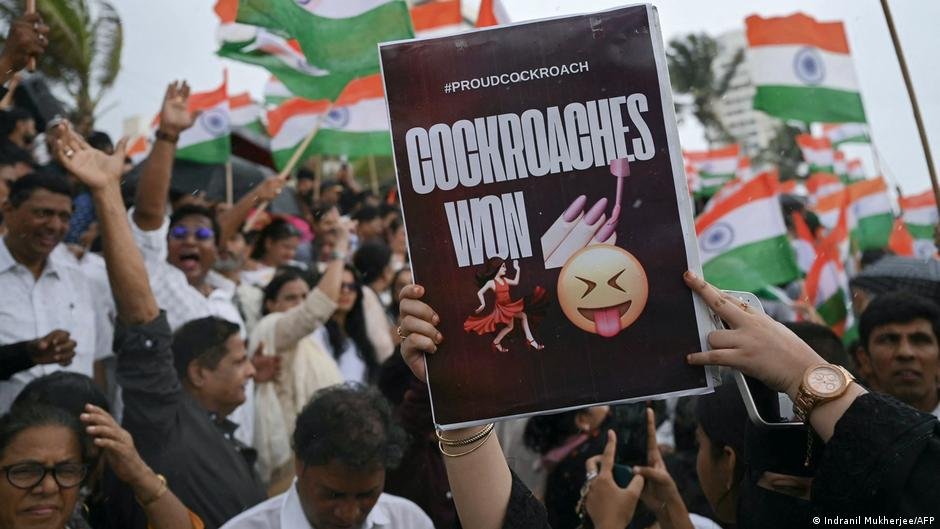
On Saturday, student protesters hugged, danced and climbed barricades as victory slogans echoed at New Delhi’s historic Jantar Mantar protest site.
After weeks of demonstrations, marathon negotiations and repeated government denials, a movement called the “Cockroach Janata Party (CJP)” succeeded in its demand for Indian Education Minister Dharmendra Pradhan to step down.
The movement began on social media as a satirical activist campaign after a question paper for the highly competitive NEET exam was leaked in early May.
With Pradhan’s resignation, the government also agreed to provide maximum possible compensation to the families of students who died by suicide following the NEET paper leak controversy. Additionally, it promised to withdraw criminal cases against the protesters, refrain from taking legal action in the future, and continue discussions on the CJP’s five-point charter for educational examination reform.
In return, the CJP announced that it was calling off further protest action “in good faith”, adding that it would closely monitor whether the government’s promises were implemented.
“This is a victory for democracy,” CJP founder Abhijit Dubke told thousands of cheering supporters.
Prime Minister Narendra Modi’s Bharatiya Janata Party (BJP) has insisted on meeting some protest demands, reflecting responsible governance rather than capitulation.
Home Minister Amit Shah said, “Pradhan’s resignation is an example of putting students and the country above political positions.”
However, the resignation of a cabinet minister following a public outcry amounts to a rare retreat by the Modi government. Overall, the concessions mark a notable victory for a movement that the government initially dismissed as little more than a social media campaign.
“One should not underestimate student power. Finally, our voice has been heard. When we are united, we can achieve many things,” Uma Singh, a CJP supporter from eastern Bihar state who is camping in New Delhi, told DW.
‘Cockroach’ movement forces a rare BJP retreat
About 48 hours before Pradhan’s resignation, senior Hindu nationalist BJP and government sources had said his removal was not being seriously considered, even as protests grew in Delhi while solidarity demonstrations spread to cities across India.
Earlier concessions, including the removal of 47 National Testing Agency officials, promises of fast-track courts and administrative reshuffle, failed to satisfy the protesters.
At the same time, the government faced growing concerns that the confrontation would overshadow the monsoon session of Parliament and hand the opposition a powerful political issue.
Facing increasing pressure on the streets and inside Parliament, the BJP changed course.
Indian activist Amrita Johri believes that the victory of the ‘Cockroach’ movement marks a major shift in the political debate in India.
“The significance of the movement is much more than the resignation of a minister. It shows that a loosely organized generation of young Indians can demand political concessions from a government that has long been considered resistant to street pressure,” Johri told DW.
He said, “It shifted the debate away from exam scams to larger questions about whether India’s institutions are still considered fair, transparent and accountable. The electoral mandate may confer power, but lasting authority depends on public trust.”
Beyond immediate political solutions, the government’s bigger challenge is to rebuild public trust in the institutions on which millions of young Indians depend for opportunity.
Gilles Verniers, a political scientist at the Paris-based Sciences Po public research university, believes the episode has also exposed the weakness in the political instincts of the BJP.
“Modi’s usual strategy of staying above the polls, making sweeping promises and shifting responsibility downwards failed this time,” Verniers told DW.
“The minister’s resignation is a clear victory for the protesters and a personal blow to a prime minister who stood by them to the end.”
Verniers said, “It exposed a ruling party that was unprepared for a movement that was neither regional nor partisan, and a political class unaccustomed to a generation that was willing to openly challenge power rather than defer to it.”
BJP generally does not bow under pressure
In the past, the Modi government has rarely seemed willing to bow to sustained public pressure.
The closest comparison came to the massive farmers’ protests, during which an estimated 700 to 750 protesters died, before the government repealed three contentious farm laws in 2021.
Nevertheless, the law was withdrawn without ministerial accountability. However, this time a cabinet minister has paid the political price.
The situation has also presented evidence to the opposition that continued mobilization on issues like unemployment, education and governance can put the government under pressure.
Senior Congress leader Jairam Ramesh described Pradhan’s resignation as “the victory of a generation tired of struggling in an unfair and corrupt system” and argued that sustained pressure from students ultimately forced the Prime Minister to withdraw his political support for the Education Minister.
On its part, the BJP argues that it acted responsibly to restore faith in the country’s education system and protect the interests of students.
Can the protest movement move forward?
The next test for the youth-led movement is whether it can transform this political momentum into a sustainable platform for institutional reform.
Talks will continue with the government on its five-point exam reform charter, and CJP leaders have warned that they will return to the streets if the promised changes fail.
The challenge is equally important for the government.
The immediate crisis may have passed, but the government has learned that a decentralized, youth-driven movement can rapidly shape the national political conversation.
Whether the CJP becomes an enduring political force or fades away after achieving its immediate goals remains uncertain.
There is no longer any doubt that it forced one of India’s most powerful governments into a concession that few believed could be made just a few weeks ago, reminding both politicians and young voters that organized public pressure can still shape Indian politics.
Edited by: Wesley Rahn