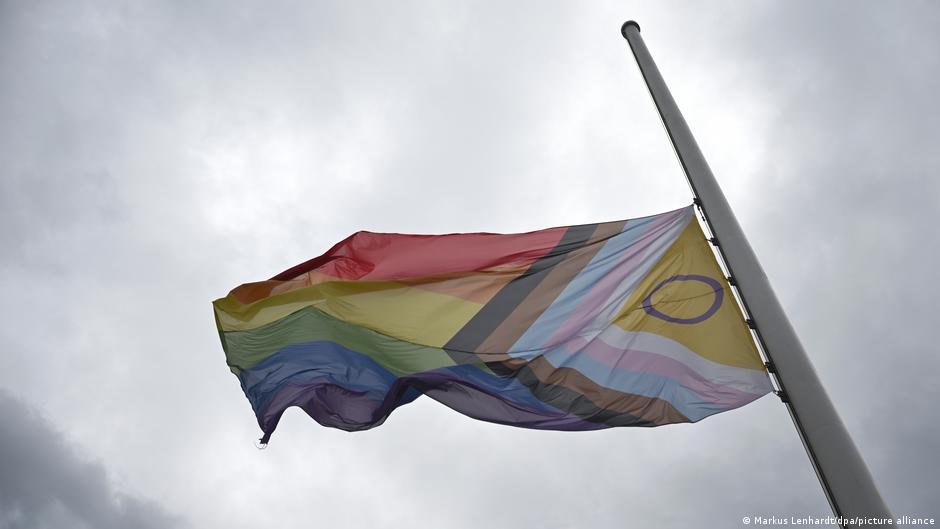
Germany is still recovering from a weekend car attack on its Berlin Pride festival. Politicians are in deep discussion about what consequences the country will have to face.
The center-left Social Democrats (SPD) are now making another effort to enshrine LGBTQ+ rights in the German constitution, known as the Basic Law. Article 3 The Basic Law addresses equality before the law, and currently states that, “No person shall be favored or disfavored because of sex, parentage, race, language, homeland and origin, belief or religious or political opinion. No person shall be discriminated against because of disability.”
But no mention is made of gender identity or sexual orientation. The SPD wants to change this.
Germany: progressive, but with gaps
There are still areas in Germany where queer people – that is, individuals who identify as lesbian, gay, bisexual, transgender, intersex, asexual, non-binary, pangender and others – are still not fully equal under the law. In addition to the lack of constitutional protection, ancestral laws are also a concern.
When a heterosexual couple has a child, the biological mother and her husband are automatically recognized as the child’s legal parents. (When a heterosexual couple is unmarried, the biological father must submit a formal declaration to the youth welfare office to recognize his paternity in order to be legally considered the father of the child.)
However, in promiscuous family groups, the legal situation is far more complex and often requires lengthy legal proceedings to establish paternity. Meanwhile, surrogacy is illegal in Germany – a position the ruling conservative Christian Democratic (CDU) party has maintained for years. Despite defending this position in the past, high-ranking CDU politician Jens Spahn recently revealed that he had circumvented this ban and that he and his husband had a child through surrogacy in the US. As a result he was pressured to resign as leader of the parliamentary group.
Hate crimes and violent attacks on gay people have increased, and many continue to report discrimination in their daily lives. But compared to other European countries, Germany still ranks relatively high in terms of legal equality for gay people.
In a comparison of 49 European countries, the International Lesbian, Gay, Bisexual, Trans and Intersex Association (ILGA), a global umbrella organization for LGBTQ+ advocacy groups, ranked Germany seventh in terms of protection and equality for gay residents. Spain is in first place, while Russia comes in last place.
Spain: leader in Europe
Spain’s leading role in LGBTQ+ rights is rooted in its recent history. Before the end of Francisco Franco’s dictatorship in 1975, gay people in Spain were tortured and imprisoned. The changes that followed brought a wave of liberalization and modernization.
The process of decriminalizing homosexuality began in 1979. In 2005, Spain introduced marriage for same-sex couples, including full adoption rights. In 2023, the Spanish Parliament passed a comprehensive self-determination law. Anyone aged 16 or over can now change their legal gender and first name in official documents with a simple declaration at the Civil Registry Office.
Transgender identities are no longer classified as disorders in Spain’s healthcare system. Spain has strong anti-discrimination laws, an equality independent authority and a legal requirement for companies with more than 50 employees to implement active inclusion and diversity plans for LGBTQ+ employees.
According to regular surveys, these legal advances are supported by the majority of Spain’s population. Pride events such as Madrid Pride are one of the largest in the world and receive support from government institutions of various political parties.
Other European countries with similar progressive records include Malta, Iceland, Belgium and Denmark.
Italy: Increasing restrictions amid shift to the right
Under the right-wing nationalist government of Prime Minister Giorgia Meloni, pressure on the LGBTQ+ community has increased significantly in recent years.
Italy still does not have marriage equality, nor does it give gay couples the right to adopt. The Interior Ministry and government prosecutors have also challenged previously issued birth certificates, resulting in some non-biological mothers being stripped of legal motherhood for their children years after they were born.
In late 2024, the Italian Parliament passed a law declaring surrogacy a “universal crime”. As a result, citizens who have children through surrogacy abroad may face prison sentences and substantial fines upon returning.
Italy also lacks a national anti-discrimination law that explicitly criminalizes hate crimes based on sexual orientation or gender identity. Archie, the country’s largest LGBTQ+ organisation, has reported an alarming increase in violent crimes and hate crimes targeting gay people.
Hungary: Orban’s legacy and its reversal?
Hungary’s legal environment for LGBTQ+ people is also restrictive and has been shaped by years of systematic legislative strictures under former Prime Minister Viktor Orbán.
In 2020, Hungary eliminated the possibility for transgender people to amend the sex recorded in their birth register. The Constitution of Hungary clearly defines marriage as “the union of one man and one woman”. Same-sex couples are barred from adopting. In 2021, Hungary passed a law under the guise of “child protection” that prohibits any positive depiction of homosexuality or transgender identity for minors. The law has since been ruled incompatible with EU law by the European Court of Justice.
However, Orban’s successor, Peter Magyar, who takes office in May 2026, may now take the country in a different direction. One indication of this was Budapest Pride in June 2026, a peaceful celebration attended by thousands of people.
The event had been banned a year earlier, at which time the government had cited assembly laws.
The Magyar government has also announced plans to fundamentally revise existing anti-LGBTQ+ legislation and bring it in line with EU law. But the gay community in Hungary remains cautious. Repealing the Orbán-era law is likely to be a complex undertaking that may face stiff political and social resistance.
Russia: systematic oppression
Russia has the most repressive anti-LGBTQ+ laws in Europe, according to ILGA rainbow map. The Russian Supreme Court has designated the “LGBT movement” as “extremist” and banned it – even though no such organization exists. Authorities have continued raids targeting activists, publishers, and private individuals. The jail sentence can be up to 12 years. Positive or neutral expression of LGBTQ+ identity and life has been criminalized, and gender recognition procedures are banned.
The Russian LGBTQ+ community is under particular pressure following Russia’s full-scale invasion of Ukraine in 2022, which President Vladimir Putin has argued in the past is a proxy fight with the West and an attempt to undermine Russian society’s “traditional family values” by promoting LGBTQ+ rights.
Under the extremist designation, queer people in Russia, as well as relatives and supporter activists, often live in fear of police and state violence. Many people have fled the country.
This article was originally published in German.