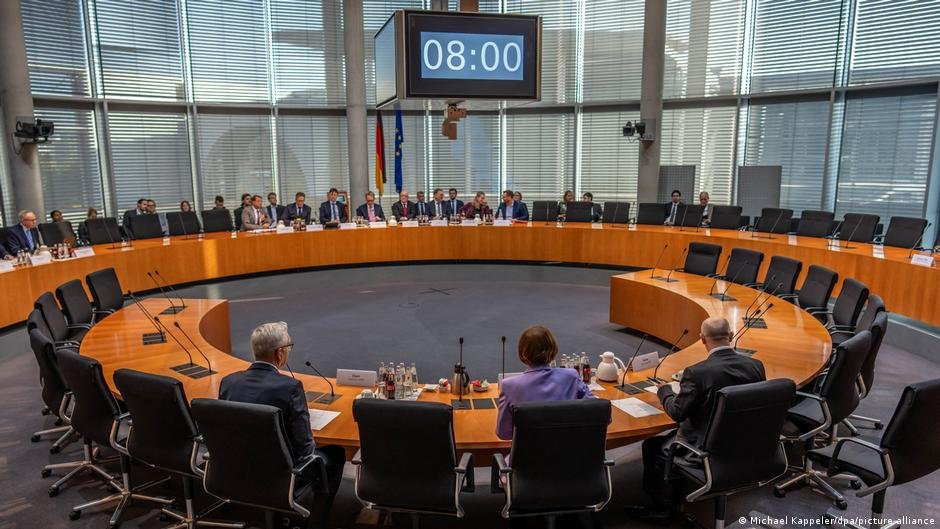
Chinese high-tech could be security risk — domestic intelligence agency
High-tech goods from China, such as electric vehicles or even robot vacuum cleaners, could represent a security risk, the BfV domestic intelligence agency has warned.
BfV head Sinan Selen told a hearing of parliament’s intelligence oversight committee in Berlin that the issue was of “great concern” to him.
“I already see substantial shortcomings that create potential for abuse,” he said.
Data collected via the products could be passed on to “state agencies”, he said, leading to risks including “potential shutdown of entire products.”
“In terms of resilience and availability (this) could confront us with problems,” he said.
The warning comes as sales of high-tech products to Germany are growing and Chinese manufacturers compete ever more strongly with their German counterparts.
https://p.dw.com/p/5NmKL
Deutsche Telekom targets billions in AI savings
Deutsche Telekom plans to use artificial intelligence and automation to cut annual costs by around €2.5 billion ($2.9 billion) by 2030.
The target covers the German telecommunications giant’s operations outside the United States.
Deutsche Telekom is already using AI for repetitive tasks in network operations, customer service, software development and administration.
Its “Frag Magenta” chatbot handled around 2.6 million customer service calls in the first half of 2026, the company said.
At T-Mobile US, in which Deutsche Telekom holds a majority stake, AI agents now handle 40% of customer contacts.
Outside the US, Deutsche Telekom expects savings from AI and automation to reach €1.1 billion by 2027 and €2.5 billion by 2030.
“AI is fundamentally changing Deutsche Telekom,” CEO Tim Höttges said. He said the technology was improving networks and customer service while opening up new business models.”
https://p.dw.com/p/5NmK5
IN DEPTH: Germany trainer Klopp’s first internationals
The German football team has had its first four international matches under its new coach, Jürgen Klopp — a mixture of success, failure and in-betweens.
DW analyzes Klopp’s methods and relationship with the team as shown over the past couple of months in this article: Klopp’s first Germany internationals: What did we learn?
https://p.dw.com/p/5Nm95
Social Democrat groups oppose coalition’s working week reform
Grassroots groups within the Social Democrats (SPD) — the junior partner in Germany’s conservative-led coalition government — have spoken out against plans to “flexibilize” the working week in a position paper.
In question is a paragraph in the coalition agreement that speaks of “the possibility of a weekly rather than a daily maximum working time.”
The conservative Christian Democrat (CDU)-Christian Social Union (CSU) bloc has pushed to have a maximum number of hours that can be worked per week rather than the current daily standard limit of eight hours.
Although the four SPD groups fundamentally accept the idea, they are calling for strict controls, among other things wanting collective labor agreements under which both parties work out details as “a necessary prerequisite.”
They also say exceptions should made in certain sectors where illegal employment is prevalent.
Employers’ associations in June objected to the idea of collective labor agreements as a coercive measure when it was put forward by the Labor Ministry, leading to its retraction, with the CDU saying that it went against the coalition agreement.
The position paper submitted by the SPD groups could thus lead to a new split in the coalition, stating as it does: “It is not in keeping with a modern reform of working hours regulation or a better compatibility of work and family when bosses can decide alone when employees can knock off work.”
https://p.dw.com/p/5NmE3
German court sets limits on deportation detention
Germany’s Federal Court of Justice (BGH) has ruled that a person facing deportation cannot be detained as a flight risk simply because their past behavior suggests they might try to avoid being deported.
The case concerned a stateless Palestinian man who sought asylum at a police station in Germany in April 2023. Austrian authorities had already issued a decision requiring him to return.
A court in the German city of Duisburg ordered the man detained while his transfer was being arranged.
The courts argued that his previous actions indicated a risk that he would try to evade deportation. He had lived in Austria since 2020, where two asylum applications had been rejected, and had also applied for asylum in Belgium and Germany.
But the man had never explicitly said that he intended to avoid deportation.
The BGH ruled that his behavior alone was not enough to establish this particular ground for detention.
A person’s words do not necessarily have to state the intention literally, the judges said. But it must be “clear and unambiguous” from what the person says and the circumstances that they intend to evade deportation.
The court found that the man’s detention from May 7 to June 6, 2023 had therefore violated his rights.
German immigration law provides several other grounds on which people can be detained pending deportation.
https://p.dw.com/p/5Nm5n
IN DEPTH: Two German scientists in Nobel-winning trio
Peter Hegemann from Germany’s Humbolt University and Georg Nagel from the University of Würzburg have won this year’s Nobel Prize in medicine alongside their US colleague, Karl Deisseroth.
You can read more about their achievements in this article: German and US scientists win Nobel Prize in medicine
https://p.dw.com/p/5Nlr0
Germany at risk of ‘violent conflict’ with Russia — intelligence chief
Germany is facing a growing risk of a violent confrontation with Russia as Moscow continues a campaign of hybrid warfare with other countries in Europe, the head of Germany’s BND foreign intelligence service warned on Monday.
Speaking before the Bundestag at the annual public hearing of intelligence chiefs, Martin Jäger said: “The confrontation we are facing with Russia has taken on a new, more dangerous dimension.”
“Germany is in danger of becoming embroiled in a violent conflict with Russia — the attempted attack in Leipzig is just one example,” he said.
“No other country currently poses such a direct, comprehensive, and concrete threat to Germany,” he added.
Jäger was referring to a drone attack at Leipzig airport in August that the German government has blamed on Russia.
Russia has repeatedly denied any intention of attacking NATO
countries, with President Vladimir Putin, however, saying on Thursday: “But if we are subjected to aggression, we will have no choice but to respond.”
https://p.dw.com/p/5NleA
Draft bill aims to help domestic abuse victims move house
The Justice Ministry has put forward a draft bill making it easier for domestic abuse victims to leave joint tenancy contracts and obliging perpetrators to pay for any ensuing costs.
“The path to a self-determined and safe life after domestic abuse is often still a long one,” Justice Minister Stefanie Hubig told newspapers from the Funke media group.
“We want to make it a bit easier,” she added.
She said the draft bill aimed to give domestic abuse victims clear legal rights against their abusers, including being able to demand that the latter pay any costs arising from the premature termination of the joint lease.
More protection for others in the household
The bill also envisages increased protection for children and relatives of victims.
Under current German law, family courts can impose bans on domestic abusers taking up contact with or approaching their victims but not other members of the same household.
Hubig said the draft law foresaw such protections being extended to other people dependent on the abuser without any separate application being made.
According to police statistics, nearly 266,000 people in Germany were affected by domestic abuse in 2024, 70% of them women and girls.
The Justice Ministry has said the real figure is likely to be much higher, estimating that 95% of cases go unreported.
https://p.dw.com/p/5NlFS
October 5, 2026
E-vehicle subsidy program has ‘exceeded our expectations’ — environment minister
Since May, the German government has paid out subsidies to 100,000 households wanting to procure an electric vehicle, Environment Minister Carsten Schneider told the mass-circulation Bild newspaper on Monday.
Schneider, from junior coalition partner the Social Democrats (SPD), said the program, worth €3 billion ($3.36 billion), had “far exceeded our expectations.”
He said that every additional electric vehicle protected households from high fuel prices and made the county less dependent on expensive oil imports and international conflicts.
According to the Bild article, half of households applying for the subsidy had a maximum annual income of €45,000 and three-quarters of them €60,000.
Schneider said he found it particularly important that this graduation of payments according to income functioned properly.
Preliminary assessments have shown that less than 15% of households that applied for the subsidy were looking to buy vehicles from China, contradicting expert views that Chinese automakers would profit the most.
https://p.dw.com/p/5Nl0U
Left Party takes Economy Minister Reiche to top court
The Left Party is taking a row about a remark made by Economy Minister Katherina Reiche to the Constitutional Court after Reiche failed to give a declaration to cease and desist on time.
Reiche had posted a remark on the official Instagram site of her ministry saying: “Antisemitism and expropriation endanger Germany and the economy.”
The comment refers first to the unproven accusation that the Left Party is antisemitic in its ideology and then to the Left Party’s plan to socialize apartments from corporate landlords in a bid to reduce skyrocketing rents in the capital.
Reiche doubled down on her criticism of the socialist party in comments she made during a visit to Ukraine over the weekend, telling the Sunday edition of the mass-circulation Bild she feared a national loss of growth if a leftist coalition took power in Berlin.
“What the Left Party represents here in Berlin and the people that it represents is dangerous not only for Berlin but for our country,” she said.
The Berlin branch of the Left Party has accused the Christian Democrats (CDU), to which Reiche and Chancellor Friedrich Merz belong, of carrying out a “large-scale campaign” against its top candidate, Elif Eralp, who won recent state elections in Berlin.
It has taken legal action over similar statements on CDU interior ministry websites in various states, criticizing the use of official government channels to denigrate another party.
The ministries in Saxony and Schleswig Holstein withdrew the statements, but those in Baden-Württemberg, Brandenburg and Hesse have so far not done so.
https://p.dw.com/p/5NkiE
Welcome to our coverage
DW’s newsroom in Bonn bids guten Tag to all its users!
The Left Party’s victory in state elections in Berlin continues to make waves, with conservatives around the country not amused at the prospect of a socialist-led government in the capital region.
The party is fighting back against what it sees as an illegal campaign against it by the Christian Democrats (CDU) and is now taking the economy minister to a top court over remarks she made on her ministry’s website.
The environment minister, Carsten Schneider from the Social Democrats (SPD), has voiced satisfaction over the number of households taking advantage of government subsidies to procure an electric vehicle.
And the justice minister wants to help victims of domestic violence escape the proximity with their tormentors by making it easier for them to move house.
For more on these and other stories, please read on!
https://p.dw.com/p/5Nkkj