
Within the framework of the recent DEVCONNECT held in Buenos Aires, Argentina, the ecosystem of cryptocurrencies and decentralized technology showed a facet that goes beyond financial speculation: the redefinition of digital property.
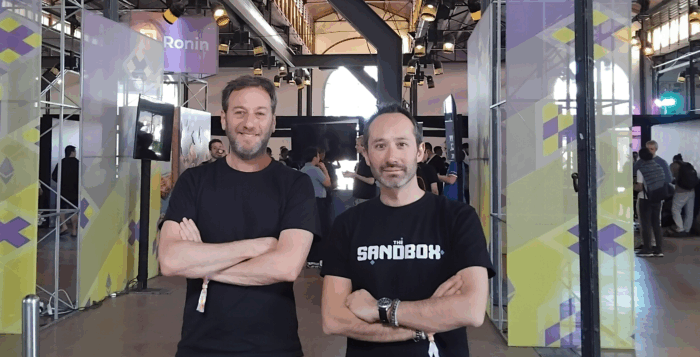
During the event, which brought together thousands of developers and enthusiasts, CriptoNoticias had the opportunity to speak exclusively with two leaders in the digital entertainment industry: Sebastien Borget, COO and co-founder of The Sandbox, one of the most important metaverses in the ecosystem, and Mariano Rubinstein, CEO of Sura Gaming, a company dedicated to building communities in the Web3 environment.
Both executives agreed on a premise that marks a turning point for the industry: the traditional video game modelwhere users invest time and money without obtaining real ownership of their items, is coming to an end.
The incorporation of blockchains and decentralized accounting networks is laying the foundations for a new standard where digital property rights are inalienable.
Argentina as the epicenter of innovation
The choice of Buenos Aires as the headquarters of DEVCONNECT was not coincidental. The Argentine capital has established itself as a hub neuralgic technology in Latin America. For Sebastien Borget, the experience in the South American country confirmed the vitality of the ecosystem, moving away from the narrative that these technologies depend on a single figure or centralized entity.
“It’s always great to come to DEVCONNECT because it’s one of the biggest events for the Ethereum community and you can really feel how big, engaged and diverse it is,” said Borget.
The co-founder of The Sandbox highlighted that the Ethereum community has evolved significantly: “It helps shape the public image that people have of Ethereum beyond Vitalik Buterin as if he were one man… it is no longer a one-person show, you really feel like there are thousands of people.”
Regarding the specific role of Argentina, Borget, who has visited the country since 2007, pointed out that the nation has been a pioneer out of necessity and talent.
«The world needs to see for itself when it comes how great Argentina is, both for the quality of life, and for the development and technology side. And it is a country that more than 10 years ago was a pioneer, for obvious reasons due to inflation and the economy, in looking at how technology can change part of that.
Sebastien Borge, co-founder of The Sandbox.
Sura Gaming’s Rubinstein supported this view, underlining the magnitude of the event compared to other global venues. «I think that Argentina has a super important position in the market and it does not always show itself. And an event like this […] “I think it is bigger than what was done in Bangkok, bigger than many other places in the world and super important,” he said.
For Rubinstein, local adoption has multiple verticals: «Both from the developers, who are a lot of people developing products and solutions, and from the users. Adoption is very strong.
The current state of “Gaming Web3”: beyond the hype
A frequent question in the market is the health of the cryptocurrency network-based gaming sector after the bull cycle of 2021. Far from having disappeared, the industry shows robust growth metrics, albeit with a more dispersed infrastructure.
“Even though people don’t necessarily talk a lot in the media or press about the metaverse or gaming Web3, what we are seeing first of all is that it is bigger than ever in terms of number of users and number of transactions,” explained Borget.
However, he warned about the current fragmentation of the ecosystem: “It’s divided between the Telegram network, Aptos, you have Sui, you have Avalanche, and of course Polygon and Ethereum and some layer 2 (L2) now.”
This maturation stage has brought with it a substantial improvement in the final product.. According to The Sandbox manager, “the quality of the games has generally increased as well. “They are building towards better quality of gameplay, longer games with deeper narrative and greater engagement.”
For his part, Rubinstein emphasized the evolution of business models, distancing himself from the initial frenzy of “Play-to-Earn» (play to win) popularized by cases like Axie Infinity. «At the time, between the pandemic plus the boom that was Axie Infinity, there was only one business model which was Play-to-Earn. Today I think it is much more open and the Gaming Web3 tends to be much more mainstream», he analyzed.
The Argentine developer and businessman was categorical about technological inevitability:
«Today I do not see that in the future there will be games that do not use blockchain technology. It does not mean that all these games will have a business model that is Play-to-Earn. “Business models are expanding.”
Mariano Rubinstein, CEO of Sura Gaming.
Digital property as a fundamental right
Much of the conversation revolved around paradigm shift that represents the real ownership of digital assets. For Borget, this transcends entertainment; It’s about rights. “I believe that property rights, whether physical or digital goods, is a fundamental human right and that Ethereum and blockchain technology allow that with NFTs,” he said.
This vision projects a future where the underlying technology becomes invisible to the user, but its benefits are tangible. «Basically there is no future without blockchain gaming. The technology is going to be fluid and integrated. Ownership of our digital assets is going to be the norm,” Borget added.
In addition, he highlighted the opening of large traditional platforms: “We are already seeing a movement where even existing stores, App Store, Google Play Store, are now forced to accept alternative forms of payment to theirs and allow games based on Web3, which is a big step forward.”
Rubinstein fully agreed, reinforcing the idea of technological “invisibility” necessary for mass adoption. «I see that every game should use blockchain technology. However, not all games should have a business model Play-to-Earn. “There will be many business models like we have now, but the technology should be behind and invisible to the user.”
Latin America increases its adoption due to need and demographics
When analyzing user behavior, both specialists pointed to Latin America as a key region, driven by a young population and particular macroeconomic conditions.
«I think the general average age of the population in the LATAM region is quite young, probably in the average of 30 or 35 years. Due to certain political and monetary instability, countries in Latam have been leading crypto adoption for 10 years… first as stablecoins and bitcoin or Ethereum as a form of payment,” explained Borget.
This familiarity with digital assets facilitates the transition to economies within video games. “I have no doubt that people have already entered much more into the idea that what they win within games, they convert it into some form of income, they have much more savings in crypto than they actually have in their bank account,” added the co-founder of The Sandbox.
Rubinstein confirmed this trend from his operational experience: “The blockchain gaming It is huge in Southeast Asia and South America. They are the two main regions right now.
Innovation and alliances: SANDchain and Sura Gaming
During the interview, the joint work between The Sandbox and Sura Gaming was also discussed, particularly in relation to SANDchaina new layer 2 solution on Ethereum. Borget described this development as a tool focused on the “creator economy.”
“We want to empower content creators with the ability to launch their own loyalty program to engage their audience and fans, and distribute points that can be on-chain,” explained Borget.
The alliance with Sura Gaming seeks to capitalize on the network of builders in the region: «As Sura is this hub, network, accelerator program and builder in the space, [buscamos] “How can we together enable game developers and different builders in the Latam region.”
Mariano Rubinstein was optimistic about the potential of this infrastructure: “I think what is coming is very powerful because what SANDchain tries to do at some point is the same thing that we do, which is empower creators.”

A favorable institutional environment in Argentina
To close, the interviewees reflected on the institutional context in Argentina, highlighting a unprecedented openness towards digital assets in both the public and private sectors.
Borget highlighted existing initiatives: “It is interesting to look at what the Argentine government has been doing in terms of general blockchain adoption and support.”
Rubinstein expanded on this panorama by mentioning the participation of high-profile figures in DEVCONNECT, such as the president of the Argentine Football Association (AFA), Claudio “Chiqui” Tapia, and Eduardo Elsztain, president of IRSA. “I think tokenization is opening up to all areas of the economy,” said the CEO of Sura Gaming.