

Every database is a point of failure, even when the custodian is not the one under attack.
Self-custody eliminates dependency on third parties by design and reduces the attack surface.
This article was written by Matías Mathey. The author has a diploma in cryptoeconomics, it is expert university in blockchain, DeFi, NFT and self-custody. In addition, he is a speaker at {(₿)} Bitcoin.ar, an educator at Satoshi Bookstore (B4OS) and an official partner of Liana Wallet (wallet for inheritances).
___________________________________________________________________________________
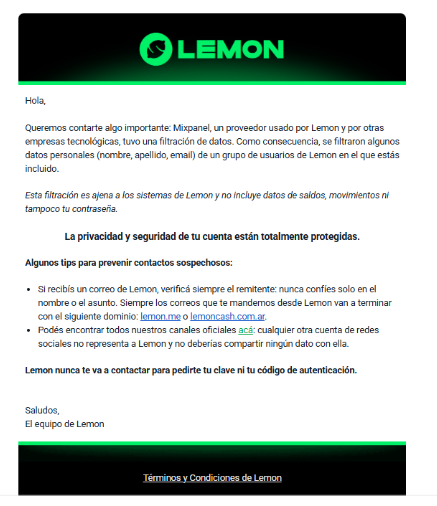
The recent data leak in Lemon, originating from its provider Mixpanel, once again brings to the table a problem that the cryptocurrency ecosystem continues to underestimate: the fragility of depending on third parties to custody and manage our digital assets.
Even though in this case no funds or passwords were exposed, names, surnames and emails of users were compromised, enough information to enable highly effective social engineering attacks.
For those of us who work in the education and design of self-custody systems, this incident is a shows more of something that we have repeated for years: real security is not left in the hands of third parties.
The silent risk of personal data in the hands of third parties
Although the news indicates that no keys were leaked, passwords nor financial movements, the exposure of personal data has profound consequences.
An email associated with a financial application allows an attacker to construct a perfectly credible message. And today, the spear phishing (spear phishing) is more dangerous than any line of malicious code.
Users who believe they “just” leaked their email underestimate the risk. The reality is different:
- Attackers can send emails simulating technical support.
- They can ask for “verification” of data or 2FA codes.
- They can induce you to install fake applications.
- They can compromise other accounts that use the same email.
Leaks do not steal funds: they steal the user’s self-confidence, weakening one of the pillars of Bitcoin: individual sovereignty.
The structural error: guarding where you operate
Self-custody education begins with understanding that exchanges, fintechs and service providers are not wallets: they are companies. They have employees, suppliers, servers, integrations, third parties and fourth parties. Each of these elements is a potential attack vector.
Relying on these platforms to store Bitcoin or sensitive information not only accumulates risk, it concentrates it. In the case of Lemon, three links were seen: Mixpanel + Lemon + User.
When one breaks, the entire chain is compromised. This model goes in the opposite direction to Bitcoin’s design principle– Elimination of single points of failure.
Self-custody is not a philosophical concept or a libertarian ideal: it is a technical security model. A model in which: There is no centralized database with your information.
No one can freeze, censor or manipulate your funds. You do not depend on servers, companies or external providers. Your identity is not associated with the possession of your keys.
When you control your private keys, the attack surface is reduced to a single element: what we know as single point of failureyourself. And although this implies responsibility, it also implies freedom.
Companies can have robust audits, security policies, data encryption, and vendors; but none of that changes the nature of the risk: if a database exists, there is the possibility of a breach.
Leaks will continue to happen, what changes is how they affect you
The cryptocurrency ecosystem is not maturing towards fewer leaks, but towards more sophisticated leaks. The supplier chain is increasingly extensive. The volume of data is increasing. The economic incentive to attack is increasingly higher.
Expecting no custodian to fail is as unrealistic as expecting no bank to be hacked, no company to be breached, or no employee to make human error.
The difference is simple: if you depend on custodians, each other’s mistake affects you personally. If you use self-custody, someone else’s mistake cannot touch your funds or your keys.
What the ecosystem should learn from this incident
Third-party providers matter as much as the primary custodian. The user rarely knows how many systems have indirect access to their data.
Communication and transparency are essential. Companies that do not report quickly worsen the damage. Self-custody is the only real protection against systemic events. It does not protect emails, but it does protect assets.
Safety education is not optional. The user must learn to recognize phishingfake links and suspicious emails.
Conclusion: the future is not with less self-custody, but with more
Incidents like Lemon’s should not cause panic, but rather mature. Remind us that for example Bitcoin was not created so that we leave the responsibility on othersbut so that we could regain control over our money.
Self-custody is demanding, it does require learning, yes. But it is the only tool that makes the user the real owner of their assets.
And when the traditional financial and cryptocurrency worlds continue to demonstrate that no third party is infallible, owning your keys is not a technical recommendation: it is a must if you want your bitcoins to remain yours.
Disclaimer: The views and opinions expressed in this article belong to its author and do not necessarily reflect those of CriptoNoticias. The author’s opinion is for informational purposes and under no circumstances constitutes an investment recommendation or financial advice.