
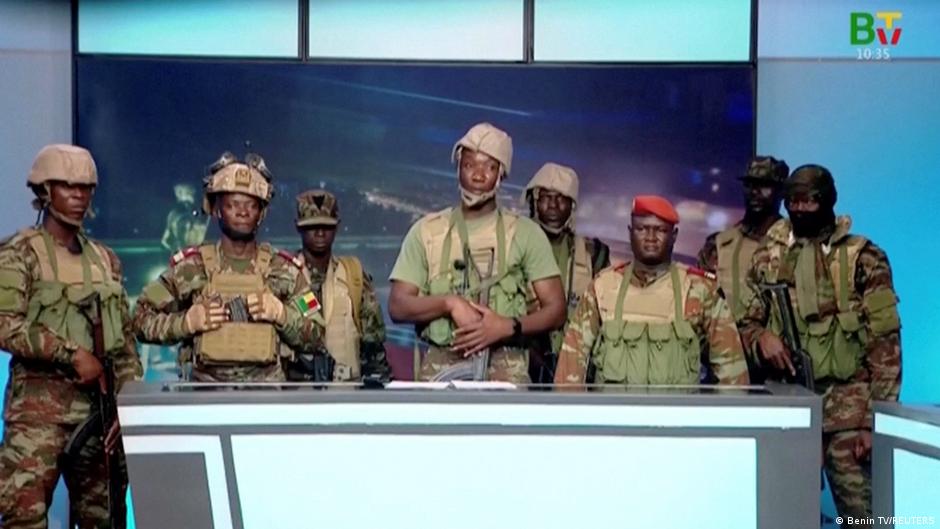
ECOWAS troops from Ghana, Ivory Coast, Nigeria and Sierra Leone will be deployed to Benin, where President Patrice Talon insisted in a TV address that the situation was “under control” after a failed coup.
West Africa’s regional security force, ECOWAS, has deployed additional troops to Benin in the wake of the failed government coup at the hands of military actors.
Officials say ECOWAS troops will “support the Government of Benin and the Republican Army to maintain the constitutional order and the integrity of the territory of the Republic of Benin.”
key points
- Soldiers were seen on TV Sunday saying the Talon had been removed
- However, the government and president later considered the coup a failure.
- 14 arrests were made and additional troops were deployed from neighboring countries
Talon said in an address to the nation that the situation is ‘completely under control’
President Patrice Talon spoke about the situation in a nationally televised address on Sunday.
“I want to assure you that the situation is completely under control and therefore invite you to resume your activities peacefully this evening,” Talon said on state broadcaster Benin TV.
“Security and public order will be maintained throughout the national territory,” he said. Talon states that the “treachery” of the rogue soldiers attempting to remove him will not go unpunished.
Benin government arrests 14 over failed coup attempt
Benin’s government said on Sunday that 14 people had been arrested in connection with an attempted military coup.
“A small group of soldiers launched a rebellion with the goal of destabilizing the state and its institutions,” Interior Minister Alassane Seydou said in a statement.
“In response to this situation, the Armed Forces of Benin and their leadership, in accordance with their oath, maintained control of the situation and foiled the maneuver.”
What do we know about the coup attempt in Benin?
Earlier on Sunday, soldiers of a group calling themselves the Military Committee for Refoundation (Commit Militaire for Refutation)or CMR, appeared on state television and announced that President Patrice Talon had been “removed from office as President of the Republic.”
All state institutions have also been dissolved and Lieutenant Colonel Pascal Tigri has been appointed chairman of the military committee, the soldiers said.
“The army is committed to giving the Beninese people true hope for a new era where brotherhood, justice and work will prevail,” said a statement read by a soldier before the TV signal was cut.
The French embassy said on social media that “shooting was reported at Camp Guizou” near the president’s official residence in Cotonou, just south of the official capital of Porto Novo, Benin’s largest city and economic capital.
Government says coup attempt failed
However, government spokesmen immediately insisted that the apparent coup attempt had failed.
“Everything is fine,” Benin government spokesman Wilfred Hongabedji told The Associated Press on Sunday.
Another source told the French AFP news agency that President Talon was safe, adding:
“It’s a small group of people who only control the television. The regular army is gaining control. The city [of Cotonou] And the country is completely safe. It’s just a matter of time before everything returns to normal. The cleanup is going well.”
A military source also said that the situation was “under control” and that coup plotters had not taken over Talon’s residence or the presidential office.
Indeed, while AFP reported that state television buildings, some international institutions and a five-star hotel were blocked off by troops, no military presence was reported at the airport or the rest of the city, and residents were reportedly going about their regular business.
African organizations condemned the coup attempt
The Economic Community of West African States (ECOWAS), of which Benin is a member, called the coup attempt “unconstitutional” and “a subversion of the will of the Beninese people.”
The African Union said it “unequivocally condemns” the soldiers’ actions and urges them to return to their barracks.
What is the general situation in Benin?
Following independence from France in 1960, Benin saw several coups but entered a period of political stability under the two-decade rule of Marxist–Leninist President Mathieu Kérékou.
President Talon, a 67-year-old former businessman known as the “Cotton King of Cotonou”, has overseen solid economic growth in the West African nation during his ten-year tenure, which is due to end in April 2026, when elections are scheduled to be held.
However, like many countries in the region, Benin has experienced an increase in jihadist violence.
Last month, a military coup in Guinea-Bissau ousted former President Umaro Emballo after contested elections, while Niger, Burkina Faso, Mali and Guinea have also seen military coups.
Coup attempt means ‘widespread uncertainty’ – security analyst tells DW
Security analyst Beverly Ochieng spoke to DW about the group behind the attempt to seize power.
On why the group did not wait for the electoral process to take place next year, Ochieng said:
“Suspending the institutions means you are basically preventing that election from taking place and delegitimizing the process and even creating more public distrust in the process which has led to some controversy with opposition members.”
Ochieng explained that the faction was “trying to reset what we have seen across the region where militaries try to intervene when political tensions rise. They act as mediators, but sometimes they just complicate institutionalism and politics.”
On what the attempt on power means for Benin in the coming days, Ochieng said it means “rampant uncertainty”.
“In the coming days we are likely to see additional people arrested either in connection with this coup attempt; people who may support either the so-called coup leader.”
Edited by: Rana Taha, Roshni Majumdar