

There are several macroeconomic data that do not favor risky speculation, yet.
Much steeper interest rate cuts are needed, the analyst says.
Dennis Liu, an investor and financial specialist best known on online forums such as “VirtualBacon,” maintains that altcoins—alternative digital assets to bitcoin (BTC)—“feel dead” due to current market conditions.
“The end of QT matters, but it’s not QE. The Federal Reserve (FED) just stopped reducing the balance sheet by $6.5 trillion. This eliminates the headwind, but it doesn’t create a tailwind. Liquidity is not increasing yet. It’s just not decreasing anymore,” exposed the analyst.
Here it is important to go in parts to understand Liu’s point. The end of QT (Quantitative Tightening or quantitative tightening) by the US Federal Reserve is a major macroeconomic change, but it does not equate to a direct positive boost for the market.
The QT consists of the reduction of the FED’s balance sheet, withdrawing liquidity from the financial system; Its completion removes a headwind, but liquidity is not yet increasing, which explains why cryptocurrencies remain subdued.
While QE (Quantitative Easingor quantitative easing) is a monetary policy used by the FED to inject liquidity into the system. It does this through the purchase of bonds, with the aim of stimulating the economy and markets.
The difference between bitcoin and altcoins
VirtualBacon explains that bitcoin does not need QE but rather requires the money supply (M2) increases. «M2 continues to grow because the government continues to issue new debt. Therefore, BTC remains an attractive purchase, even in an unstable macroeconomic context,” he highlights.
To argue his point, the analyst shares a graph that compares the price of BTC with the size of the Federal Reserve’s balance sheet (WALCL). It shows how changes in the system’s liquidity, expansions or contractions of the balance sheet, have accompanied the main movements of BTC in recent years:
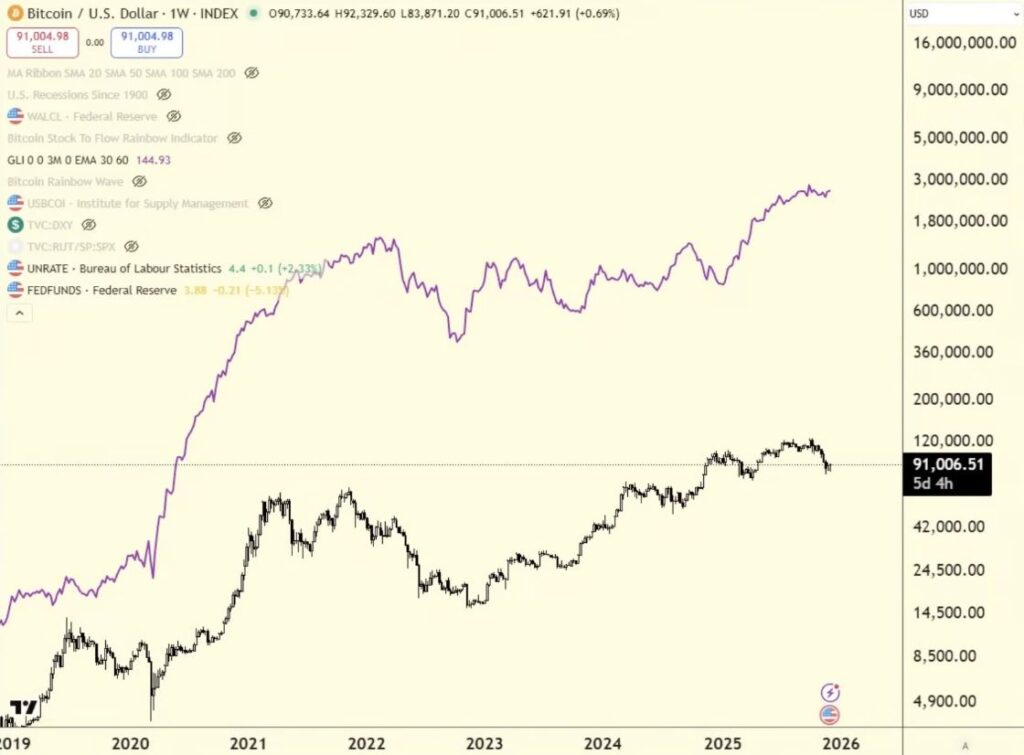
And at this point VirtualBacon makes the difference between BTC and the behavior of cryptocurrencies. «They are different. Its behavior depends on the liquidity of the central banks and the economic cycle, not on the growth of M2,” he details.
Furthermore, the specialist highlights that liquidity has not yet improved, unemployment in the United States continues to rise and the manufacturing sector price index remains weak. “This is why altcoins feel dead,” complete.
In simpler terms, altcoins depend on the liquidity of central banks and the economic cycle, unlike BTC, according to VirtualBacon’s thesis. So, with liquidity still not improving, unemployment still high, and the manufacturing index weak, altcoins feel dead.
Historically, the analyst says, each quantitative easing cycle since 2008 followed a clear pattern: first interest rates are cut, then QE begins, liquidity increases and altcoins skyrocket.
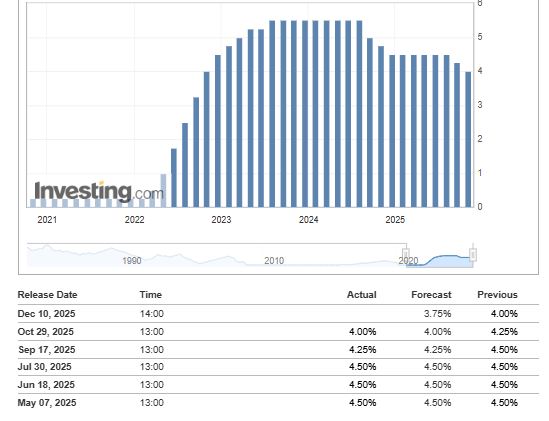
Currently, rates remain at 4%, which means that the conditions for a new QE do not exist. Therefore, the analyst maintains that altcoins have not yet shown a significant rebound.
What do altcoins need?
As CriptoNoticias has explained, assets considered risky, such as cryptocurrencies, benefit from rate cuts. This is because the cost of financing is reduced and liquidity in the markets increases.
For Liu, before QE returns, several conditions must be met. The first is that interest rates fall more than expected. “Historically, the FED only applies QE when rates are close to zero,” says the analyst.
Secondly, it mentions that TGA (Treasury General Account) liquidity must be used first: the government shutdown brought the TGA to $900 billion, with approximately $50 billion expected to return to the market in the next month.
On the other hand, he points out that, for QE to return, the economy must weaken even more. That is, more unemployment and a weaker manufacturing index.
“These conditions are not yet met. That is why QE will not arrive this year,” says VirtualBacon.

Besides, remark: “Any altcoin rallies we see now will be brief, not real. Until liquidity expands, consider each rally as a trade, not a cycle.”
However, this analysis assumes that the FED will only apply new stimulus measures, such as QE, when the interest rate is close to zero.
This does not take into account the possibility of monetary policy adapting to unexpected changes in the economy, which could affect the liquidity available to risk markets and, therefore, altcoins.
Furthermore, factors such as geopolitical pressures, unexpected market events or the need to stabilize certain financial sectors could motivate the implementation of QE-like measures even before all the mentioned conditions are met.