
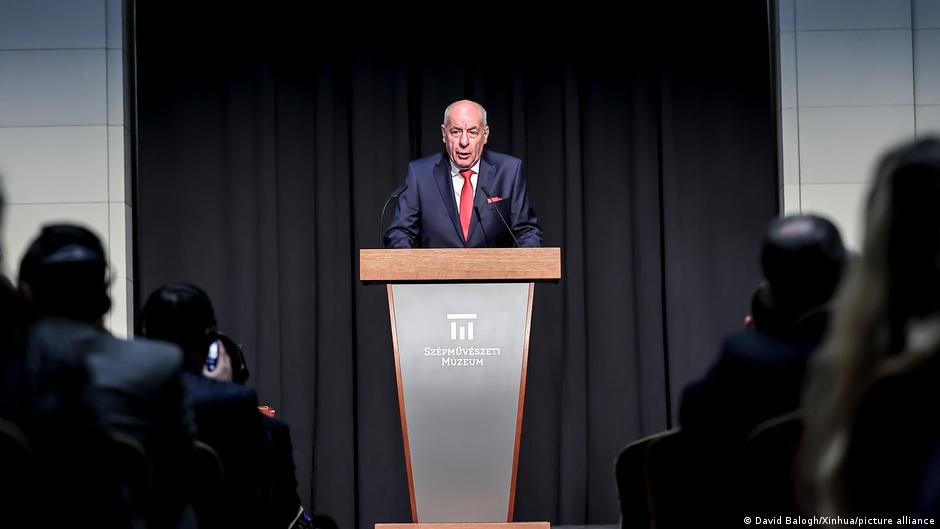
Hungary’s parliament voted in favor of strengthening the president’s position in the future, just months before parliamentary elections where longtime Prime Minister Viktor Orban faces the biggest challenge to his grip on national politics in years.
Conservative opposition leader Peter Magyar and his TISZA party currently have a lead of about 10 points in opinion polls, with the vote likely to be held in April 2026.
The Hungarian Parliament voted 134 in favor of the bill, with 49 votes against and two abstentions, meeting the two-thirds majority required for constitutional change.
The chamber is currently dominated by Orbán’s Fidesz party and its allies. When Hungary last held parliamentary elections in 2022, Magyar’s party did not exist; The 44-year-old broke with Fidesz in 2024.
Largely ceremonial position, but with veto powers over legislation
The current president is Tamas Suliok, a former head of the Constitutional Court who is seen as an Orbán ally. His tenure will end in 2030.
The role is largely ceremonial, not unlike the presidency of Germany, with real power being held by the Prime Minister, who is the head of government.
However, the President has the power to veto any legislation or refer it to the Constitutional Court for review, meaning the head of state theoretically has the power to thwart the government’s agenda.
The Constitutional Court is led by another Orbán ally, former Chief Public Prosecutor Peter Polt, who was appointed to a 12-year term earlier this year.
Under previous rules, MPs could declare the President incapable of performing the duties of office by a simple majority vote. Going forward, a two-thirds majority will be required.
Government says it has closed gap ‘which could encourage abuse’
While much could change between now and the 2026 vote, and Hungary’s first-past-the-post voting system makes it possible for large changes in seat distribution to occur with relatively small changes in popular vote share, it currently seems unlikely that any party will be able to achieve the two-thirds majority in the National Assembly that Fidesz has achieved in recent years.
The Hungarian government stated that the changes were sought at the request of President Suliok himself.
“The President of the Republic has indicated that he sees a gap in his legal status that could give rise to potential abuses, and therefore we have accepted his observation,” Orbán’s chief of staff Gergely Gulyas said in a media briefing on Wednesday.
Meanwhile, TISZA told independent media Telex that the bill was “further proof” that Orbán’s government feared voters would not return it to power next year.
Edited by Shawn Sinico