
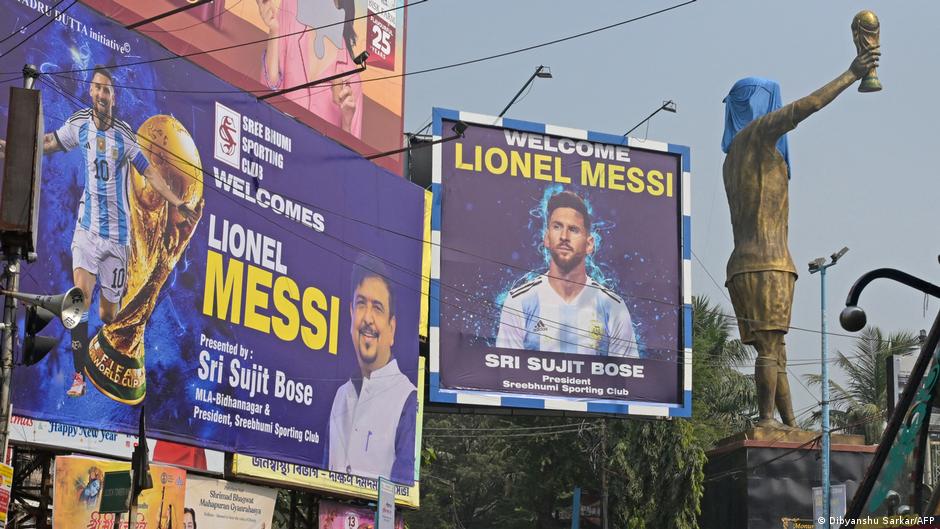
Argentine football star Lionel Messi’s much-awaited visit to India, popularly known as his “GOAT (Greatest of All Time) Tour”, has created a lot of excitement.
Messi, who won Major League Soccer’s Most Valuable Player award for the second consecutive season, last visited India in 2011, when Argentina faced Venezuela in an international friendly in Kolkata, the football hub of India.
After starting his four-city tour in Kolkata on Saturday, Messi is scheduled to visit the southern cities of Hyderabad and Mumbai before concluding the tour in New Delhi on Monday, where the 2022 World Cup winner is scheduled to meet Prime Minister Narendra Modi.
One of the highlights of his stay in Kolkata was Messi inaugurating his world’s largest statue, a 70-foot (21.3 m) tall giant statue.
He will be joined by Bollywood star Shah Rukh Khan as well as former India cricket captain and current Bengal Cricket Association president Sourav Ganguly during the three-hour event at the main stadium in Kolkata, which will include 7-on-7 celebrity matches and coaching clinics for selected young talents.
Football has deep, though regional, roots
While cricket remains India’s dominant sport, football also has deep roots in the country, especially in states like West Bengal, where Kolkata clubs Mohun Bagan and East Bengal have passionate fan bases.
Arjun Sen, a fan of the game for 30 years, has taken leave from work to attend Saturday’s event.
“I have already arranged for the day off and plan to arrive at the stadium hours early. This is something we have only dreamed of. But seeing Messi in person will be unforgettable for everyone here,” Sen told DW.
Amateur football coach Priya Das told DW how excited her young players are feeling.
“They’re constantly talking about Messi’s visit and looking forward to attending the clinic. It’s not every day that football legends come to India, and it makes football feel more alive for us.”
beginning of positive change
Satadru Dutta, the mastermind behind Messi’s visit, said it is not just a spectacle, it is about growing the game in the country.
“He’s a world champion. If I can talk about reviving football, I think that’s a big start. Messi coming in won’t change football, but there might be some small steps that can be started,” Dutta told DW.
Dutta also talked about another of his ventures, “Edu Soccer”, which is a grassroots initiative. The project, launched by Messi, involves taking a group of 10-12 children and sending them through professional football training over a period of 15 years.
However, the self-described “football-mad businessman” declined to disclose how much money Messi will make from his Indian stay or how much revenue he is expected to generate through sponsorships, VIP packages, broadcasting rights and merchandise.
“It’s classified. Messi is priceless and it will stay that way,” he said.
Challenges hold the game back
India is ranked 142nd in the FIFA men’s rankings – 27th among 46 countries in Asia. This is despite the fact that it is the most populous country in the world and areas like Kolkata, Kerala and the North-East region have a passionate football following.
The country has never qualified for the World Cup, and its domestic leagues have struggled with inconsistent attendances, limited infrastructure, and negligible international visibility.
Additionally, the Indian Super League (ISL) is facing serious financial and operational challenges, which have been further exacerbated by the recent failure by the All India Football Federation (AIFF) to secure a new commercial rights partner, which has led to several clubs suspending operations.
Former AIFF general secretary Shaji Prabhakaran agrees that although Messi’s visit will not change Indian football, it could act as a catalyst that forces stakeholders to create lasting value.
“The timing is opportune because Indian football is facing a difficult period, and this tour can put Indian football firmly in the spotlight, sparking discussions among politicians, industrialists and football bodies,” Prabhakaran, who is serving as a key advisor on Messi’s GOAT tour, told DW.
“If this trip can focus national attention on football, rather than just treating it as a celebrity show-off, that might help.”
More commercial than transformational?
The tour undeniably has important commercial dimensions. Ticket prices range from around ₹4,500 (€43/$50) to ₹11,800 depending on the city and seating category, with Mumbai tickets starting at ₹8,250.
Prices for premium hospitality packages tend to be quite high, although exact figures for VIP experiences are not publicly disclosed.
Bollywood stars are expected to attend the event at Mumbai’s Wankhede Stadium and take part in a charity fashion show with Messi, Luis Suarez and Rodrigo De Paul also scheduled to attend.
A senior AIFF official told DW on condition of anonymity that the event was “a fascinating stop on a branded world tour that will leave Indian football right where it was, starstruck but still hungry.”
Arup Das of the India Youth Soccer Association (IYSA) wondered whether this moment would prove to be something lasting for Indian football or fade away like previous high-profile visits.
“Messi’s tour seems like another superstar comet flying towards India, especially at a time when Indian football is under huge uncertainty. The ISL is without any commercial partner and there is no sign of resumption anytime soon,” Das told DW.
IYSA is an NGO established in 2000 that provides support to football-playing children in rural areas, where small academies have mushroomed in the last decade. It said it has so far reached more than 5,000 children and coaches in more than 50 villages and small towns in North India.
‘Motivation is not infrastructure’
“Messi is not leaving Kolkata and going to football-loving parts of India like Kerala, Goa and the North-East, but going to Delhi, Hyderabad and Mumbai, which are no longer football hubs and these events take place in cricket stadiums, which shows how neglected our football stadium infrastructure is,” Das said.
Jaideep Basu, former director of communications and media at the AIFF, hopes football administrators will take advantage of Messi’s visit to invest in sustainable football infrastructure.
Basu underlined, “Motivation matters in the development of the game. Watching Messi can inspire passion in young players who would otherwise never take up football seriously. But without infrastructure, motivation is just emotion, not change.”
Edited by: Chuck Penfold