
Donald Trump’s announcement of a “complete and total blockade” of sanctioned oil tankers traveling to and from Venezuela has raised questions about the economic consequences for the regime of leftist President Nicolas Maduro.
Trump has made oil a central target in his ongoing campaign against Maduro, fueled by the US president’s claims that Maduro was to blame for the illegal flow of both migrants and drugs from Venezuela to the US.
The fragile Venezuelan economy is exceptionally dependent on oil. If Trump’s blockade threat proves to be more than mere words, it will have a significant impact on Caracas.
What threat has Trump actually made?
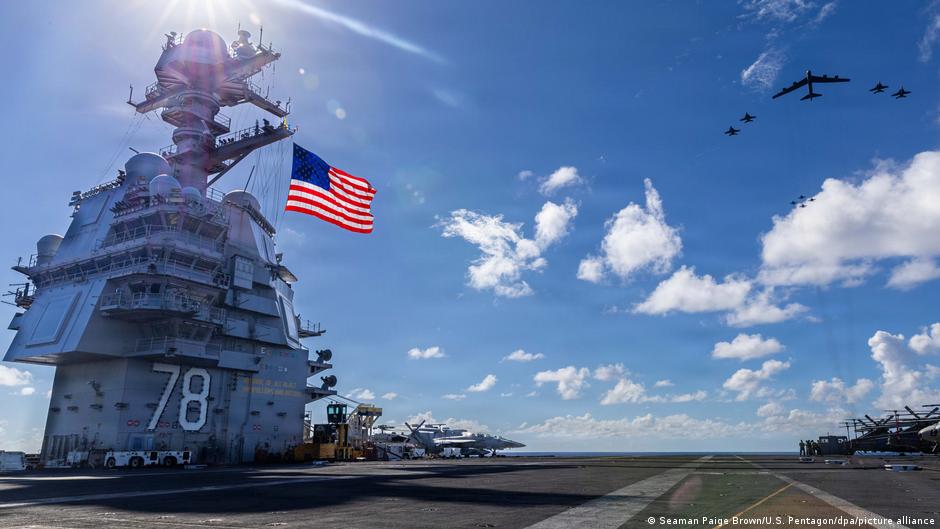
In a Truth Social post on Tuesday (Dec 16), Trump said Venezuela was “totally surrounded by the largest armada ever assembled in the history of South America”, before ordering the blockade.
Since late August, the US has been establishing a major naval buildup in the Caribbean Sea – one of the largest US naval deployments to the region since the so-called Cuban Missile Crisis in 1962.
More than a dozen U.S. military ships have been operating in the Caribbean in recent weeks, including aircraft carriers, guided-missile destroyers and amphibious assault ships.
How will the interruption work?
A naval blockade is a military operation where warships surround a specific coastline with the aim of preventing maritime traffic from entering or leaving.
Trump’s threat specified that “all approved oil tankers going in and out of Venezuela.”
Last week, the US military seized an oil tanker off the coast of Venezuela. US Attorney General Pam Bondi said the tanker was transporting sanctioned oil from Venezuela and Iran. Caracas declared the seizure an act of “international piracy”.
If successfully and fully implemented, the naval blockade threatened by Trump would dramatically reduce the amount of oil flowing from Venezuela. However, it is not yet clear which tankers will be affected or how exactly the blockade will be implemented.
As is often the case with Trump’s social media pledges, there are legal doubts. Elena Chachko, an international law scholar at UC Berkeley Law School in the US, told news agency Reuters that the blockade would raise “serious questions both on the domestic law front and on the international law front.”
While Venezuela’s state oil company, PDVSA, is heavily sanctioned and many ships carrying oil from there are specially sanctioned, other ships transporting oil out of the country are not specifically sanctioned. For example, US oil giant Chevron was granted a special license by the Biden administration in 2022 to resume Venezuelan oil exports. The idea at the time was that the easing of Venezuelan sanctions would ease pressure on the oil market in the wake of Russia’s invasion of Ukraine.
But in October this year, the Trump administration gave Chevron new rights to produce oil in Venezuela, arguing that the American company was a vital partner for Caracas.
How US sanctions have already affected
Venezuela is almost entirely dependent on oil for state income. Crude oil and related products such as petrochemicals account for more than 90% of Venezuela’s export revenues. They keep Maduro’s highly sanctioned and isolated government functioning and in power.
Experts say that if there had been more cargo seizures, or if Trump had followed through with the blockade, much of Venezuela’s oil would have remained in the country, while the oil that came out would have been sold at deep discounts.
There is already evidence that the recent seizure of a Venezuelan tanker by US forces and the threat of further measures are having an impact.
The number of oil tankers bound for Venezuela has fallen sharply over the past few weeks, according to data analytics firm S&P Global Commodities Insights. The London, UK-based firm said a report It was reported on Tuesday that in the week beginning December 14, 17 tankers were sailing in or near Venezuelan waters. This is down from 24 ships a month ago.
The S&P report also said that several sanctioned vessels currently “appear to be turning away” from Venezuelan waters and the wider Caribbean Sea following the US tanker seizure and subsequent sanction announcements.
On December 11, the US imposed sanctions on six shipping companies and six tankers that regularly operate in Venezuelan oil fields, with more sanctions expected in the coming weeks.
Can Venezuela’s economy handle this damage?
Given the level of crisis the Venezuelan economy has gone through over the past decade, few could have predicted what new depths it might reach without impacting Maduro’s grip on power.
The country’s oil production has already declined in recent years as a result of sanctions, corruption and economic mismanagement. Venezuela has the world’s largest known oil reserves, but continues to struggle to maximize revenue from it.
During the rule of Maduro’s predecessor, the late Hugo Chávez, oil prices and revenues soared but have fallen dramatically for more than a decade. While Caracas once extracted more than $100 billion (€85.6 billion) per year from oil, the figure is now closer to $20 billion.
According to the International Monetary Fund (IMF)In the period after Maduro took power in April 2013, the Venezuelan economy suffered “the largest economic collapse for a non-conflict country in nearly half a century”.
What about global oil markets?
Although oil prices rose more than 1% on Wednesday, most analysts say Trump’s threat of a blockade on Venezuelan production has limited impact on global markets.
“Overall, Venezuela’s export volume in the global supply share is relatively small. With all eyes on the Russia-Ukraine discussion, the market is still facing downside risks,” an oil trader told Reuters.
Muyu Xu, senior oil analyst at Brussels-based data analytics firm Kpler, told Reuters that while Venezuela’s oil production accounts for about 1% of global output, “the majority of it is focused on a small group of Chinese buyers and others in the US and Cuba.”
There are already expectations that the global oil market will face an oversupply next year.
Saad Rahim, chief economist at commodity-trading giant Trafigura, told financial Times Earlier this month it said the oil market would face a “super amber” in 2026 as an explosion of new supply conflicts with weakness in the global economy and puts pressure on already falling crude prices.
Edited by: Uwe Hessler