
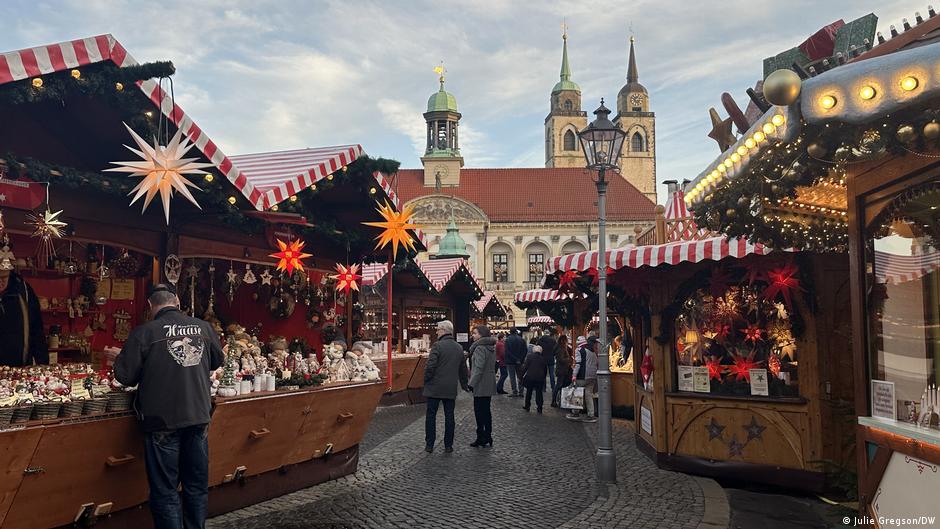
Police officers – each carrying a submachine gun – and security guards have gathered around the entrances to Magdeburg’s Christmas market. Sometimes people are stopped and interrogated. Large red and green concrete blocks, sandbags and steel security barriers mark the access points to the market located in the square near City Hall.
On December 20, 2024, six people were killed here – five women and a 9-year-old boy – and more than 300 were injured, some of them seriously, when a man drove a vehicle into a crowd. Their exact objectives remain unclear.
Stallholder Mirko Stage stood only 20 meters (65 ft) from the area where most of the victims were killed in Magdeburg on December 20, 2024.
Right around the corner from their sugar-almond and waffle stand, there are memorial stones lining the sidewalk, decorated with candles and flowers.
Stege, who lives in Magdeburg, said he had smoked some before the November 20 inauguration. “We all went into this Christmas market with a strange feeling because we weren’t sure what it would be like to suddenly reopen here after the events of last year,” Stage said.
He said their experiences have been unexpectedly positive, with stallholders and visitors beginning to open up and express their grief. “At first, you’re shocked and sad,” he said, “and, at some point, you start talking to each other about what happened.”
Stage said that visitors had contacted them to share their experiences. “People who say: ‘I was standing there as a first aider and I was standing there that evening’ are the same people coming back here because Old Market Square is the city’s living room. We don’t want to let it be taken away from us by some crazy criminal,” Stage said.
Karim Champi, an Italian stallholder of Tunisian origin, saw the attacker’s car drive right past his olive-wood handicraft stall.
His stall is now at a different location. “This year, not as many tourists have come. People are scared,” he said, crying.
The joys and tragedies of Christmas side by side
The market has been redesigned. The optical changes, along with security measures, are aimed at allaying people’s concerns.
Not everyone is convinced by the changes. “It’s like Fort Knox,” said one Christmas market visitor. “All this barricading is madness.” The 54-year-old man lives about 60 kilometers from Magdeburg, but he came here with his wife “out of principle and protest.”
“If we didn’t come, he would have won,” she said in reference to the drunken attacker.
As evening falls and the lights come on, more people start coming to the market. The sound of voices, Christmas music and fairground rides become louder. Couples, families and friends of all ages stroll or gather at the square.
Mixed opinions about market reopening
Magdeburg’s Christmas market has around 140 shops this year. Traditional wooden Christmas decorations made of Ore Mountains and lighted stars are offered. But also lots of food – from German bratwursts and Christmas biscuits to burgers, Belgian waffles and, this year, falafel.
Paul-Gerhard Steiger, managing director of the market, said not everyone agreed with the decision to hold the event again this year.
“Of course, some of those affected by the attack say: ‘How could you do this here?’ And there are some townspeople of that opinion,” Steiger said. “But there are also people directly affected who have contacted us and said they think it is important that the Christmas market takes place here.”
The number of visitors is less this year. Steiger says turnout is still better than expected. He admitted that organizing the event was a difficult balancing act. “Of course, the Christmas market is a commercial event, but it is also the livelihood of the stallholders. This is their peak season.”
The market organizer said only two stallholders had withdrawn their names – one in connection with the tragic events. And there were 10 new people this year, Steiger said.
These include Fares Saleh Agha, who came to the city from Syria eight years ago and now runs a falafel store in the city. He said that he has decided to come here to send a signal.
“People walk by me and see a friendly face. Christmas means peace. I’m very happy. People are nice,” said Agha, who was giving people heart-shaped chickpea balls to taste.
A visitor who was there with her husband and son said she welcomed the inclusion of food from other cultures. The 49-year-old admitted he was feeling a little uneasy, but added, “Christmas markets are definitely part of Christmas for us. It’s our tradition and we love Christmas.” She said she also wants to support traders.
False news about canceled Christmas markets
Frank Heckelberg, CEO of the Deutscher Schöstellerbund, a national organization representing event stallholders and fairground operators, confirmed that visitor numbers were down across Germany this year, but said they appeared to be on the rise ahead of the holidays. He blamed the slow start to the season in part on a social media campaign.
Heckelberg said his organization had fielded media inquiries from around the world after rumors spread that Christmas markets in Germany would be cancelled. In fact, he stressed that out of 3,200 major markets in the country, only a few have been closed.
He said there is no such thing as 100% protection – no matter how stringent the measures.
On 12 December, a man was detained in Magdeburg in connection with a suspected plan to attack a Christmas market.
The trial of last year’s culprit has been going on in the city since October. He has been charged with six counts of murder and 338 charges of attempt to murder. The now 51-year-old man was detained minutes after the attack and has admitted driving the hire car. It does not appear that he had Islamist intentions.
The market remains closed on Saturday. Instead, memorial services will be held to commemorate the one-year anniversary. Chancellor Friedrich Merz and Rainer Haseloff, Prime Minister of the state of Saxony-Anhalt, will be present. A cross-faith initiative is calling on people to build a chain of lights around a Christmas market.
Edited by: Reena Goldenberg
While you’re here: Every Tuesday, DW editors provide insight into what’s happening in German politics and society. You can sign up for the weekly email newsletter, Berlin Briefing, here.