
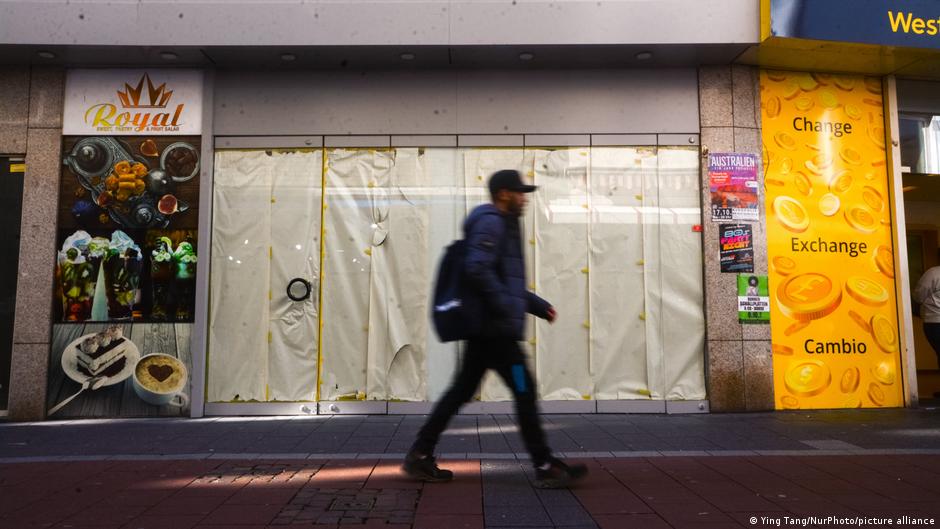
Data for the first three quarters of 2025 showed that small German companies have borne the brunt of almost three years of economic recession in Europe’s largest economy over the past three years.
On December 12, Volker Treuer, chief analyst at the Association of German Chambers of Industry and Commerce (DIHK), told news agency Reuters that “the wave of bankruptcies continues.” He said small and medium-sized enterprises in particular “are running into difficulties.”
In a recent survey, DIHK found that almost one in three companies with fewer than 20 employees feared their business situation would worsen. Such firms account for about 85% of all businesses in Germany.
Official figures confirm this trend, with Germany’s Federal Statistics Office (Destatis) saying the same day that German local courts recorded 18,125 corporate bankruptcy filings by the end of September, about 12% more than the same period last year.
This makes the number of company bankruptcies in the first three quarters of 2025 the highest since 2014.
Small companies most exposed
The disproportionate risk of small businesses in a stagnant economy is no surprise to bankruptcy researchers.
Stefan Müller, head of bankruptcy research at the Halle Institute for Economic Research (IWH), says the recent wave of bankruptcies is “overwhelmingly in the small business sector.”
He told DW that the average bankrupt company employed about 10 people, but added that “most are even smaller.”
The broader financial stress is visible beyond the corporate sector. The number of personal bankruptcies increased again this year, with 57,824 consumer bankruptcies recorded in the first three quarters, up more than 8% year on year.
increasing pressure on jobs
Although most bankruptcies involve small companies, this increase has also led to a sharp increase in the number of jobs lost or at risk. According to IWH estimates, about 170,000 positions have been affected this year, down from less than 100,000 before the COVID-19 global pandemic.
Klaus-Heiner Rohl, an economist at the German Economic Institute (IW) in Cologne, cautioned against overstating the impact on employment. “Bankruptcies increase unemployment a little, but the growth is not dramatic,” he told DW.
However, IWH researcher Müller expects the labor market impact to be more pronounced. They estimate that about 200,000 jobs will be affected in 2025, almost double the level seen in the years before the pandemic.
“Some of these positions are likely to be lost permanently as closures occur due to bankruptcy,” he said.
At the same time, Mueller stressed that the overall impact remains manageable, as jobs are often created elsewhere and workers move from weaker firms to stronger ones during periods of market adjustment.
A predictable trend?
Both economists believe the increase in bankruptcies was largely expected. “The increase was expected,” Mueller said, although the scale of the increase was “somewhat surprising.”
Rohl agreed, pointing to Germany’s long-standing economic stagnation. “Given the continued weakness in the economy, the number of bankruptcies could have been even higher,” he said.
Rohl attributed the increase primarily to macroeconomic factors, citing nearly three years of “stagnant or slightly falling economic output.” Rising energy prices, Russia’s war in Ukraine and the transition toward climate neutrality have put further pressure on companies’ finances.
However, Rohl said that “it is difficult to determine how much the delay in policy reforms or late corporate adjustment has contributed to the problem.”
Mueller also rejected blaming any single factor. “The causes of bankruptcy are always highly personal,” he said, pointing to issues such as poor product choices, management conflicts or disputes with key stakeholders. When these weaknesses coincide with rising costs, structural change, geopolitical uncertainty, and tariffs, “bankruptcies occur more quickly.”
According to Muller, it is relatively rare for fundamentally strong and competitive companies to fail simply because of “external circumstances worsened”.
limited signs of relief
Germany’s Association of Insolvency Administrators and Trustees (VID) took a cautious stance of optimism.
“After the impact of the pandemic and the associated increase in bankruptcies, growth is beginning to normalize,” VID Chairman Christoph Neering recently told German news agency dpa. He emphasizes that this has not brought any change yet, “but there is light at the end of the tunnel.”
Mueller expects the number of bankruptcies in 2026 to remain close to the high levels seen this year.
“This is only partially good news,” he said, warning that Germany had entered the “red zone”. The situation should not get much worse as the level of bankruptcies among large corporations is roughly equal to the levels seen 20 years ago.
Rohl sees a possible further softening. If the German economy grows by about one percent next year, as many institutions project, they believe bankruptcy activity should also decline.
“However, structural challenges will persist as US tariffs, competition from China and high energy costs are not going away,” he cautioned.
This article was originally written in German.