
Mention “perfume” and one might first imagine scented liquids in fancy flacons.
Yet its name, which is derived from the Latin word “per fumum” – meaning “through smoke” – indicates that what we understand as “perfume” today is quite different from its origins and use among our ancestors.
Its sweep through time is also a study in scientific breakthroughs, knowledge transfer, trade expansion, colonialism and natural resource extraction, and latter-day Eurocentric marketing.
smells as old as time
Britannica says the ancient Chinese, Hindus, Egyptians, Israelites, Carthaginians, Arabs, Greeks, and Romans were all reportedly familiar with perfume. References to perfume and its use are found in the Bible as well as in the hadith (sayings or actions) of the Prophet Muhammad.
The early perfume industry – dating back more than 4,000 years in ancient Mesopotamia – involved burning aromatic substances such as frankincense and myrrh, with the belief that the upward-swirling smoke connected the earth with the divine.
In fact, the earliest recorded “nose” – or highly skilled master perfumer – was a woman named Tapputi, an alchemist whose work in Mesopotamia was recorded on a cuneiform tablet dated to around 1,200 BC. “Tapputi was a murakkitu, an elite professional category of expert perfumers associated with the Assyrian and Babylonian courts … Her importance lies in authenticating the high-status, ‘perfumed’ roles women played in royal courts,” perfume maker and historian Alexandre Helvani tells DW.
According to archaeochemist Barbara Huber, whose research focuses on human-plant interactions throughout history, over time “perfume” came to include a wide range of aromatic materials and practices: burning incense and aromatic woods, scented oils, balms, auguants, and even cosmetics.
“Many of these were used not only for personal decoration, but also for ritual purposes, offerings to gods, purification or healing. The boundaries between perfume, medicine and cosmetics were often blurred,” Huber tells DW.
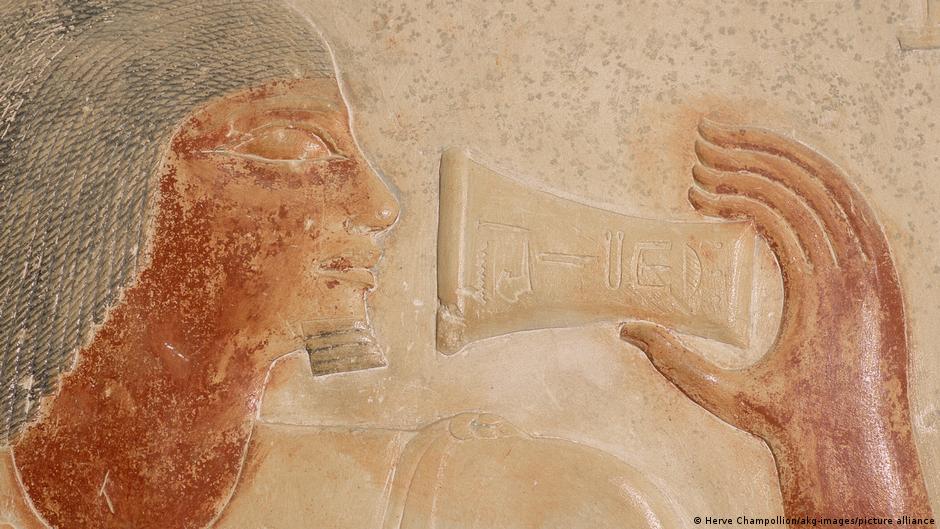
In ancient Egypt, aromatic oils and resins were central to rituals and mummification, while in India, sandalwood paste was applied to the skin, jasmine was braided into the hair, and saffron was woven into clothing—a layered sensory practice that sanctified the body itself.
Recent research also found that Greco-Roman statues of gods and goddesses were “perfumed” with aromatic substances to make them more lifelike.
From smoke to distillation
What started as incense and balm turned into liquid distillation in the Arab world during the Islamic Golden Age. In 9th-century Baghdad, the polymath al-Kindi wrote “The Book of the Chemistry of Perfumes and Distillations”, the first comprehensive manual on perfumery.
A century later, the Persian polymath Ibn Sina (known in the West as Avicenna) refined steam distillation to extract “attar” (or essential oil) from flowers, especially roses, which became a model for later perfume makers.
Together, they established many of the foundational techniques and methods on which the modern fragrance industry is based.
how the west was conquered
This progress reached Europe through many routes. Al-Andalus – the then Muslim-ruled part of Spain and Portugal – between the 8th and 15th centuries served as a scholarly bridge, where scholars based in Toledo translated Arabic texts into Latin. At the same time, Mediterranean trade brought rose water and spices to ports such as Venice and Genoa, while the Crusades exposed Europeans first-hand to Arab medical and perfumery practices.
To be clear, Europe was no stranger to the perfume industry. The Romans had scented baths and oils, and medieval nobles used herbs, pomanders, and incense. In the Middle Ages, perfume served practical and symbolic needs: doctors filled their bird-beaked masks with herbs to filter out the “bad air” or miasma that was believed to cause the Black Death; The orange blossom water, a favorite of Louis XIV of France, came from the fountains of the Palace of Versailles; And scented gloves not only masked odors but were also fashionable accessories.
But the advanced technologies and rich ingredients of the Arab world reawakened and transformed European perfumery into a sophisticated industry that used alcohol as a base to create light, long-lasting perfumes.
‘Eau de colonialism’
As the European perfume industry flourished, particularly in France, colonial expansion supplied the ingredients that sustained the growing industry.
Alexandre Helwani explains, “Marketing images present raw materials as timeless gifts of nature, often portrayed in vague post-colonial exoticism. Complex questions of land ownership, labor conditions, pricing and environmental impact are usually left out.”
A notable example of this is vanilla. Introduced to Europe by the Spaniards in the 16th century, it became a major colonial crop in the Indian Ocean. Helwani cites the story of Edmond Albius, a slave boy on the island of Réunion (formerly Bourbon), who at the age of 12 discovered a practical method of hand-pollinating vanilla orchids in 1841.
“If he had not been there, vanilla would have persisted… In the world of patented technologies, I often wonder what a great billionaire Edmund Albius would have been if he had not been enslaved,” says Helwani, underscoring how “when we talk about the ‘history of perfume’ we are simultaneously talking about the history of empires, trade, and colonialism.”
A whiff of Eurocentrism?
Over time, European perfume houses became the center of branding and marketing, strengthening the association of sophistication with European aesthetics.
Barbara Huber says, “Although the basic ingredients come from diverse global regions with rich historical traditions of aromatic use, the presentation and marketing narratives are often Eurocentric.”
Thus, there has also been considerable criticism of the classification of fragrances as “Oriental” by some European perfume houses. A Change.org petition objecting to such a classification states: “‘Orient’ attempts to encompass a vast region including the Middle East, North Africa, South Asia, where many ancient fragrance practices and raw materials originated. The frequent use of this term to summon the exotic and exoticism erases the imperialism and Islamophobia that continue to destabilize these regions of the world today.”
Thus, changes in marketing since the 2000s have led to “amber” being used for a warm, spicy scent.
effect of perfumetok
Today, global audiences can easily find out about once-niche or regionally specific fragrances through TikTok influencers and their unpacking reels.
An early viral sensation on PerfumeTok – TikTok’s hashtag dedicated to fragrance – was Fleur’s “Missing Person”, which sold out in 2022 and garnered an initial waiting list of more than 200,000 people in the US. It even opened the door to emotional reels (literally), including people who were reminded of their loved ones after smelling the scent.
Meanwhile, young entrepreneurs in India are redefining perfumes (essential oils) made using age-old methods as sustainable luxury through Instagram and digital storytelling, demonstrating how social media can reconnect consumers with traditions that colonial trade once obscured.
Overall, the history of perfume – like its top, heart and base notes – is multifaceted. And just as no one perfume can capture every scent in the world, no one recap can encompass the diverse history of fragrance.
As Alexandre Helwani says, each spray of perfume carries the weight of heritage. “That’s what I love about perfume: It’s a very small effect on the skin that has a huge, layered history behind it.”
Edited by: Elizabeth Grenier