
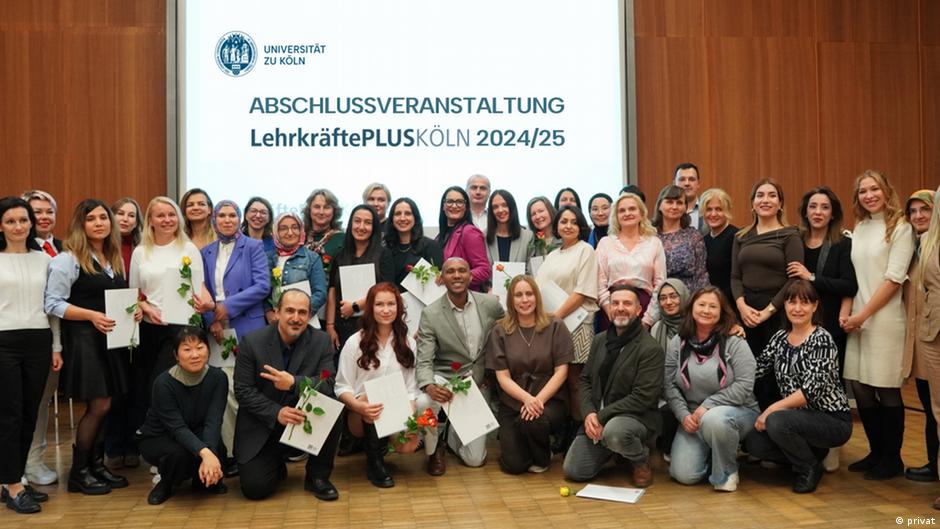
If Germany could choose a well-trained teacher from abroad, it would probably be someone like Inge Pizarro Kruse. With her eight years of study in Viña del Mar and two years of classroom experience, the 33-year-old Chilean is highly qualified and is now preparing to tackle the severe teacher shortage in Germany. Pizarro Cruz has been studying German, preaching and pedagogy under a special program since August. And she’s already had a taste of teaching at a vocational school.
“When I came to Germany, I felt like I had to start from scratch again, which of course is very disappointing,” she told DW. “You have studied, you have worked as a teacher, you want to start again immediately and you are looking for a program that will somehow introduce you to the German education system. teacher plus It was exactly what I needed.”
In just twelve months, Pizarro Cross and 23 other participants from Bosnia, Kyrgyzstan and Ukraine will be given fast-track training and plenty of practical experience to prepare them to teach in German schools. teacher plus The program is available at four other universities in North Rhine-Westphalia. This is the state’s attempt to respond to the teacher shortage in Germany, which is becoming more and more widespread.
There is a shortage of thousands of teachers across the country – and the number is growing. Additionally, immigrants with many years of professional experience as teachers are often forced to make do with temporary jobs. Pizarro Krause says, “You ask yourself what this means: Germany urgently needs teachers, yet the bureaucratic obstacles before us are too great. The country must work on a system to accelerate integration.”
Germany cannot ignore potential
This requires dedicated people like Semra Krieg and Ariane Elshof, who helped launch the qualification program in Cologne in 2018 and have been continuously developing it since then. Even at that time, the feeling was: “We can do this.” Like former German Chancellor Angela Merkel, who used these words to encourage the German population to take up the challenge of integrating refugees, Elshoff recalls.
“In the early days, we had a lot of qualified teachers from Turkey and Syria, but now most of them come from Ukraine. But we also receive applications from Brazil and even Tanzania. Given the teacher shortage, Germany cannot ignore such potential. They are thorough teachers; they put their heart and soul into it.”
A study from the University of Potsdam recently took a closer look at the Teacher Plus program. Its findings: Teachers feel more confident about their future work, speak better German and are more motivated to work as teachers in Germany for a longer period of time. And, most of all, the vast majority would recommend the qualification to other expats.
New applications are piling up
Craig told DW that on average, less than one person dropped out of the program per year. Another 50 applications are already deposited on its desk for the next admission in August 2026, and the application deadline is January 8, 2026. And yet, despite being a success story, funding for the program is only secured until the end of 2027. The Germany-wide pioneering project “Refugee Teacher Programme”, which was initiated by the University of Potsdam in 2016, has now come to an end.
“We have received very positive feedback that Teacher Plus is like a springboard. At the same time, it is a challenge for the participants. In a full-time, year-long program, you can be pushed to your limits. Language proficiency is an important factor in getting settled in school. In addition, openness, perseverance and tenacity are also important,” says Semra Craig.
How a Ukrainian teacher jumped
Natalia Zemlyanskaia was determined and resilient. The Ukrainian had participated in the program two years earlier, having completed an internship at a vocational school in Bonn at the same time, and was subsequently taken on directly by the school. After teaching English in Odessa for more than 20 years, she now teaches the language in her new home and also teaches German to young people in Guinea, Syria and Turkey.
“When I arrived here in 2022, I knew that I definitely wanted to continue working as a teacher. I completed a lot of German courses at the beginning and then by chance found Plus with teachers. The best thing about the program: German courses and internships, which you are given an in-depth access to, even if your German is not perfect yet.”
Germany needs more programs like this, not less
So what does a teacher from abroad need to do to become familiar with everyday school life in Germany? The 47-year-old doesn’t have to think twice: actively absorb everything about the new school to understand what makes it tick, especially with students. Have mentors and colleagues who accept you, support you and, if necessary, are there to listen to you in an emergency. And not just in a few cities, establish more programs like Teachers Plus and advertise them more.
“Every teacher abroad should know that this qualification is available. And there needs to be more places offering it. On my course at the time, there was also a participant from Bremen who was travelling. Some people stayed in a hotel for the week.”
Zemlyanskaia’s appeal to German politicians? Integrating such skilled workers more rapidly into the German education system! “They should recognize degrees from abroad more easily. I’m not a novice, I’m an experienced teacher.”
This article was originally written in German.
While you’re here: Every Tuesday, DW editors provide insight into what’s happening in German politics and society. You can sign up for the weekly email newsletter, Berlin Briefing, here.