
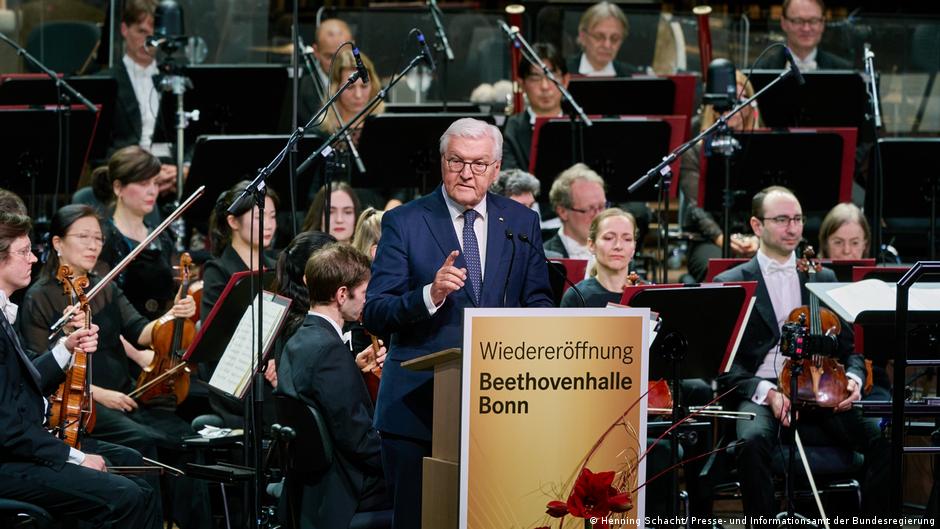
On 16 December, the Beethovenhalle Bonn reopened after almost 10 years of renovation. The concert hall welcomed the audience with a “Beethoven Night” concert lasting almost four hours.
In front of approximately 1,600 guests, Federal President Frank-Walter Steinmeier gave the opening speech. He thus followed in the footsteps of his predecessor, Theodor Heuss, who inaugurated the “courageous and modern building” (as the then Federal President described it in his speech) in September 1959.
At the opening of the renovated venue, Steinmeier said that the Beethovenhalle is dedicated not only to Bonn’s most famous son and his music. “It is also, and you can certainly guess that this is particularly close to my heart, a place of democratic history.”
This democratic history began after World War II. Germany was in ruins – destroyed, divided and internationally isolated. How can the country restart? The Western Allies required German leaders to establish a new democratic system and create a republic that its citizens could trust. But which of the devastated cities could serve as the seat of government?
After much debate, the choice fell on Bonn, a small university city on the Rhine River in the west of the country – and also the birthplace of Ludwig van Beethoven.
an exciting commission
Bonn was unwilling to function as a capital, and residents had to improvise. The first meeting of the Parliamentary Council took place in the Natural History Museum, surrounded by taxidermy animals and prehistoric artefacts. There was also no concert hall: the 19th-century municipal Beethovenhalle was destroyed in a bombing in 1944.
However, a new building had already been planned. The architect was 29-year-old Siegfried Wolske, who had won a design competition in 1954 out of 100 submissions.
Architectural historian Constanze Falke says, “Wolske was one of those very young, inspired, creative people who represented the desire for a fresh start in a new Germany, in a young democracy.”
Falke spent more than 15 years working to save and restore the Beethovenhalle and oversaw the renovation as chief conservator of the city.
“But the young architect had already gone through a long and dramatic chapter,” he told DW.
Drafted into the army at age 18, Volske, a native of Berlin, became a prisoner of war and, after returning home, earned a high school diploma at age 21 before resuming his studies.
“The city of Bonn was courageous enough to entrust it with overall construction management,” explains Phalke.
After three and a half years of construction, the hall – simple, comfortable and elegant – was completed and handed over to the city.
For the next 60 years, the Beethovenhalle served as the “parlour” of German democracy. It hosted federal meetings, party conferences and, above all, concerts. During its six decades of operation, more than 15,000 events were organised.
The building eventually fell into disrepair, and after heated debate over whether to demolish or renovate it, the residents of Bonn decided to preserve the hall.
A gem of post-war modernism
Falke has described the Beethovenhalle as “a special feature of post-war modernist architecture”. In architectural terms, the building exemplifies “organic architecture”, a style closely associated with Hans Scharoun. Wolske was actually a student of Scharoun’s at the Technical University of Berlin and applied his mentor’s ideas here,” she says.
The school of thought, which emerged during the Bauhaus era, was well suited to the post-war moment: away from pomp and rigidity, toward a simple functionality that consciously rejected Nazi monumentalism. The aim was to create buildings that were in harmony with their surroundings, with form based on function.
The modest exterior of the hall contrasts with its richly detailed interior. The list of materials reads like a travelogue: Italian marble, Swedish granite, precious woods from West Africa and Japan.
According to Falke, Beethovenhalle incorporates these international materials for two main reasons. First, the reopening of trade routes after the war made such materials available again. However, she says, more important is the building’s commitment to authenticity. “The content should have its own impact; it appears as it is.”
The diversity of locations presented major challenges during the renovation. The rooms, designed during different eras, took years and cost millions to bring up to modern standards. Ultimately, the total cost exceeded €220 million ($258 million), while Wolske completed the original building for just under 10 million Deutschmarks: approximately one eighth of that.
Borrowing a metaphor from a colleague, Phalke likes to drive trucks in a garage meant for cars. She says it’s expensive to work with existing structures, but she doesn’t question that necessity. “If we have a monument that is significant for its time, it is our duty to preserve and protect it properly, ensuring that it remains accessible to future generations as a testament to the past.”
Beginning with Beethoven and Mahler
Above all, the Beethovenhalle can now reclaim its original role: as a place for people to experience music. It will once again be the home venue of the Municipal Beethoven Orchestra.
After an absence of almost ten years, conductor Dirk Kaftan is eager to return to this “new-old home”. He says the Beethovenhalle aims to “reflect the diversity of the city – through music, through culture, through thought-provoking events, partnerships and community projects, youth work and music education.”
Works performed during the Long Beethoven Night, which this year take place the day before Beethoven’s 255th birthday, include Beethoven’s Fourth Piano Concerto, performed by Bonn’s star pianist Fabian Müller, as well as a work by the young Croatian composer Sara Glojnarić.
“But the highlight of the evening is Gustav Mahler’s ‘Resurrection’ Symphony, the Second,” Kaftan told DW. It will be performed “with a wink, but really only a very small one. Because this piece is about things that persist, even when we no longer exist.”
The editorial team thanks the Shefgans Foundation and Boris Shefgans for their generous support.
You can watch the full live stream of the concert on the DW Classical Music YouTube channel Here,
This article was translated from German.