
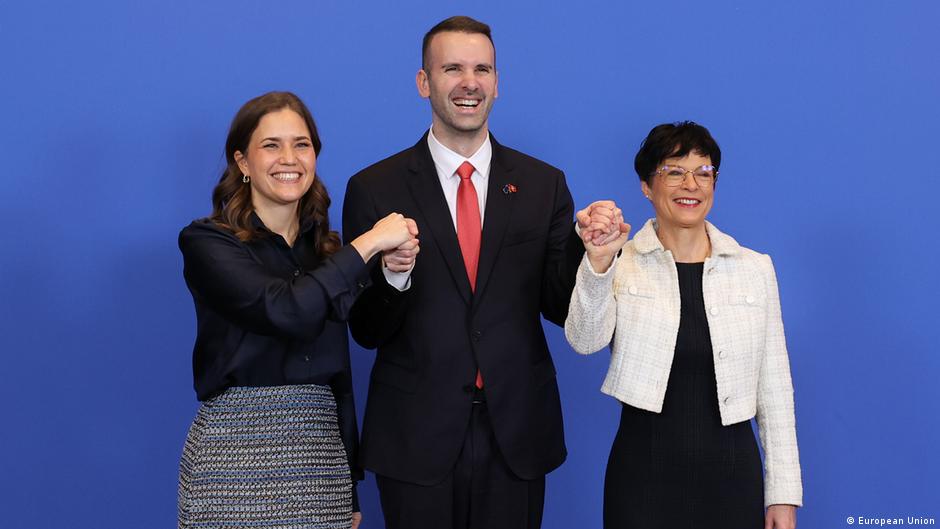
When the leaders of the EU and the countries of the Western Balkans meet in Brussels on Wednesday for the EU-Western Balkans summit, progress on EU enlargement will be high on the agenda.
Following the wars that tore the Balkans in the 1990s, the EU promised to integrate the seven countries of the Western Balkans: Albania, Bosnia and Herzegovina, Croatia, Kosova, Montenegro, North Macedonia and Serbia into the bloc in 2003.
Croatia joined the EU after 10 years.
Apart from Kosovo, which applied for membership in 2022, the remaining five countries have been recognized by the EU as official candidate countries.
How are things?
More than a decade after Croatia joined the EU, enlargement in Brussels appears closer to reality than in previous years.
As Brussels signals a renewed commitment to enlargement, the question is no longer about which countries in the Western Balkans are ready to move forward and which will be left behind.
Montenegro – the smallest of the five candidate countries in the region – is widely seen as the frontrunner in the Western Balkans accession process, with Albania close behind.
According to EU Enlargement Commissioner Marta Kos, Montenegro could technically complete accession negotiations by the end of 2026 and Albania a year later.
“Then we need one to one and a half years to go through the ratification process. So, I’m really optimistic that even during my term, which will end at the end of 2029, the EU can have at least two new members,” Koss told DW.
In Serbia, the region’s largest and economically strongest candidate, the pace of reform has slowed markedly. In response, Serbian President Aleksandar Vucic suggested last week, before traveling to Brussels for a meeting on Serbia’s EU progress, that all Western Balkan countries should join the EU simultaneously.
But is this a viable option, and would it be acceptable to Serbia’s neighbors and the EU as well?
montenegro leads the way
The process of expanding the EU to include the countries of the Western Balkans has been slow for several reasons.
On the one hand, there are unresolved bilateral issues, lack of rule of law and high levels of corruption in the Western Balkans. On the other hand, there has been a certain degree of reluctance and “enlargement fatigue” on the part of EU member states.
After years of setbacks, Montenegro pushed through major reforms two years ago and built a broad political consensus on EU membership. Both Podgorica and Brussels now aim to complete the accession process as quickly as possible.
Montenegro recently achieved a new milestone by closing five accession chapters, a prerequisite for joining the EU, but remaining requirements include ensuring final convictions in high-level corruption and organized crime cases, appointing key judicial officials and filling vacant leadership positions in key institutions.
Local critics argue that the reforms have been rushed and may lack substance.
“Nobody seriously claims that the system can be changed from the ground up in a few years,” said Maida Gorcevic, Montenegro’s minister of European affairs. “Criticism is legitimate if it speeds up reforms, but it is important to note that progress today is measured by clear European indicators, not by political perceptions, and that Montenegro’s progress is objectively confirmed by the EU institutions,” he told DW.
Albania’s progress
Meanwhile, Albania has also increased the pace of reforms.
While the European Commission points to progress in judicial reform, it also warns that further efforts are needed to fight corruption and strengthen the rule of law.
But, as political analyst Florian Bieber points out, the outcome is not certain, and continued reforms are still needed.
“Albania is at least carrying out formal reforms, but in a context where you have a very strong leader, Edi Rama, [it] Certainly it has very serious democratic shortcomings. So, there are some reservations, and so, it is not clear whether Albania will be able to bridge that gap and really be ready by the same time as Montenegro,” he told DW.
Why does the EU want to enlarge?
For the EU, enlargement is both a strategic and credibility issue.
According to the European Policy Center policy brief, integrating Montenegro would be a low-risk, high-impact way to show that the EU can deliver on its promises, strengthening confidence in its leadership in uncertain geopolitical times.
Enlargement is also about Europe’s security and geo-strategic interests.
Commissioner Koss said, “We are paying the price for not integrating these countries when they wanted to join in the first place, leaving an area of instability.”
But EU enlargement is also seen as a geostrategic investment in Europe’s security and prosperity, says Tintin Akhvalediani, research fellow in the EU Foreign Policy Unit at the Center for European Policy Studies.
“If the Union does not expand into these countries, other powers could come in and exploit the region, using it against the EU, including Russia and China,” Akhvalediani told DW.
What about Serbia’s suggestion?
So, if the pace of progress towards EU accession varies so much across the region, where does this leave Aleksandar Vucic and his suggestion that all Western Balkan countries should join the bloc simultaneously?
Many analysts interpret Vucic’s proposal as an attempt to slow down the overall integration process.
There appears to be little interest in the idea within the European Commission.
“Admission is a merit-based process. Every candidate should join when they are ready and meet the conditions and criteria set out in EU treaties, including the Copenhagen criteria. There are no pre-set deadlines. The process is driven by driving improvements and demonstrating sustainable results,” a European Commission spokesperson told DW.
Every country sets its own path
Tinatin Akhvalediani and Florian Bieber both emphasized that the enlargement process has always followed the “regatta principle”, meaning that interested member states chart their own course with integration based on their own merits, reforms and fulfillment of technical criteria.
However, Bieber says the idea of simultaneous access has some merit.
“This would avoid creating EU external borders between Western Balkan countries and prevent bilateral issues from being imported into the EU,” he said.
“That said,” he continued, “there are serious drawbacks, because the pace of the slowest member – or candidate, rather – will set the pace for everyone else. So, if Montenegro is set to join the EU in the coming years, it could be held back by countries like Bosnia-Herzegovina or Kosovo, which could take the next 10 years.”
montenegro not ready to wait
The Albanian Prime Minister’s office had no comment on Vucic’s proposal at the time of publication.
However, Montenegro reacted immediately, making it clear it wanted to proceed.
Minister Gorcevic said, “Montenegro does not want to wait for anyone and does not expect that anyone will wait for us.” “We are leading this process and want to join the EU when our results show that we are ready and worthy of membership.”
It was announced late Tuesday that Serbia would not attend Wednesday’s summit in Brussels.
Vucic himself announced the decision, saying that he was acting to protect Serbia’s interests and that he took the decision “so that no one else would be blamed and there would be no pressure on the government.”
Edited by: Angiel Flanagan
Correction, December 17, 2025: In a previous version of this article, quotes from the Government of Montenegro were attributed to the wrong person. DW spoke to European Affairs Minister Maida Gorcevic. The current version has been corrected accordingly. We are sorry for this error.